How Accurate Is Our Bug Identifier? We Tested 366 Photos
We tested the Pest.gg Bug Identifier on 366 new photos from iNaturalist on November 21, 2026, using the same version that runs on this site. On 336 photos of the 70 pests in our Pest Library, its top answer was right 71% of the time, and the right pest was in its top three 90% of the time. When its confidence was low, it said “Not sure” instead of naming a pest. Below: where it does well, where it gets things wrong, and exactly how we tested.
Many bug ID apps advertise 95% accuracy or more without saying how they measured it. Here’s exactly how we measured ours.
The Results at a Glance
- 71%: top answer right (240 of 336 photos)
- 90%: right pest in the top three (304 of 336)
- 82%: right when the page named a pest (197 of 240)
- 26%: got “Not sure” instead of a name (89 of 336)
- 29 of 30: photos of bugs we don’t cover that didn’t get one of our 70 names
The 89 “Not sure” results include 8 photos of pests that can harm people, such as brown recluse spiders and kissing bugs, where the page holds back the name unless the AI is at least 80% sure. The remaining 7 photos didn’t get a Library name either: 5 got a name the AI came up with itself, and 2 weren’t recognized.
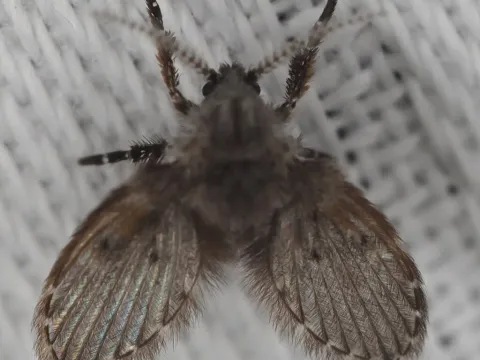 RightRight: drain flyNamed “Very likely,” 95%.
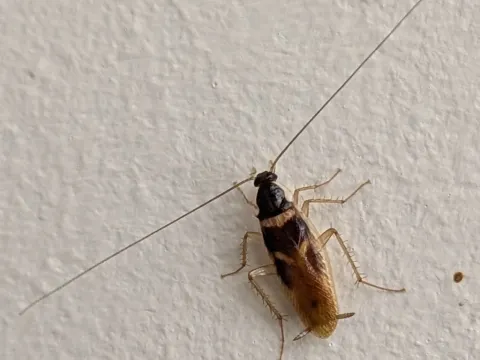 WrongWrong: brown-banded cockroachCalled a German cockroach, 90%.
What “Very likely” and “Likely” Mean
When the page names a pest, it labels the answer “Very likely” or “Likely”:
- “Very likely” was right 137 of 153 times (90%).
- “Likely” was right 60 of 87 times (69%).
- “Not sure”: when the AI was less than 50% sure, its top answer was right only 36 of 86 times, about 4 in 10. That’s why the page says “Not sure” then instead of naming a pest.
The percentage on a result is how sure the AI is. This test shows how often that turned out right, but any single answer can still be wrong, so check the Pest Library page before you treat.
Where It Does Well, and Where It Struggles
It did best on moisture bugs and pantry and fabric pests, about 9 in 10 right. It did worst on cockroaches (15 of 30) and rodents (9 of 20).
| Group (Pest Library) | Photos | Top answer right | Page named the wrong pest |
|---|---|---|---|
| Moisture bugs | 40 | 36 of 40 | 2 |
| Pantry & fabric pests | 40 | 35 of 40 | 2 |
| Wasps & bees | 33 | 28 of 33 | 3 |
| Seasonal invaders | 26 | 21 of 26 | 1 |
| Flies & gnats | 24 | 18 of 24 | 2 |
| Spiders & scorpions | 35 | 23 of 35 | 8 |
| Biting pests | 50 | 32 of 50 | 2 |
| Ants & termites | 38 | 23 of 38 | 8 |
| Cockroaches | 30 | 15 of 30 | 10 |
| Rodents | 20 | 9 of 20 | 5 |
If the result is a cockroach, compare your bug with the photos on its Pest Library page before you treat. Different cockroaches need different treatment; types of cockroaches shows how to tell them apart.
Bugs Outside Our Library
We also tested 30 photos of common look-alikes that aren’t in our Library, such as wheel bugs, cellar spiders, crane flies and flea beetles. Here’s what the page showed:
- 19 got a name the AI came up with itself, and 18 of those were right. A few named only the family, such as “ground beetle.” The wrong one called a tobacco hornworm a tomato hornworm, a close relative.
- 8 got “Not sure.”
- 2 masked hunters, close relatives of the kissing bug, got “Not sure” plus the kissing bug health note. For pests that can hurt you, the AI has to be at least 80% sure before the page names them.
- 1 got one of our Library names, wrongly: an oleander aphid was called a boxelder bug, at 85%.
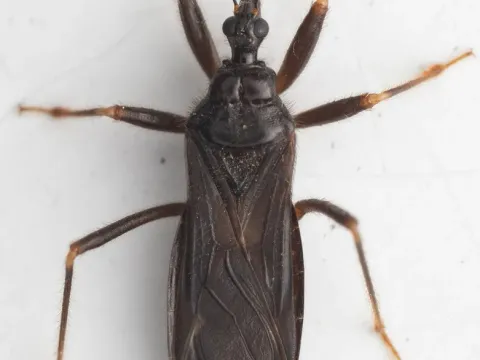 Held backMasked hunter“Not sure,” plus the kissing bug note.
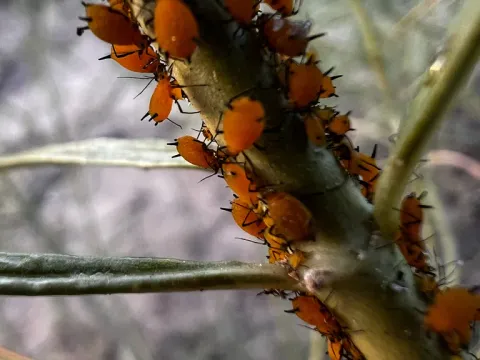 WrongWrong: oleander aphidsCalled a boxelder bug, 85%.
How We Tested
- New photos. We picked 376 photos from iNaturalist, all rated research grade and licensed CC0 or CC BY. Most were taken in the U.S. (350 of the 366 we tested); for a few pests with too few U.S. photos, we added photos from other countries. We checked them against our three earlier test rounds, and none were used to build the tool or tune its rules. We took one photo per observation, and no more than two per photographer for the same pest.
- What we picked. Up to five photos of each of the 70 pests in the Pest Library (one of them a nymph or larva where the Library describes one), plus 30 common look-alikes that aren’t in the Library.
- What we removed, and when. Before the test, we looked at every photo and removed 10 where you couldn’t see the bug, such as a hornet nest with no hornets. After we saw the results, we removed none. That left 366 photos.
- The right answer is the iNaturalist research-grade identification. Where the Library covers a whole genus or family, such as mosquitoes or wolf spiders, any species in it counted as right.
- Same tool as the site. Each photo was prepared the way your browser does it (turned upright, longest side 1,024 pixels, saved as a JPEG) and run once through the same AI and rules the site uses, without a location.
- Scoring rules first. We wrote down how we’d score before running the test.
Limits
- iNaturalist photos are often clearer and better framed than a quick photo taken at home, so results at home may be lower.
- AI answers can change from run to run: when we ran 43 of these photos a second time, 5 flipped between right and wrong.
- Nymphs and larvae: only 7 nymph and 4 larva photos, too few to draw conclusions.
- No comparison with other apps. We didn’t test them, so we don’t compare.
Try It
Identify a bug from a photo with the free Bug Identifier. If a result looks wrong, tap “Wrong result? Tell us” under it; reports help us find mistakes.