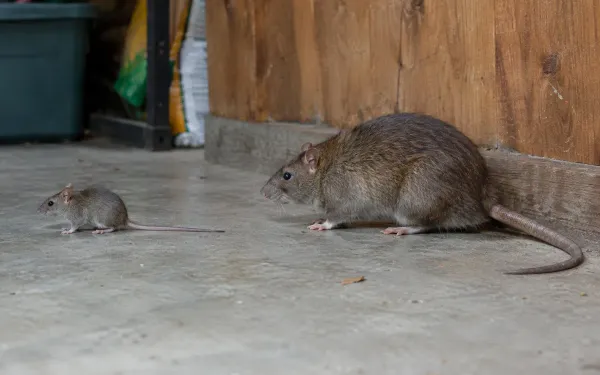
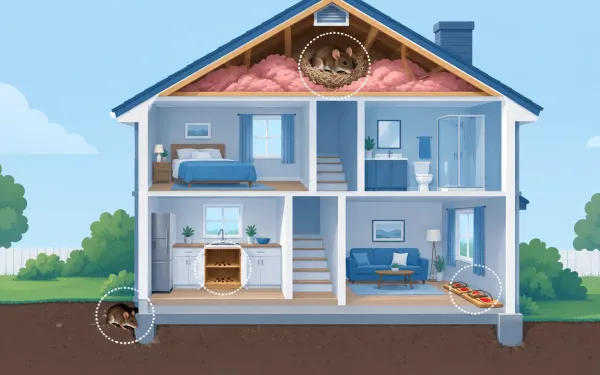
Field Mice: Deer Mice vs. House Mice, Hantavirus and Safe Cleanup
A “field mouse” in the U.S. is usually a deer mouse or its close relative, the white-footed mouse: brown on top with a white belly and feet, big eyes and ears, and a tail that’s dark on top and white underneath (UC IPM). That two-tone tail is the easiest way to tell one from a house mouse, which is gray-brown all over with an almost hairless tail. Deer mice move into cabins, sheds and garages when the weather turns cold (Utah State University, New Mexico State University), and they’re the main carrier of Sin Nombre hantavirus (UC IPM). Never sweep or vacuum their droppings. Soak them with disinfectant first, as below.
Cost: about $29 in supplies. Difficulty: easy. Call a pro if droppings and nests are spread through a cabin, attic or crawl space, or you’d have to clean up a heavy infestation in a closed space.
This guide covers telling field mice from house mice, why they come inside in fall, what they eat, the hantavirus risk and how to clean up and keep them out. We haven’t trapped field mice ourselves; it rests on UC IPM, CDC, Utah State, New Mexico State and Cornell guidance.
Found droppings in a cabin or shed you just opened? Don’t sweep. Open the doors and windows and leave for 30 minutes, then follow the cleanup steps below with gloves and a bleach solution (CDC).
Deer Mouse vs. House Mouse
The usual U.S. “field mouse” is the deer mouse, so this is the comparison that matters. The tail is the quickest check: UC IPM calls the deer mouse’s bicolored tail the easiest way to tell it from a house mouse.
| Feature | Deer mouse (field mouse) | House mouse |
|---|---|---|
| Size | About 6 in including the tail (Utah State) | 5–7 in including a 3–4 in tail (UC IPM) |
| Coat | Brown back, white belly, legs and feet (UC IPM) | Gray-brown all over (UC IPM) |
| Tail | Two-tone, dark on top and white below, furred (UC IPM) | One color, almost hairless (UC IPM) |
| Eyes, ears | Larger than a house mouse’s (UC IPM) | Large ears, small black eyes (UC IPM) |
| Where | Fields and woods; cabins, sheds and garages in cold weather | Can live its whole life indoors (Cornell) |
| Droppings | Look like house mouse droppings (UC IPM) | About 1/4 in, like a grain of rice |
| Other clue | Stashes seeds and nuts (UC IPM) | Musky odor (UC IPM) |
| Hantavirus | Main carrier of Sin Nombre virus (UC IPM) | Not the main carrier |
Droppings and nests won’t settle it, since UC IPM says they’re similar for both (sizes are in mouse poop vs. rat poop). Look at the tail, or for a hidden pile of seeds.
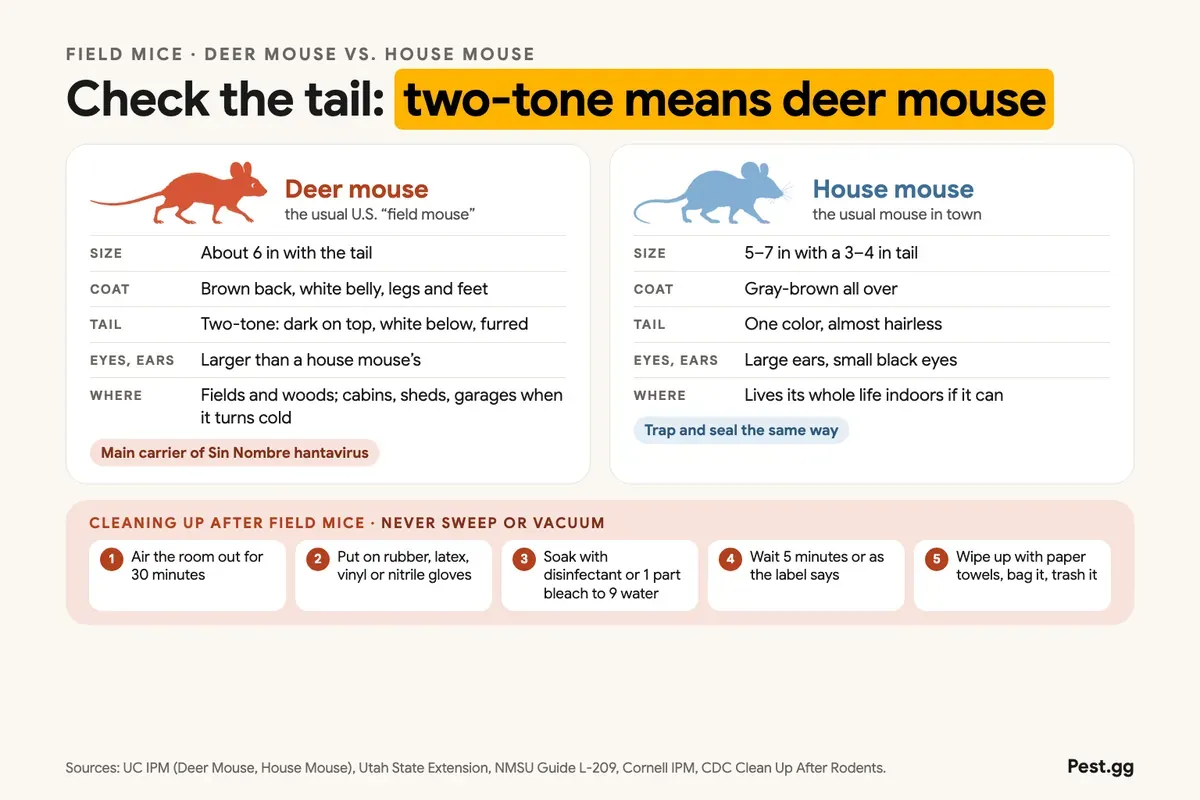
Infographic: deer mouse vs. house mouse, and the CDC’s wet cleanup. Sources: UC IPM, Utah State, NMSU, Cornell, CDC.
The names get mixed up. The deer mouse (Peromyscus maniculatus) and the white-footed mouse (Peromyscus leucopus) are separate species that look much alike; New Mexico State University says the white-footed mouse is found in New England, the mid-Atlantic and southern states, the Midwest and parts of the West. Both go by “field mouse,” and both are handled the same way. See deer mouse and house mouse in the Pest Library for photos.
Not sure it’s a mouse at all? A heavy body, small ears and a thick tail point to a rat; see rat vs. mouse.
Why Field Mice Come Inside in Fall
They’re looking for shelter and food. New Mexico State University says the deer mouse is sometimes found indoors, especially with the onset of cold weather in fall, when it moves into buildings for shelter and food, and Utah State says deer mice move indoors when it gets cold outside. They’re occasional invaders rather than year-round housemates (Utah State).
UC IPM says deer mice often move into vacated homes, cabins and other buildings, where they build nests and store food, and the Pest Library notes they aren’t normally found in towns unless fields, woods or large parks are nearby. So the classic field mouse problem is a rural house, a seasonal cabin, a shed, a barn or a garage, especially one that sat closed for weeks.
What Do Field Mice Eat?
Mostly seeds. UC IPM calls the deer mouse predominantly granivorous, and Utah State lists seeds, fruits, berries, nuts, vegetation and insects. They also stash food: a drawer or boot full of acorns, seeds or nut shells is a strong sign of a field mouse rather than a house mouse. What do mice eat compares field and house mouse diets.
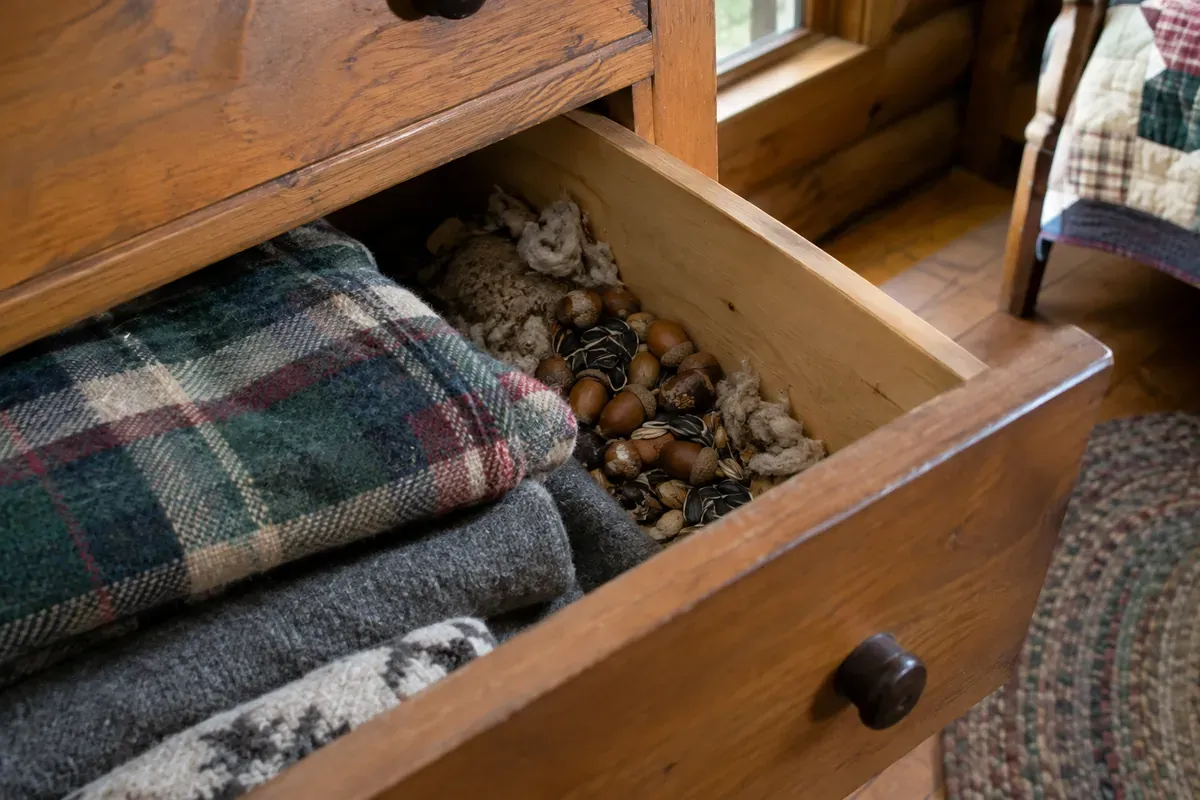
Illustration: a field mouse food cache at the back of a cabin drawer.
Birdseed, grass seed and dry pet food in a garage are what draw them in. Utah State’s advice is to store food in pest-proof containers.
Are Field Mice Dangerous? The Hantavirus Risk
The deer mouse is the principal carrier of Sin Nombre virus, which causes hantavirus pulmonary syndrome, a severe respiratory disease with a fatality rate of about 36% (UC IPM). People catch it by breathing in dust from the droppings, urine or nests of infected rodents, usually while cleaning. There’s no evidence that North American hantaviruses spread from person to person (UC IPM).
It’s rare: the CDC counted 890 U.S. cases from 1993 through 2023, most of them west of the Mississippi River, as our deer mouse page details. Other hantaviruses found in the U.S. are linked to the white-footed mouse and, in the Southeast, to cotton rats and rice rats (New Mexico State University). If you get sick after cleaning up after rodents, tell your doctor about the exposure.
How to Clean Up After Field Mice
Never stir up dust by sweeping or vacuuming (UC IPM). The CDC’s method:
- Air it out. Open doors and windows and leave for at least 30 minutes.
- Put on gloves: rubber, latex, vinyl or nitrile.
- Soak it. Spray droppings, urine and nests with a disinfectant or 1 part bleach to 9 parts water (about 1½ cups of bleach per gallon) until very wet.
- Wait. Let it soak 5 minutes, or as long as the disinfectant label says. For nests, UC IPM says to let everything soak 10 minutes before removing the nest material.
- Wipe and bag it. Pick it up with paper towels, bag it and put it in the trash, then mop or wipe the area with the same solution.
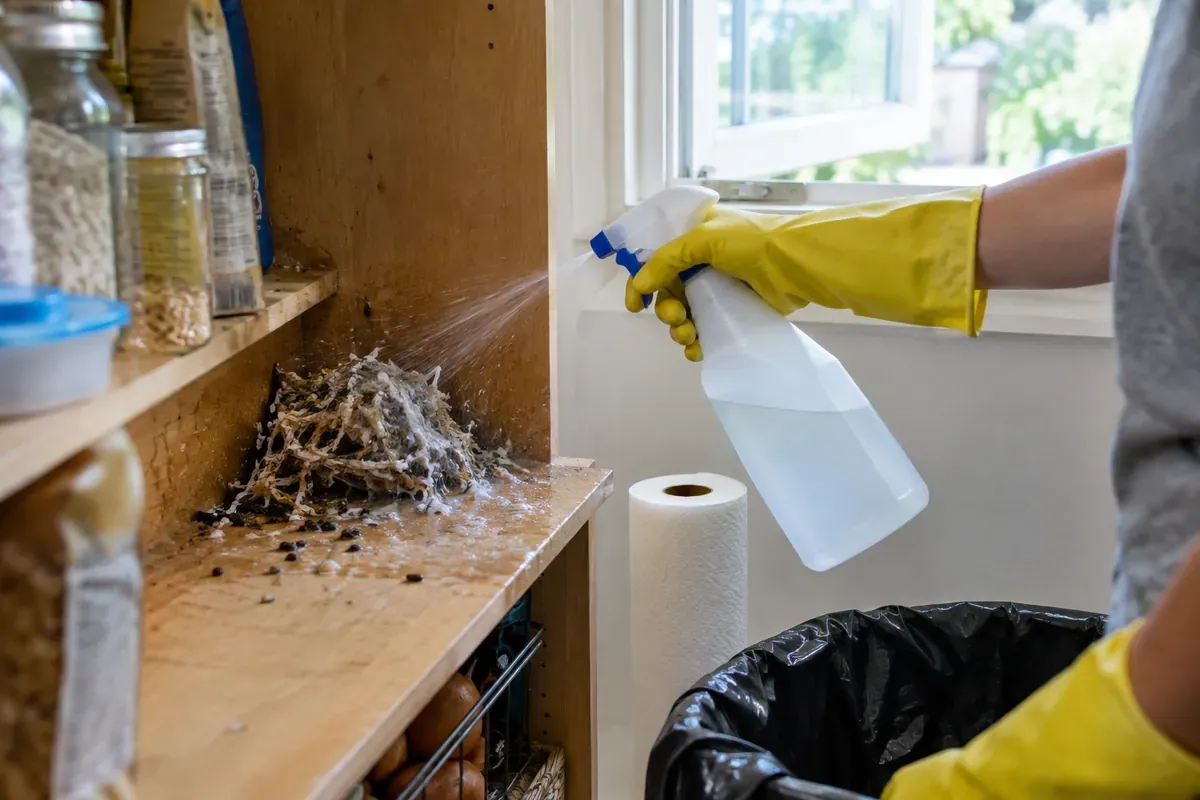
Illustration: soaking droppings and a nest before wiping them up, window open.
Wash gloved hands before taking the gloves off, then wash your hands again. How to clean mouse droppings covers bedding, upholstery and heavy infestations.
How to Get Rid of Field Mice
Step 1: Seal openings larger than ¼ inch, since mice gnaw to enlarge them (UC IPM). Use steel wool as a temporary plug and metal or concrete for a lasting fix; check around pipes, wires and vents, and keep exterior doors closed (Utah State). How mice get in the house lists the usual gaps.
Step 2: Set snap traps, no more than about 10 feet apart where you see droppings (UC IPM), triggers toward the baseboard (Utah State), especially in dark corners. Skip glue boards: UC IPM says they greatly increase the chance of hantavirus exposure. The full plan is in how to get rid of mice.
Step 3: Take away the food and cover. Store birdseed, grass seed and pet food in metal or hard plastic bins with tight lids, and clear high weeds near the building (Utah State).
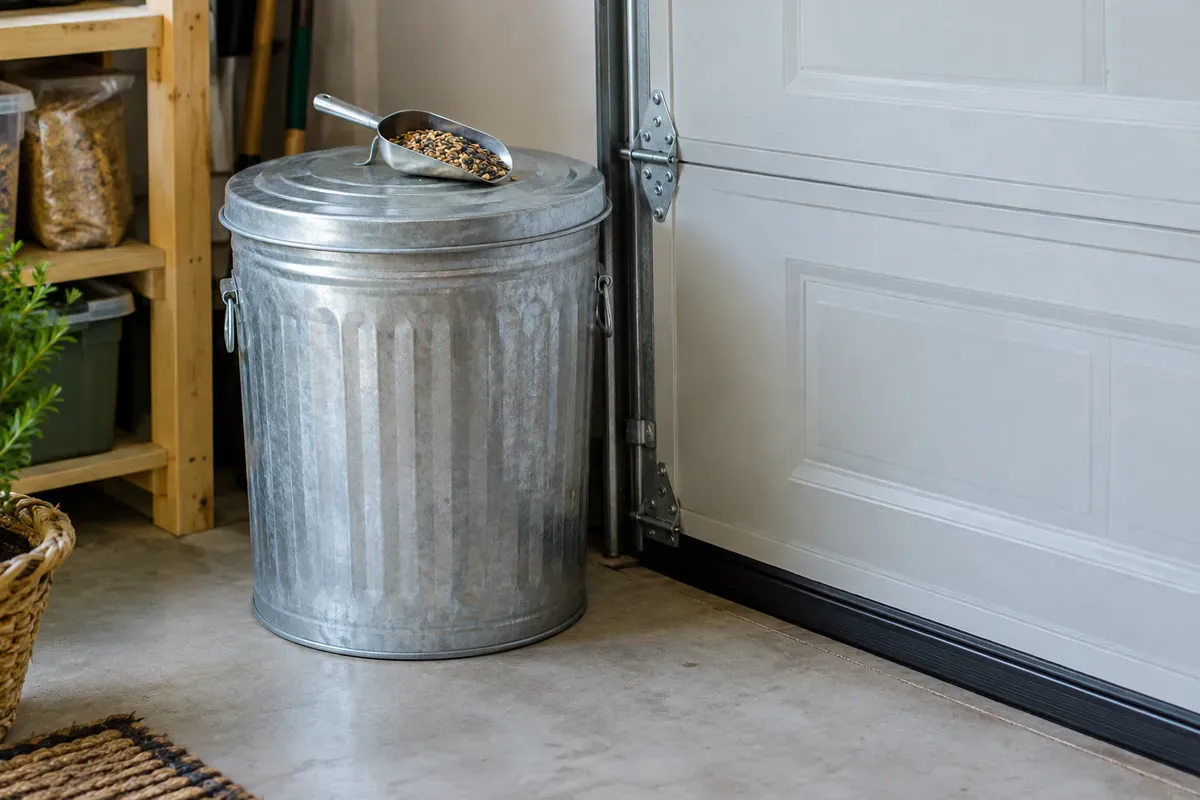
Illustration: birdseed in a lidded metal can and a door sweep on the garage door.
Step 4: Seal before fall. The best time to close gaps is before the first cold snap, when field mice start looking for shelter.
What It Costs
| Item | Typical cost |
|---|---|
| 12 wooden snap traps | $13.74 |
| Nitrile gloves, 50 count | $8.49 |
| Bleach for cleanup, 81 oz | $6.39 |
| DIY total | About $29 |
U.S. list prices, September 2026, before tax. Steel wool, copper mesh or metal for sealing is extra.
When to Call a Pro
If droppings and nests are spread through a cabin, attic or crawl space, or you’d have to clean up a heavy infestation in a closed space.
Common questions
The tail and belly. A field mouse (deer mouse) has a white belly and feet and a two-tone, furred tail; a house mouse is gray-brown all over with a one-color, almost hairless tail (UC IPM).
Sometimes, especially in fall when it turns cold; they move in for shelter and food (New Mexico State University). They favor rural homes, cabins, sheds and garages over town houses.
The deer mouse is the main carrier of Sin Nombre hantavirus (UC IPM). Cases are rare, but clean up wet, with gloves, and never sweep or vacuum droppings.
Usually, yes. “Field mouse” is a common name, and in the U.S. it most often means the deer mouse or the closely related white-footed mouse.
The Bottom Line
A field mouse is most likely a deer mouse: white belly, big eyes, two-tone tail. Seal gaps over ¼ inch before fall, use snap traps rather than glue boards, and clean up wet with gloves and a bleach solution, never by sweeping or vacuuming.
Sources and further reading · 6
- UC IPM: Deer Mouse: identification, diet, buildings, hantavirus, cleanup, sealing, traps and glue boards.
- UC IPM: House Mouse: house mouse size, coat and tail.
- Utah State University Extension: Deer Mouse: size, coloring, moving indoors in cold weather, diet, control.
- New Mexico State University: Rodent Control and Protection from Hantavirus (Guide L-209): fall entry, white-footed mouse range, other U.S. hantavirus carriers.
- Cornell IPM: Mouse and Rat Biology and Behavior: house mice can live entirely indoors.
- CDC: Clean Up After Rodents and Preventing Hantavirus: wet cleanup steps.