Carpenter Ants vs. Termites: How to Tell Them Apart
Carpenter ants and termites both show up with wings in spring, and both live in wood. Up close they are easy to tell apart: check the waist, the antennae and the wings. If you only found damage, the debris next to it tells you which one made it.
Difficulty: easy. Call a pro if you find mud tubes on the foundation, winged termites or piles of shed wings indoors, six-sided pellets under wood, or wood that is hollow and lined with soil. Termite treatment is a job for a licensed professional.
It matters because the next step is very different: carpenter ants can often be handled with bait and some repairs, while termites usually need a licensed professional (University of Kentucky, UC IPM).
In this guide:
- Carpenter Ants vs. Termites at a Glance
- Flying Ants vs. Termites
- Sawdust, Pellets or Mud: Droppings and Debris
- What to Do Next
Carpenter Ants vs. Termites at a Glance
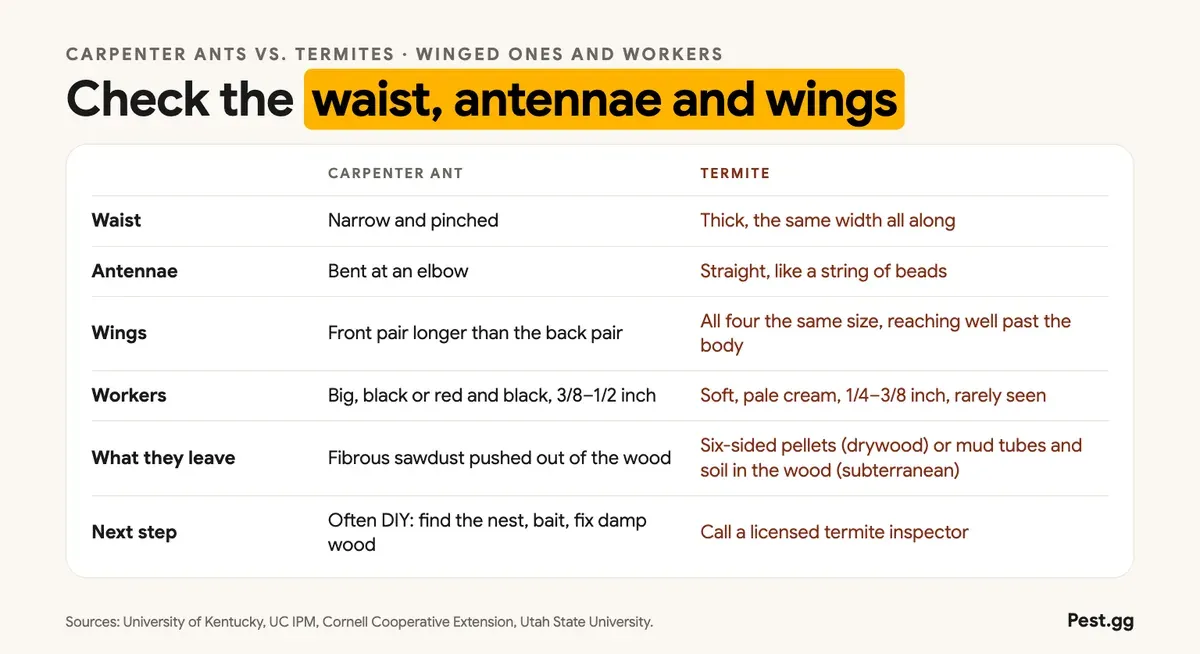
Infographic: the four checks. Sources: University of Kentucky, UC IPM, Cornell Cooperative Extension, Utah State University.
| Check | Carpenter ant | Termite |
|---|---|---|
| Waist | Narrow and pinched (Univ. of Kentucky) | Thick, the same width all along (Univ. of Kentucky) |
| Antennae | Bent at an elbow (Univ. of Kentucky) | Straight, like a string of beads (Cornell) |
| Wings | Front pair longer than back pair (Univ. of Kentucky) | All four the same size, longer than the body (Cornell) |
| Workers | Large, black or red and black, 3/8–1/2 in (Univ. of Kentucky) | Soft, pale cream, 1/4–3/8 in (Utah State) |
| Does it eat wood | No. It digs nests in wood (UC IPM) | Yes. It feeds on wood (UC IPM) |
| Debris | Fibrous sawdust (UC IPM) | Six-sided pellets (drywood) or mud and soil (subterranean) |
| Who treats it | Often you, with bait and repairs | A licensed professional (Univ. of Kentucky, UC IPM) |
Flying Ants vs. Termites
Winged ants and termites often swarm at the same time of year (University of Kentucky). Subterranean termite swarmers are about 3/8 inch (Utah State University); a carpenter ant queen can reach 3/4 inch (University of Kentucky).
Where you see them matters (University of Kentucky). Winged termites indoors almost always mean an infestation; a swarm from a yard stump or woodpile doesn’t automatically mean the house has one. Many winged carpenter ants indoors suggest a nest inside. Check windowsills for swarmers and shed wings.
No swarm? A big, dark insect walking in the open is very likely an ant, not a termite: termite workers never come out in the open (Cornell Cooperative Extension).
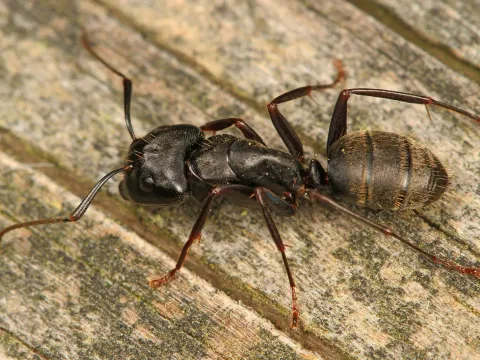 Carpenter antBig and black; pinched waist.
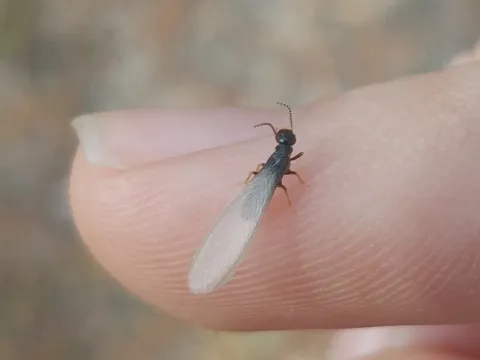 Call a proTermite swarmerDark body; long, equal wings.
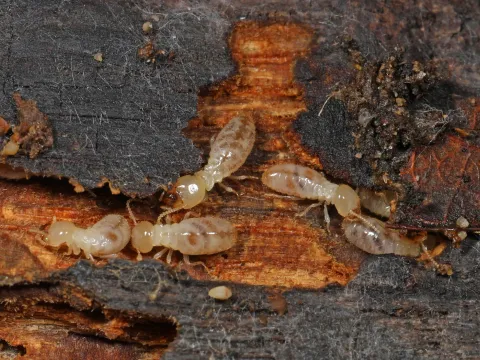 Call a proTermite workersSoft, pale cream; no pinched waist.
More termite photos: what do termites look like.
Sawdust, Pellets or Mud: Droppings and Debris
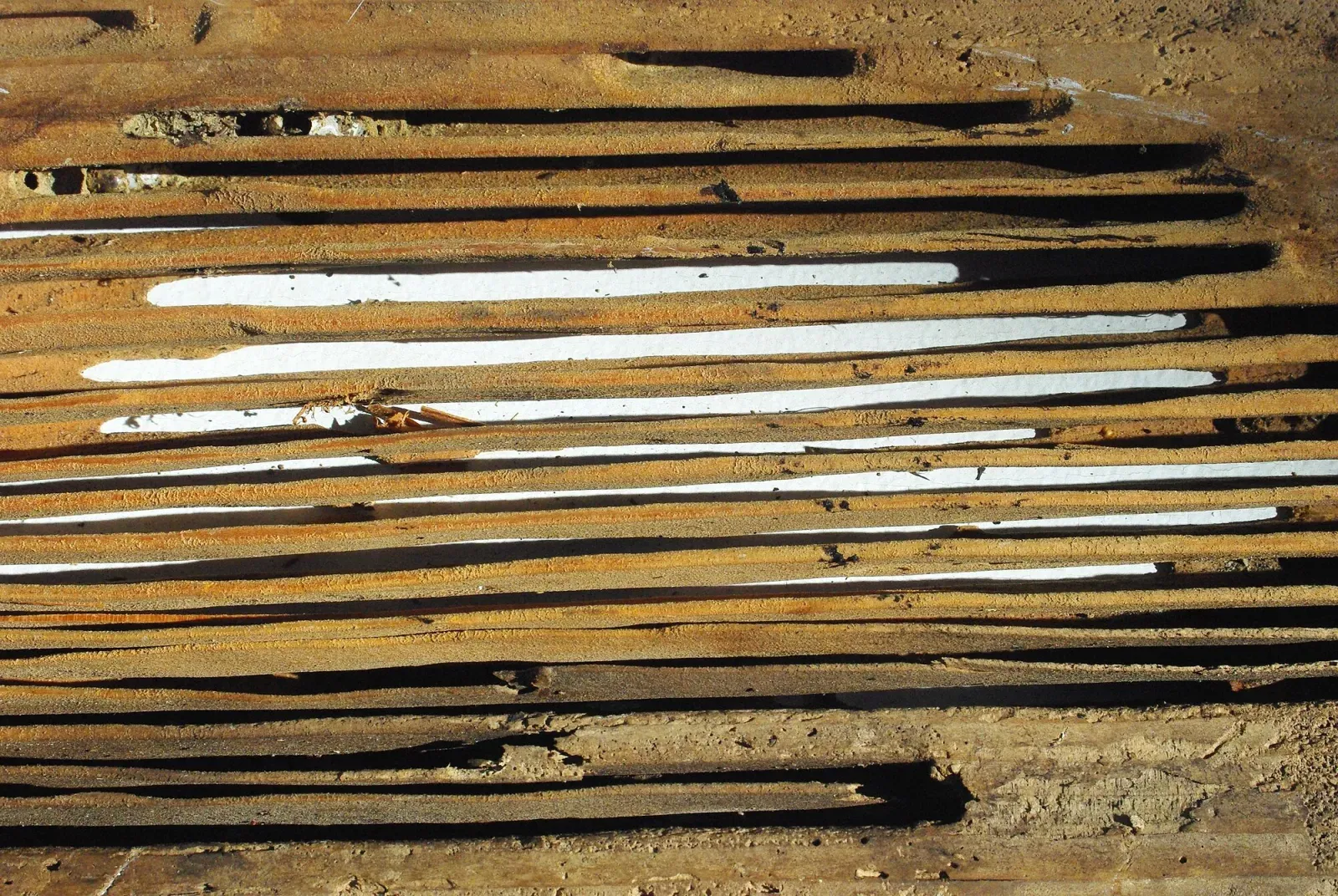
Carpenter ant galleries: clean and smooth, with no soil inside. Photo: Nwbeeson (CC BY-SA 4.0), via Wikimedia Commons.
- Carpenter ants: sawdust. They dig nests in wood and push out fibrous sawdust (UC IPM).
- Drywood termites: pellets. Their droppings have six flat sides, a shape UC IPM calls diagnostic. See termite droppings for photos.
- Subterranean termites: mud. Their damaged wood is hollowed along the grain and lined with soil, and they build pencil-wide mud tubes (University of Kentucky).
Damage from water or carpenter ants has no soil lining (University of Kentucky). For other holes, see holes in wood.
What to Do Next
Carpenter ants are often a job you can do yourself. Follow them after dark to find the nest (UC IPM), fix the damp or decayed wood they usually start in (University of Kentucky) and use slow-acting bait. Steps: how to get rid of carpenter ants.
Termites usually need a licensed professional; UC IPM says do-it-yourself termite products are generally not effective. Don’t spray: leave tubes and pellets for the inspector, and vacuum any swarmers indoors; they can’t damage wood (University of Kentucky). Termites damage wood slowly, so take time to get two or three inspections (University of Kentucky).
Common questions
No. They nest in wood but don’t eat it (UC IPM); termites do.
Not by themselves: a pinched waist and elbowed antennae mean it’s an ant. A winged termite indoors almost always means an infestation (University of Kentucky).
Termites, usually: treatment needs special tools and training (University of Kentucky). A carpenter ant nest can often be handled with bait and repairs, though large or hidden nests may need a pro.
Rarely. UC IPM notes they occasionally fly inside in winter where basements are heated. Most swarms happen in spring.
Sources and further reading · 7
- University of Kentucky: Termite Control, Answers for Homeowners (EF604): swarmers indoors, mud tubes, soil-lined damage, hiring a pro.
- University of Kentucky: Carpenter Ants (EF603): size, color, winged ants indoors, moist wood.
- UC IPM: Carpenter Ants: no wood eating, fibrous sawdust, active after dark.
- UC IPM: Subterranean and Other Termites: feeding on wood, winter swarms, DIY products.
- UC IPM: Drywood Termites: six-sided pellets.
- Cornell Cooperative Extension, Nassau County: Eastern Subterranean Termites: antennae, wings, hidden workers.
- Utah State University: Western Subterranean Termite: swarmer and worker sizes.