How to Get Rid of Sugar Ants (and What They Really Are)
“Sugar ant” is a nickname, not a species. The ant most often called a sugar ant in U.S. homes is the odorous house ant: Oregon State and University of Nevada extension both list “sugar ant” as one of its common names. Pavement ants and Argentine ants also go for sweets.
Time: about 1–3 weeks. Difficulty: easy. Call a pro if the ants keep coming after several weeks of baiting with two different products, you find nests inside walls you can’t reach, or the ants are large and black and you see sawdust (possible carpenter ants).
To get rid of them, you need to reach the queens in the nest. Spraying the ants you see doesn’t do that. The University of Kentucky calls it the most common mistake. The fix is slow-acting bait, and the steps below show how to use it so it works.
In this guide:
- What Are Sugar Ants?
- Why Spraying Sugar Ants Doesn’t Work
- How to Get Rid of Sugar Ants in 5 Steps
- Keep Sugar Ants From Coming Back
- Common Questions
What Are Sugar Ants?
Small ants on a sweet spill are usually one of these three. Check with a magnifier or your phone’s zoom.
- Odorous house ant. About 1/8 inch, dark brown to black (University of Wisconsin). Crush one and smell it: the University of Kentucky describes a rotten coconut or pine smell. It’s the most common and hardest ant to control in Kentucky and much of the Midwest (University of Kentucky).
- Pavement ant. Also small and dark. Under a magnifier it has two bumps at the waist and fine grooves on its head and back (University of Kentucky). It often pushes small piles of soil out of cracks in driveways and patios.
- Argentine ant. About 1/8 inch and dull brown (UC IPM). UC IPM says it’s the most common ant in and around homes in California.
Big black ants, 1/4 inch or more, with sawdust nearby are a different problem: see how to get rid of carpenter ants.
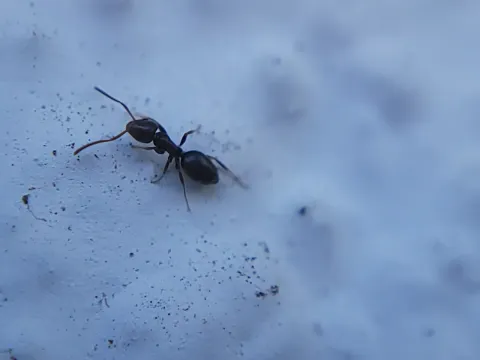 Odorous house antAbout 1/8 inch; smells like rotten coconut.
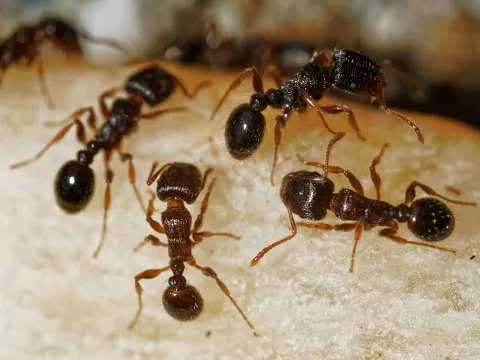 Pavement antTwo waist bumps; soil piles at cracks.
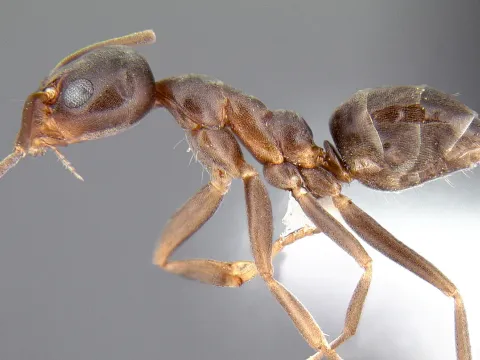 Argentine antAbout 1/8 inch; dull brown.
Why Spraying Sugar Ants Doesn’t Work
The ants on your counter are a small part of the colony. Thousands more, and one or more queens, stay hidden in the nest (University of Kentucky). Odorous house ants often have many queens and many connected nests (University of Wisconsin), and colonies move fast when disturbed (University of Kentucky).
So spray kills the workers you see, and the nest sends more. UC IPM says spraying ants indoors will not stop more ants from coming in.
Bait works differently. Workers carry it back and share it mouth to mouth with the larvae and queens (UC IPM). That’s why it must be slow-acting: fast poisons kill the workers before they get home.
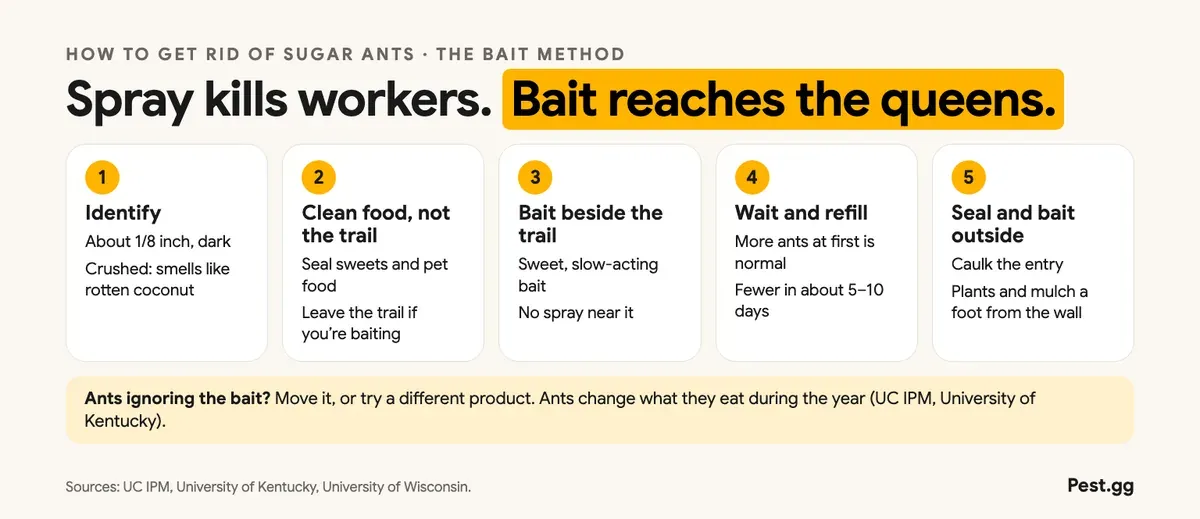
Infographic: the bait method in five steps. Sources: UC IPM, University of Kentucky, University of Wisconsin.
How to Get Rid of Sugar Ants in 5 Steps
- Identify the ant. Catch a few on tape. If it’s 1/8 inch, dark and smells like coconut when crushed, it’s an odorous house ant. Different ants like different baits (UC IPM), so this step saves time.
- Clean up the food, not the trail. Wipe spills, rinse soda cans and seal sugar, honey, syrup and pet food in closed containers (UC IPM). If you’re about to bait, don’t wipe the trail itself: the University of Kentucky says not to disturb foraging trails while using bait.
- Put bait right next to the trail. Odorous house ants usually take sugar-based baits well (University of Wisconsin). The University of Kentucky suggests sweet, syrupy gel baits for them. For gels, put small dabs on a piece of masking tape or wax paper to protect the counter. Keep baits away from children and pets.
- Don’t spray near the bait, and wait. Spraying or cleaning around the bait keeps ants away from it (University of Kentucky, University of Wisconsin). You’ll see more ants at first. That means they’re feeding. UC IPM says it can take 5 to 10 days to see fewer ants. Refill the bait when it’s empty.
- Seal where they come in. Follow the trail to the entry point: under a door, along a window sill, or where siding meets the foundation (University of Kentucky). Caulk it once the ants are gone.
Ants ignoring the bait? Ants change what they want to eat during the year. Move the bait, or try a different product (UC IPM, University of Kentucky). Offering a small amount of sweet, protein and oily bait side by side shows which one they prefer (UC IPM).
Want to see where they go? The University of Kentucky suggests a dab of honey or jelly on an index card. After feeding, the ants walk back to the nest or entry point.
Keep Sugar Ants From Coming Back
Most sugar ants indoors come from nests outside (University of Wisconsin). UC IPM suggests:
- Bait outdoors. Put bait stations near nests and trails, about every 10 to 20 feet around the foundation. Outdoor bait draws ants out of the house.
- Keep plants back. Keep plants, grass and mulch at least a foot from the foundation.
- Fix drips. Leaky faucets and sprinkler heads attract thirsty ants.
- Watch the shrubs. Aphids and scale insects make honeydew, a sweet liquid that feeds ants (UC IPM).
- Bait early. Treating in late winter and early spring, when colonies start to grow, works best (UC IPM).
UC IPM also warns against regular perimeter sprays around the foundation. They kill only the foragers, can pollute waterways and sometimes trap ants indoors.
For more on baits, traps and natural repellents, see ant traps. For why a queen keeps a colony going for years, see how long do ants live.
Common questions
Mostly a nuisance. The University of Nevada says damage to the home from house ants is minimal, though they get into food.
Usually because the queens survived. Spraying kills workers but not the nest (University of Kentucky). Odorous house ants also have many nests and queens (University of Wisconsin), so one bait placement may not reach all of them. Keep baiting where you still see ants.
They can clean up the ants you see, but they don’t kill the colony. UC IPM says soapy water removes the scent trail, and plant-oil products like peppermint kill ants on contact but don’t last. We found no extension guide that recommends vinegar over soapy water. Use them for a quick cleanup, and use bait for the nest.
UC IPM says 5 to 10 days to see fewer ants, and several weeks or more for full control with bait. Large or spread-out colonies take longer.
Sources and further reading · 5
- UC IPM: Ants: why sprays fail, how baits work, 5 to 10 days, bait types, outdoor spacing, mulch and plants, plant-oil products.
- University of Kentucky: Ants (EF619): odorous house ant vs. pavement ant, spraying mistake, sweet gel baits, don’t disturb trails, more ants at first, honey card.
- University of Wisconsin: Odorous House Ants: size, smell, many queens, sugar-based baits, no spray near bait.
- Oregon State University: Ants (PNW 761): odorous house ants are also called sugar ants; pavement ants favor sugary items.
- University of Nevada, Reno Extension: House Ants: “sugar ant” as a common name; minimal damage.