Baby Cockroach: What Nymphs Look Like and What to Do
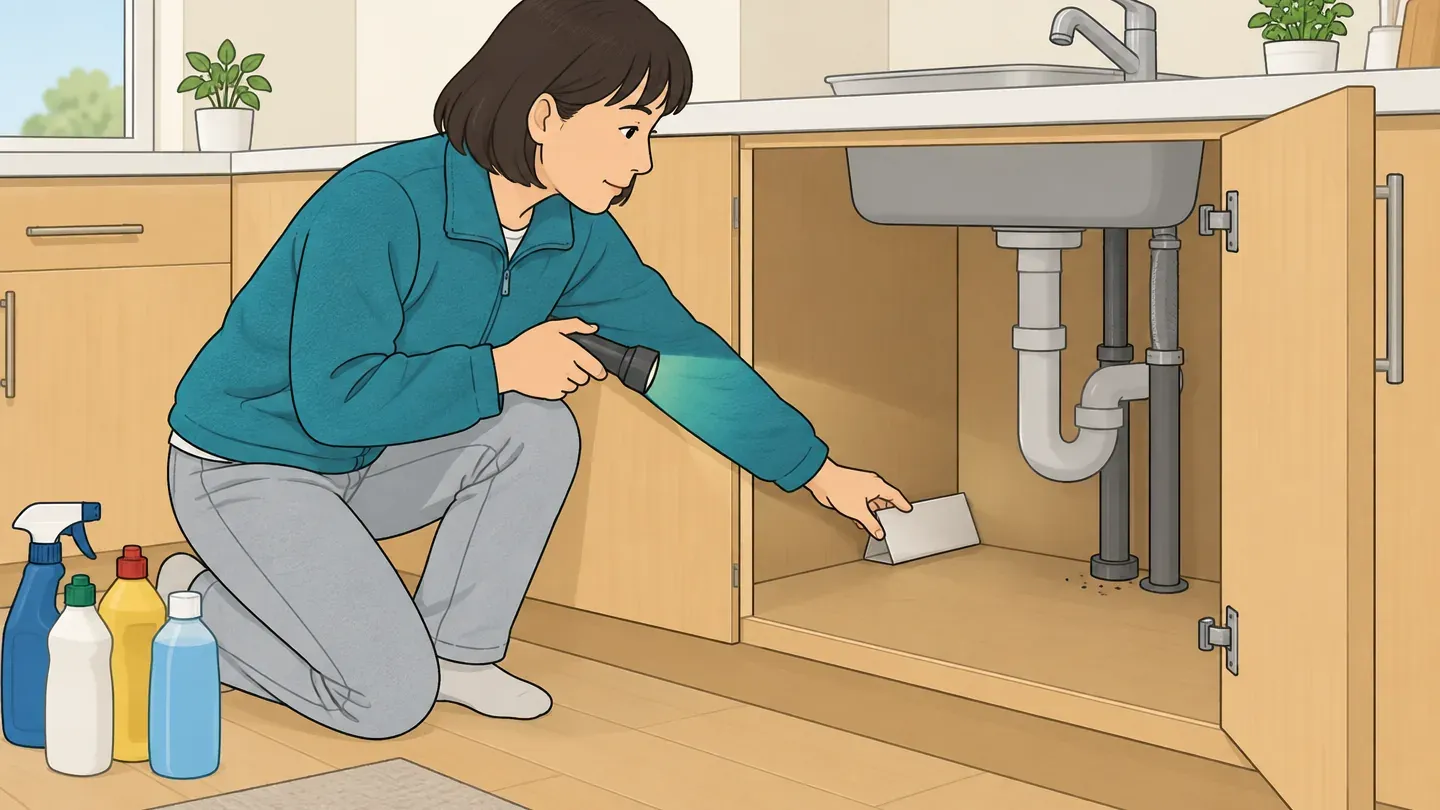
Illustration: a sticky trap pushed flush into the back corner of the cabinet under the kitchen sink.
A baby cockroach, or nymph, is a smaller, wingless version of the adult. The German cockroach nymph most people find indoors is 1/8 to 9/16 inch long (3 to 14 mm), dark brown to black with a pale stripe down its back. It usually means roaches are breeding nearby. Sticky traps confirm it; gel bait clears it. Skip bug spray.
Cost: about $10–20 in supplies. Difficulty: easy. Call a pro if you have brownbanded roaches, roaches keep arriving from a neighboring unit, or baiting with follow-ups every 2–4 weeks still hasn’t emptied your sticky traps.
This page covers how to identify a baby roach, how to tell it from a small adult and from look-alikes, what it means and how to confirm it. We haven’t tested products ourselves; it rests on Rutgers, UC IPM, University of Kentucky, NC State and other extension guidance plus list prices.
Baby Roach vs. Look-Alikes at a Glance
| What you found | Looks | Size | Usually where |
|---|---|---|---|
| German cockroach nymph | Dark brown to black, pale stripe down the back | 1/8 to 9/16 inch | Kitchen and bathroom |
| Brownbanded nymph | Two pale bands across the body behind the head | German-sized | High on walls, behind pictures |
| American nymph | Grayish to reddish brown | Grows toward a 2-inch adult | Floor drains, basements, pipes |
| Bed bug nymph | Translucent or whitish yellow | 1.5 to 4.5 mm | Mattress seams, bed frames |
| Carpet beetle larva | Hairy, reddish or light brown, tail tuft | Up to about ¼ inch | Wool, lint and carpets, not food |
Sources: Rutgers, University of Kentucky, EPA and Colorado State.
What Does a Baby Roach Look Like?
A cockroach nymph looks like a small adult with no wings: a flat oval body, long thin antennae and spiny legs. There’s no grub stage; nymphs just get bigger, shedding their skin 5 to 7 times before they become adults (Rutgers).
A white roach has usually just shed its skin and darkens within hours. Nymphs also outnumber adults: growing German cockroach populations are about 80 percent nymphs. Only adults make egg cases, so cockroach eggs are a separate sign to look for.
German Cockroach Nymphs: The Small Roaches in Your Kitchen
Tiny roaches in the kitchen or bathroom are almost always German cockroaches, the most common roach in U.S. homes. In a Rutgers survey of about 1,500 New Jersey apartments, 97.8 percent of cockroach finds were German.
Look for a pale tan stripe down the middle of the back, between two dark bands, near the stove, fridge, sink and cabinet hinges. Just-hatched nymphs can be as small as 1/16 inch (University of Minnesota Extension), so the first ones are easy to miss. The adult is light brown, about ½ inch long, with two dark stripes behind the head (University of Kentucky).
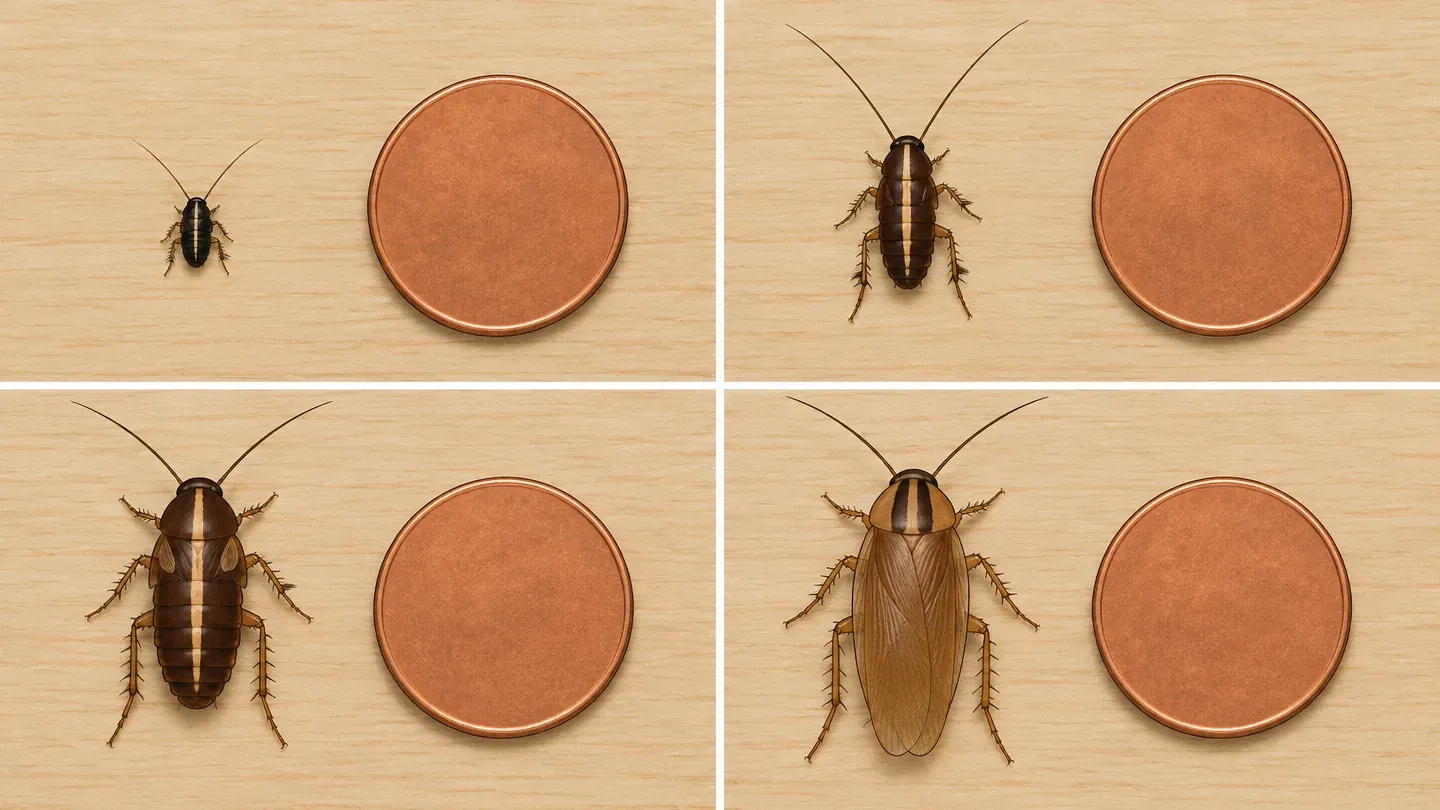
Illustration: German cockroach nymphs from newly hatched to late stage, next to an adult, with a plain coin for scale.
Real photos of baby roaches:
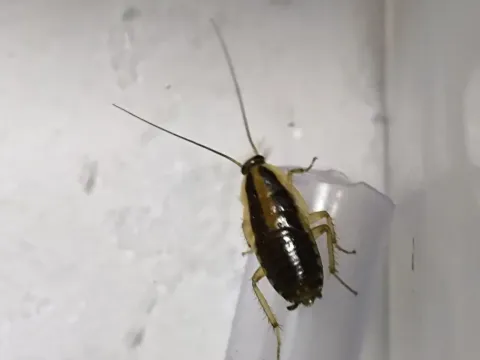 KitchenYoung German nymphTiny and dark, with a pale stripe down the middle of the back.
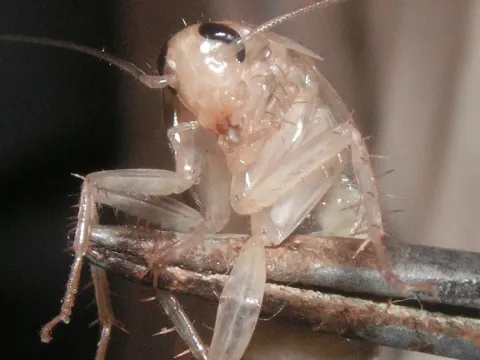 Not albinoWhite, just moltedA “white roach” is one that just shed its skin. It darkens within hours.
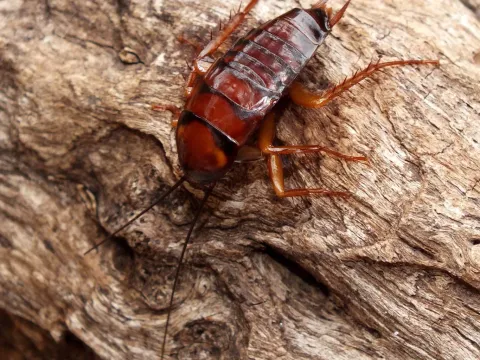 BiggerAmerican roach nymphBigger and reddish brown. Usually basements and drains.
Other Roach Nymphs: Rarely in the Kitchen
Found yours in the kitchen? It’s almost certainly German. American nymphs are white at hatching, then grayish to reddish brown, with wing pads after a few molts. Oriental nymphs are reddish brown and slow, in damp basements and drains.
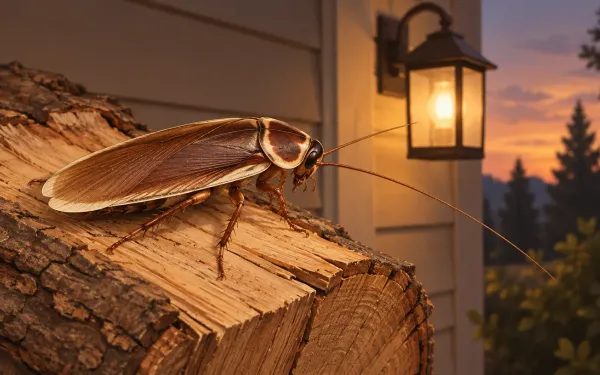
A brownish nymph near woodpiles or firewood is likely a wood roach. They rarely breed indoors, so one inside is usually a stray.
Is a Small Cockroach a Baby or an Adult? Check the Wings
A small roach isn’t always a baby: adult German and brownbanded cockroaches are only about ½ inch long.
- No wings, stubby body: a nymph.
- Wings over the body: an adult. German adults have full wings but can’t fly.
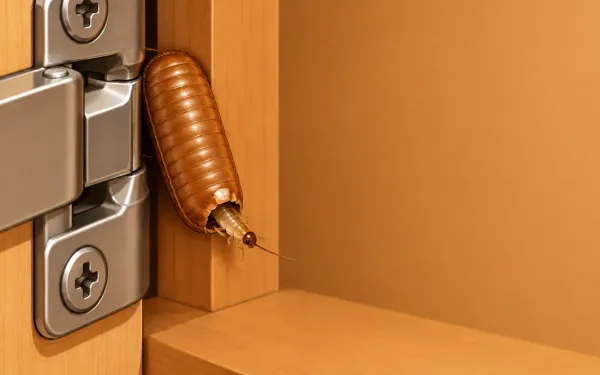
- A light beige capsule sticking out of the rear: an adult female carrying an egg case of about 30 to 40 eggs.
A small roach flying to your porch light is likely a wood roach male; brownbanded males also fly when disturbed.
What Seeing Baby Roaches Means: Breeding Indoors
German and brownbanded cockroaches live and breed only indoors (UC IPM), so a German nymph most likely hatched in your home or building. Young nymphs hide in even smaller cracks than adults, so you rarely see them until numbers build.
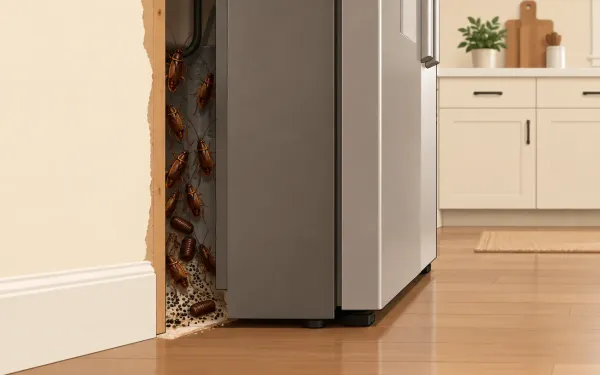
One nymph can be a hitchhiker: German cockroaches often arrive in grocery bags, drink cartons or used furniture (University of Kentucky). Nymphs of different sizes mean more than one generation is growing, and roaches out in daytime are typical of a severe infestation (Rutgers). Droppings and shed skins, among other signs of roaches, help confirm it.
Are Baby Roaches Dangerous? Not From Bites
Cockroaches don’t generally bite people (National Pesticide Information Center). The real issue is allergens and germs: droppings, shed skins and saliva can trigger allergies and asthma, and roaches can carry germs such as Salmonella onto food (NC State Extension).
University of Kentucky entomologists say roach baits pose minimal hazard to children or pets. Still put gel bait deep in cracks and traps out of reach; if a child swallows bait, call Poison Control at 1-800-222-1222, and for a pet, call your vet.
Baby Roach vs. Bed Bug vs. Carpet Beetle Larva: Check the Spot
Where you found it usually settles it: food and water for a roach nymph, mattress seams for a bed bug, wool and lint for a carpet beetle larva. A roach nymph is also flat and fast.
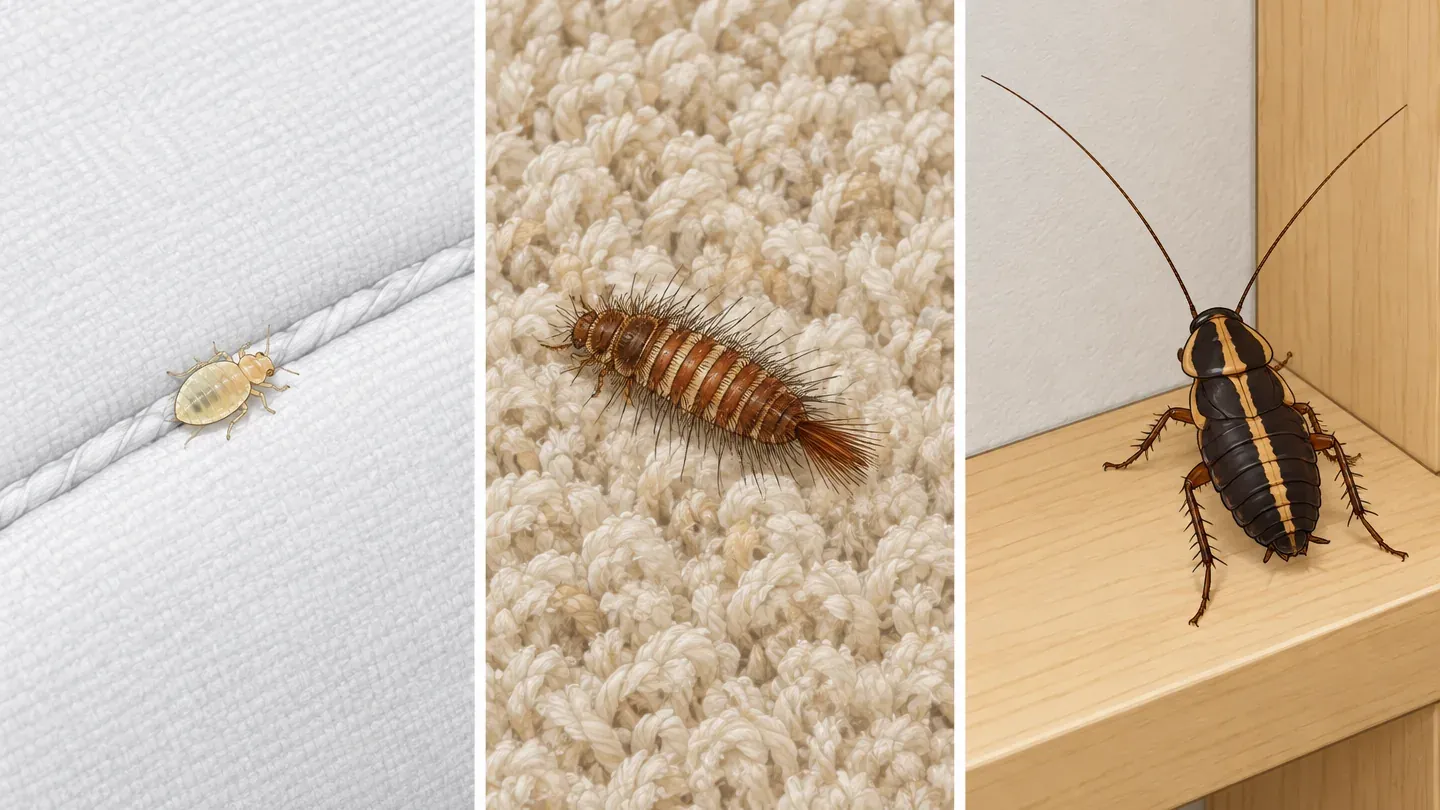
Illustration: a bed bug nymph on a mattress seam, a carpet beetle larva on a wool rug and a German cockroach nymph on a cabinet shelf.
How to Confirm It With a Sticky Trap
UC IPM calls sticky traps the best way to detect and monitor roaches, and they give you a specimen to look at.
Step 1: Place sticky traps where floors meet walls, behind the fridge and stove, under the sink and in the cabinets next to it.
Step 2: Number them and check daily for a few days; many catch roaches within 24 hours.
Step 3: Compare the catch with the German nymph description. Still unsure? Your county extension office can identify one.
Step 4: Use oil, not force, if skin or fur gets stuck: work cooking oil or baby oil into the glue.
What to Do Next
Nymphs need the standard plan for getting rid of German roaches: remove competing food tonight, then many pea-sized dabs of gel bait where traps catch most, not a few big ones. Bait reaches the youngest nymphs too, because they feed on droppings from roaches that ate it (NC State). Keep sprays, foggers and cleaners away from the bait, and expect 7 days or longer before you see fewer roaches (UC IPM).
Rutgers counts roaches as eliminated when none turn up over 4 weeks, so plan on at least a month of follow-ups. Dust options are in boric acid for roaches, and the full plan is in how to get rid of roaches. Renting? German roaches move between apartments through shared walls and pipes; tell your landlord in writing, with trap photos and dates.
| Item | Typical cost |
|---|---|
| 12 plain glue boards | $10.49 |
| Or: 10 baited cockroach traps | $19.99 |
| Gel bait, box of 4 × 30 g tubes | $26.98 |
| Pro cockroach visit, 25 shared quotes (middle half) | $200–$400 |
| Pro cockroach treatment, price-guide range | $100–$600 a round |
| Pro full treatment with follow-ups, 10 shared quotes (middle half) | $450–$1,500 |
DIY: list prices from Catchmaster (traps) and DoMyOwn (bait), October 1, 2026, before tax and shipping. Pro: the middle half of 25 single-visit and 10 full-treatment quotes homeowners shared on Reddit. Price-guide range and annual plans: This Old House (March 2026). Rutgers puts a typical one-bedroom apartment at 10 to 30 grams of bait, so one tube may be enough.
Call a pro for brownbanded roaches, which UC IPM says are especially hard to control with baits, when neighbors have them too, or when traps still fill after a few rounds of baiting.
- Catch one on clear tape and compare it with the table.
- Seal food and pick up pet food before bed.
- Set numbered sticky traps under the sink and behind the fridge.
- Bait in many small dabs where traps catch the most.
- Keep sprays away from bait.
- Rebait every 2 to 4 weeks until traps stay empty for a month.
Common questions
Usually, yes, if it’s a German or brownbanded nymph: those species breed only indoors. German nymphs reach adulthood in about 60 days at room temperature (University of Florida), so numbers climb fast.
No. Nymphs have no wings, so they can only run.
Females carrying egg cases eat very little, so bait may not reach them right away (UC IPM), and their eggs can still hatch. Keep up the follow-ups.
Sources and further reading · 11
- Rutgers NJAES: German Cockroach (FS1322) and Cockroach Species in New Jersey (FS1327).
- UC IPM: Cockroaches Pest Notes.
- University of Florida IFAS: German Cockroach and American Cockroach.
- University of Kentucky: Cockroach Elimination in Homes and Apartments (ENTFACT-614).
- NC State Extension: German Cockroach Surveillance and Management.
- University of Minnesota Extension: German cockroach nymph.
- National Pesticide Information Center: Cockroaches.
- EPA: Bed Bugs: Appearance and Life Cycle.
- Colorado State University Extension: Carpet Beetles.
- Poison Control: 1-800-222-1222.
- Prices: DoMyOwn gel bait, Catchmaster glue boards, Catchmaster cockroach traps.