How to Get Rid of Roaches for Good: A Step-by-Step Plan
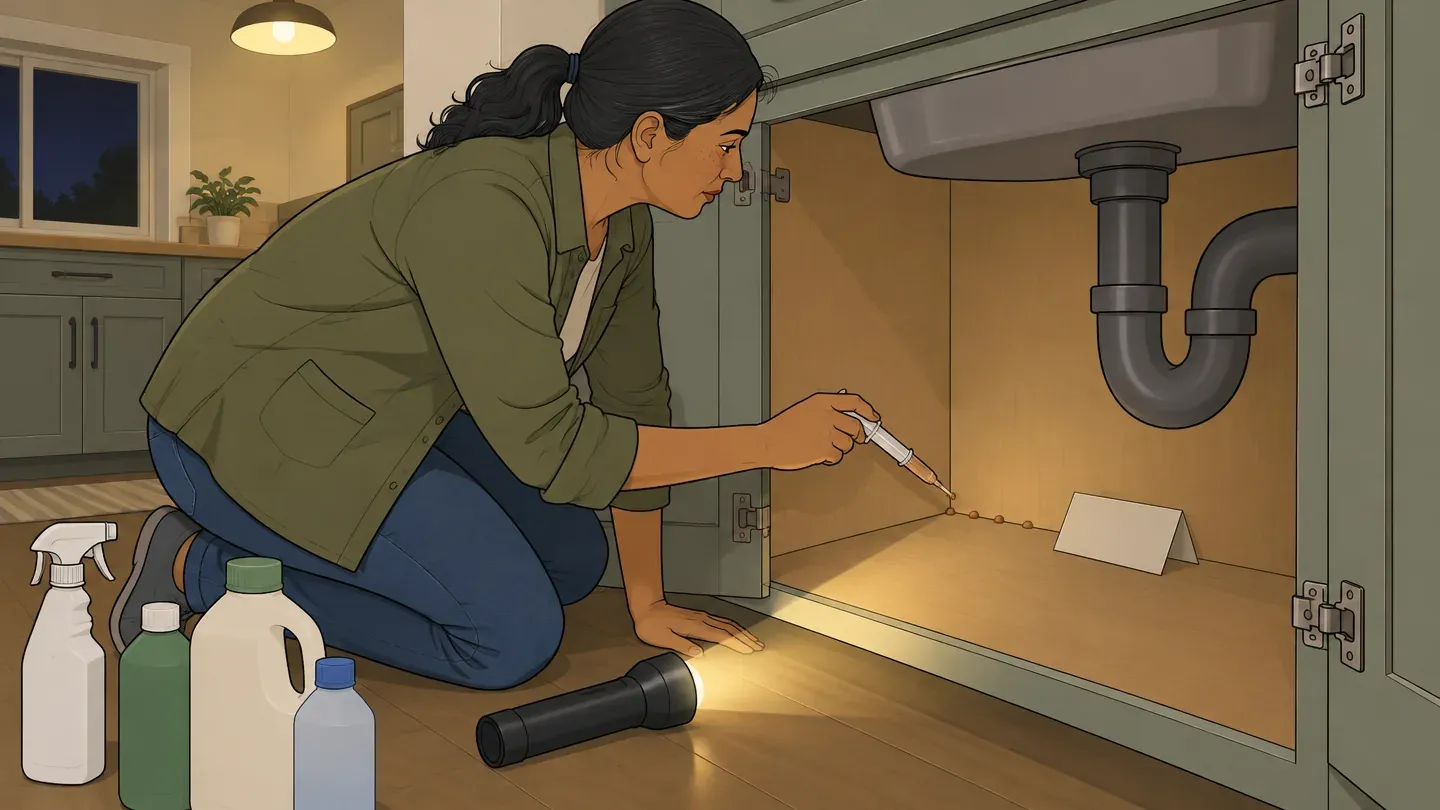
Illustration: small dots of gel bait in the corner of the cabinet under the kitchen sink, with a sticky trap along the back edge.
To get rid of roaches, identify the species, clear away crumbs, water and clutter, set sticky traps along the walls, then put pea-sized dabs of gel bait where roaches hide. Don’t spray near the bait. Expect fewer roaches after about a week. You’re done when the traps catch nothing for a month.
Cost: about $24–$54 in supplies. Difficulty: moderate. Call a pro if your sticky traps still catch roaches after two rounds of baiting, they have spread beyond the kitchen and bathroom, or they keep coming in from a neighboring apartment.
This guide covers the six steps, what each method is worth, which plan fits a rental or a home with pets, and what it costs. We haven’t run our own trials; it rests on UC IPM, University of Kentucky, NC State, Rutgers and NPIC guidance and store list prices.
Saw a roach tonight? Wash the dishes, wipe the stovetop, seal food, pick up the pet bowl and take out the trash. Vacuum any roach you see and seal the bag. Roaches don’t generally bite. Skip the spray can and the bug bomb; bait and traps can wait until tomorrow.
One roach, or a lot? A small, light-brown roach with two dark stripes behind the head is a German cockroach, and there are probably more. One big reddish roach near a door or drain usually came in from outside. A night of sticky traps tells you for sure, along with the other signs of a roach infestation.
What to buy tomorrow: one pack of bait stations and one pack of sticky traps, about $24 together. Add a syringe of gel bait later for hinge gaps and cracks the stations can’t reach.
What Works and What Doesn’t Against Roaches
Bait and sticky traps do the work; sprays and bombs undo it.
| Method | Works? | Cost | Main limitation |
|---|---|---|---|
| Gel bait, pea-sized dabs in cracks | Yes, the core of the plan | $26.98 for 4 tubes | Needs many small placements and refills |
| Bait stations | Yes; safer with kids and pets | $13.99 for 18 | Can’t reach hinge gaps and deep cracks |
| Sticky traps | Yes, to find hot spots and track progress | $10.49 for 12 | Monitor only; won’t clear an infestation alone |
| Boric acid | Yes, as a barely visible dust | Low | Skip it with kids or pets; never in piles |
| Diatomaceous earth | Somewhat | Low | Works less well than boric acid |
| Spray insecticide | Only on the roach you hit | Varies | Scatters roaches and puts them off bait |
| Bug bombs | No | Varies | Fails against German roaches; raises residue 85-fold |
| Baking soda, borax | No | Low | Does little to reduce numbers (Virginia Tech) |
| Essential oils | No | Varies | Repel briefly in lab tests; kill nothing inside |
Without chemicals, your best tools are sticky traps, a vacuum, caulk and a dry, crumb-free kitchen. Bait is what clears an indoor infestation.
Can You Get Rid of Roaches Overnight?
No. Bait takes about a week to cut numbers and about a month to finish the job. Sprays kill the roaches they hit but don’t give long-term control, and bait takes 7 days or longer to show results (University of California’s pest program, UC IPM).
The fastest way is to start baiting soon, with many small placements. A roach that eats bait usually dies within 1 to 3 days (University of Kentucky).
A few new babies in weeks two and three are normal. Pregnant females barely eat, so the bait misses them until their cockroach eggs hatch. Keep baiting.
Step 1: Identify Which Cockroach You Have
| What you see | Likely species |
|---|---|
| About ½ inch, light brown, two dark stripes behind the head; kitchen, bathroom | German (indoor) |
| About ½ inch, light bands across the body; away from the kitchen, in furniture, behind wall art | Brownbanded (indoor) |
| 1½ to 2 inches, reddish brown; drains, sewers, ground floors | American (outdoor or sewer) |
| About 1 to 1¼ inches, nearly black, slow; basements, drains, damp spots | Oriental (outdoor) |
Sizes and hiding spots: UC IPM.
The species tells you how to get rid of cockroaches in your home. Indoor species are a baiting job; American and oriental roaches are mostly a sealing and outdoor cleanup job.
Step 2: Cut Off Food, Water and Hiding Spots
Cockroach control starts here: the less other food roaches find, the more bait they eat (NC State Extension).
- Food: no dishes left overnight, lids on trash cans, pet food sealed and bowls picked up at night, sink strainer emptied.
- Water: fix leaks (renters, report them), don’t leave water standing in the sink, and empty the drip pan under the fridge if it has one.
- Clutter: recycle stacked cardboard, paper bags and newspapers.
Vacuum cracks and behind appliances, ideally with a HEPA filter. Roaches aren’t proof of a dirty home: they find food and water even in homes cleaned regularly.
Droppings: wipe the pepper-like specks off open surfaces now. In hidden spots, bait right beside them, since their scent draws roaches, and clean up once the traps go quiet.
Step 3: Set Sticky Traps to Find the Hot Spots
Sticky roach traps are the best way to monitor roaches (UC IPM): they show where to bait and whether the bait is working. They won’t clear an infestation alone.
- Where: where wall meets floor, behind the fridge and stove, and inside cabinets. Roaches travel along edges.
- Check daily for the first few days. Many catch roaches within 24 hours.
- Count weekly and bait heaviest near the busiest traps.
Kids or pets at home? Put traps behind appliances or inside latched cabinets. If fur or skin gets stuck, work cooking oil into the glue rather than pulling.
Step 4: Bait Where Roaches Hide
Bait is the best way to get rid of roaches at home. Used correctly, it can match professional results (University of Kentucky).
- Pea-sized dabs, lots of them. A dozen or more may be needed under one kitchen sink.
- Right where they hide: cabinet hinge gaps and corners, around the sink and toilet, behind the fridge, stove and dishwasher, near the trash and next to droppings.
- Bait stations go flush against corners and edges.
- No need to empty cabinets. Just keep bait off shelves, counters and anything food touches.
- Already sprayed? Bait cracks and hinge gaps you didn’t spray. The gel label we checked says not to bait recently sprayed surfaces; it gives no waiting time.
- Refill anything eaten or dried out after about a week.
How much? A typical one-bedroom apartment may need 10 to 30 grams, so up to one tube of roach gel bait (Rutgers). Use dabs, not lines or blobs.
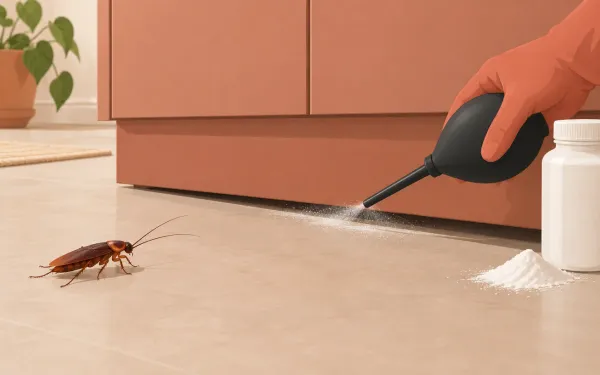
Optional, and skip it with kids or pets: a barely visible film of boric acid dust in dry gaps under cabinets and around pipes, never piles.
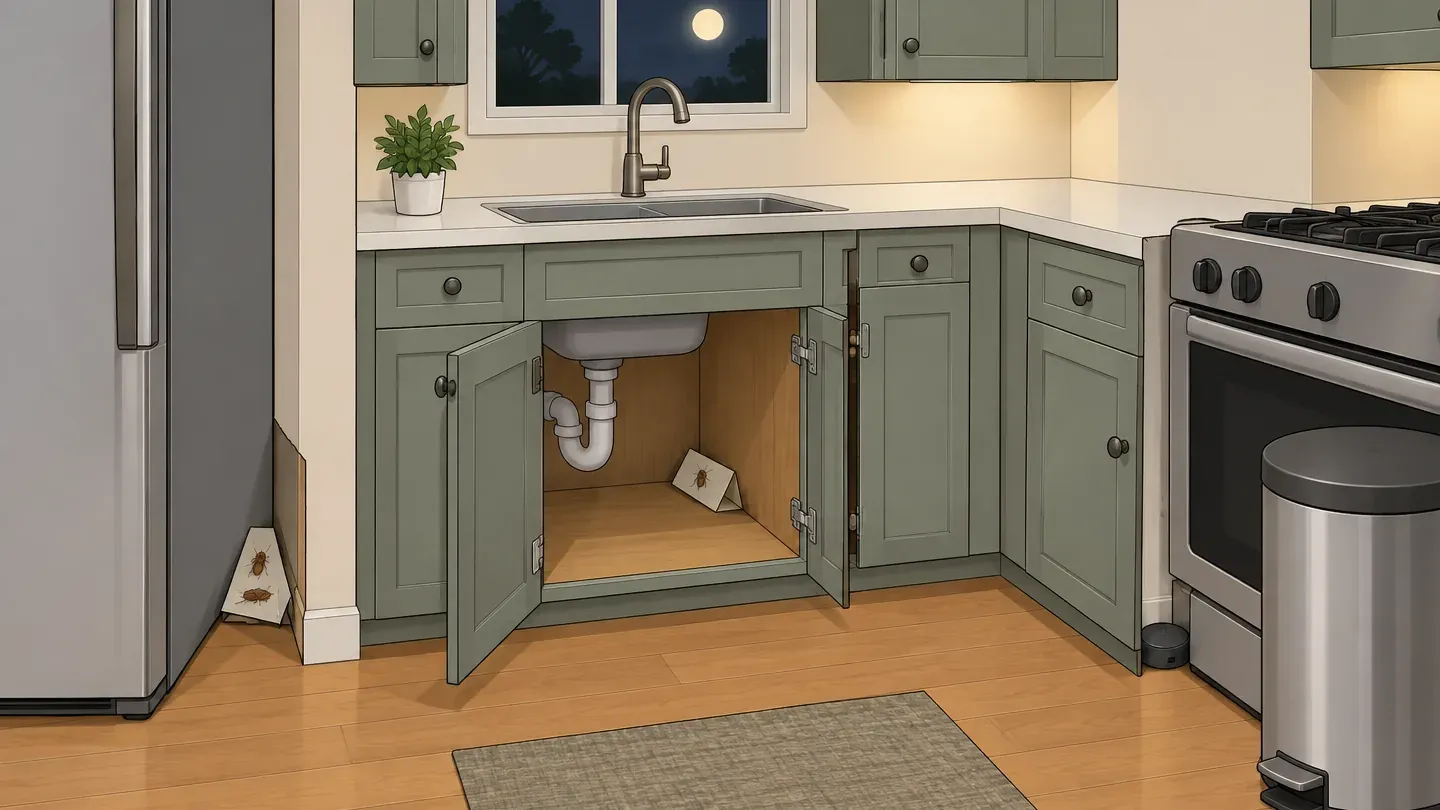
Illustration: sticky traps where the wall meets the floor behind the fridge and under the sink, and small bait dots in the cabinet hinge gaps.
Step 5: Seal Cracks and Entry Points
Use silicone caulk, screening or copper mesh around cabinets, backsplashes, windows, doors, pipes and wires (National Pesticide Information Center, NPIC).
Sealing rarely wipes out German roaches already inside (NC State), but it pays off in apartments, where roaches move between units through shared walls and pipes. For outdoor species, add door sweeps and weatherstripping, and clear ivy and woodpiles from the walls.
Renting? Tell your landlord in writing, with trap counts and photos, and ask before you caulk. In apartments, NPIC says to work with neighbors and the landlord, because nobody can fix it alone.
Step 6: Recheck Your Traps Every 2 to 4 Weeks
To get rid of roaches permanently, check and re-treat every 2 to 4 weeks until no roaches turn up for at least a month (Rutgers).
- Week 1: count each trap and refill eaten bait.
- Weeks 2 and 4: counts should fall. Add bait near traps still catching roaches.
- Done: four straight weeks of empty traps. Leave a few out as an early warning.
Is Bait Safe Around Kids and Pets?
Bait is the lower-risk way to kill cockroaches: it poses minimal hazard to children or pets (University of Kentucky).
- Keep it out of reach. Gel goes deep in cracks; use enclosed stations where a toddler or cat can get in.
- Cats and dogs like the taste. There’s so little bait in these products that an upset stomach is typically the only problem; a swallowed plastic station is the bigger worry (ASPCA). Call your vet or ASPCA Animal Poison Control at (888) 426-4435 (a fee may apply).
- Kids: Poison Control, writing about ant baits that use the same insecticides, says accidental tastes usually carry little risk; a toddler might vomit. Call 1-800-222-1222.
Sprays and Bug Bombs: Why They Make Baits Fail
Cleaners or insecticides sprayed around bait can put roaches off it (University of Kentucky). Sprays also scatter roaches, and many populations resist common spray insecticides.
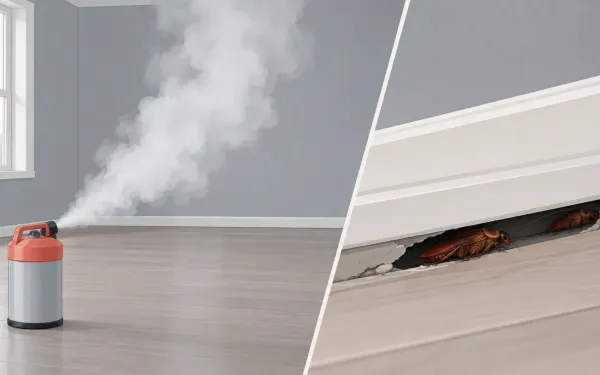
Bug bombs are worse. In an NC State study, foggers failed against German cockroaches yet raised pesticide residue in the typical home 85-fold. The mist misses the cracks where roaches live, and foggers can catch fire near a pilot light.
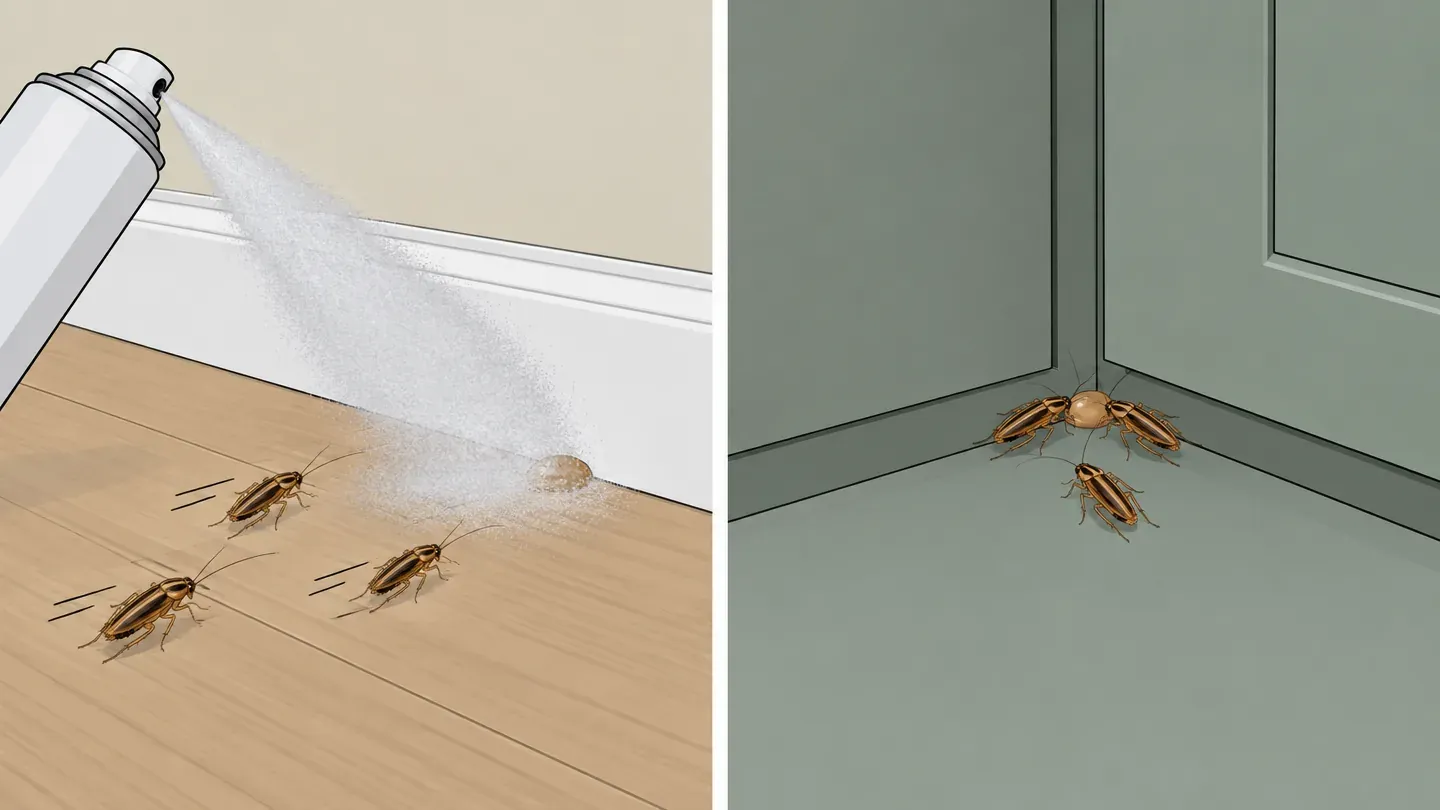
Illustration: spray mist on a baseboard with roaches running away (left), and roaches feeding at a dot of gel bait in an unsprayed corner (right).
Why Roaches Keep Coming Back: Too Little Bait, Too Rarely
“It does work, but never enough,” one Reddit poster wrote about gel bait they put out now and then. When roach control stalls, it’s usually one of these:
- Too little bait, too rarely.
- Roaches stop eating it. Switch to a bait with a different active ingredient (NPIC).
- Missed hiding spots, such as toaster ovens and other warm appliances.
- New arrivals in grocery bags, drink cartons and furniture, or from next door.
How to Get Rid of German Roaches
German roaches, the small striped kind, are the hardest to clear because they live and breed entirely indoors. The same six steps work, with three changes:
- Bait heavier and longer. Expect a dozen or more dabs per room with roaches, and keep going until the traps stay empty for a month.
- Rotate the active ingredient if they stop taking the bait. Effective ones include fipronil, indoxacarb, abamectin, dinotefuran and hydramethylnon (University of Kentucky); the name is on the label.
- Never spray near bait. Many German roach populations resist common spray insecticides.
There’s a fuller bait-rotation plan in our guide to German roaches.
Which Plan Fits Your Situation
| Situation | Plan | Why |
|---|---|---|
| Kids or pets at home | Enclosed bait stations, traps behind appliances; no boric acid | Bait poses minimal hazard when it’s out of reach (University of Kentucky). |
| You rent an apartment | Bait your unit; tell the landlord in writing, with trap counts | Roaches move between units; nobody can fix it alone (NPIC). |
| Small, striped roaches in the kitchen | Heavy gel bait, rotate the active ingredient | German roaches breed indoors; see the German roach guide. |
| One big reddish roach near a drain or door | Seal gaps, door sweeps, outdoor cleanup | American and oriental roaches mostly come in from outside. |
| Roaches in your car | Clear out food and trash, vacuum, then traps and bait under the seats | Never bomb a car; see roaches in a car. |
| Roaches still caught after two bait rounds | Call a pro | Serious indoor infestations often need professional help (UC IPM). |
What It Might Still Cost
| Item | Price |
|---|---|
| Bait stations, 18-pack | $13.99 |
| Glue boards, 12-pack | $10.49 |
| Starter set | About $24 |
| Gel bait, 4 × 30 g tubes | $26.98 |
| Sticky monitor traps, 25 boards | $21.99 |
| Silicone caulk, 2.8 oz | $5.29 |
| Full kit: gel, 25 traps, caulk | About $54 |
| Pro cockroach visit, 25 shared quotes (middle half) | $200–$400 |
| Pro cockroach treatment, price-guide range | $100–$600 a round |
| Pro full treatment with follow-ups, 10 shared quotes (middle half) | $450–$1,500 |
| Pro annual pest plan | $200–$1,000 per year |
DIY: list prices from Target, Catchmaster, DoMyOwn and HomeandGardenSupply, October 1, 2026, before tax and shipping. Pro: the middle half of 25 single-visit and 10 full-treatment quotes homeowners shared on Reddit. Price-guide range and annual plans: This Old House (March 2026).
Before You Start: A Quick Checklist
- Identify the roach with a night of sticky traps.
- Clear food, water and clutter before the bait goes out.
- Put away the spray can, and never use a bug bomb.
- Place pea-sized dabs, many of them, right where roaches hide.
- Keep bait out of reach of children and pets, in cracks or stations.
- Count trap catches weekly, and refill eaten bait.
- Stop only after four weeks of empty traps.
When to Call a Pro
Serious indoor infestations often need a professional (UC IPM). Call one if:
- Your traps still catch roaches after two rounds of baiting.
- Roaches have spread beyond the kitchen and bathroom.
- They keep coming from a neighboring apartment.
- You have brownbanded roaches, which are especially hard to control with bait.
Ask whether you can cancel once they’re gone: clearing a home shouldn’t take a full year of service if it’s done right (University of Kentucky). Ask for treatment in cracks and hiding spots, not along baseboards.
Common questions
A direct hit of spray or a shoe, but only the roach you can see. Bait kills the hidden ones within 1 to 3 days of eating it, which is why it clears an infestation and a spray doesn’t.
The Bottom Line
Bait and traps, not sprays: identify the roach, starve it of other food, trap to find the hot spots, then bait heavily where it hides. Expect fewer roaches in a week and empty traps in about a month. If two rounds of bait haven’t done it, it’s time for a pro.
Sources and further reading · 11
- UC IPM: Cockroaches (Pest Notes 7467)
- University of Kentucky: Cockroach Elimination in Homes and Apartments (ENTFACT-614)
- NC State Extension: German Cockroach Surveillance and Management
- NC State: “Bug Bombs” Are Ineffective.
- Rutgers NJAES: German Cockroach (FS1322)
- NPIC: Cockroaches and Why Do I Have Cockroaches in My Home?
- Virginia Cooperative Extension: Cockroaches Found in Living Spaces (ENTO-528NP)
- Poison Control: Is Ant Bait Safe Around Children?
- ASPCA: Don’t Panic! Five Items Pet Parents Shouldn’t Worry About and Animal Poison Control
- Cockroach gel bait label (indoxacarb 0.6%, EPA Reg. No. 352-652)
- This Old House: Roach Exterminator Cost.