Roach Traps: Which Kind Works, Where to Put Them
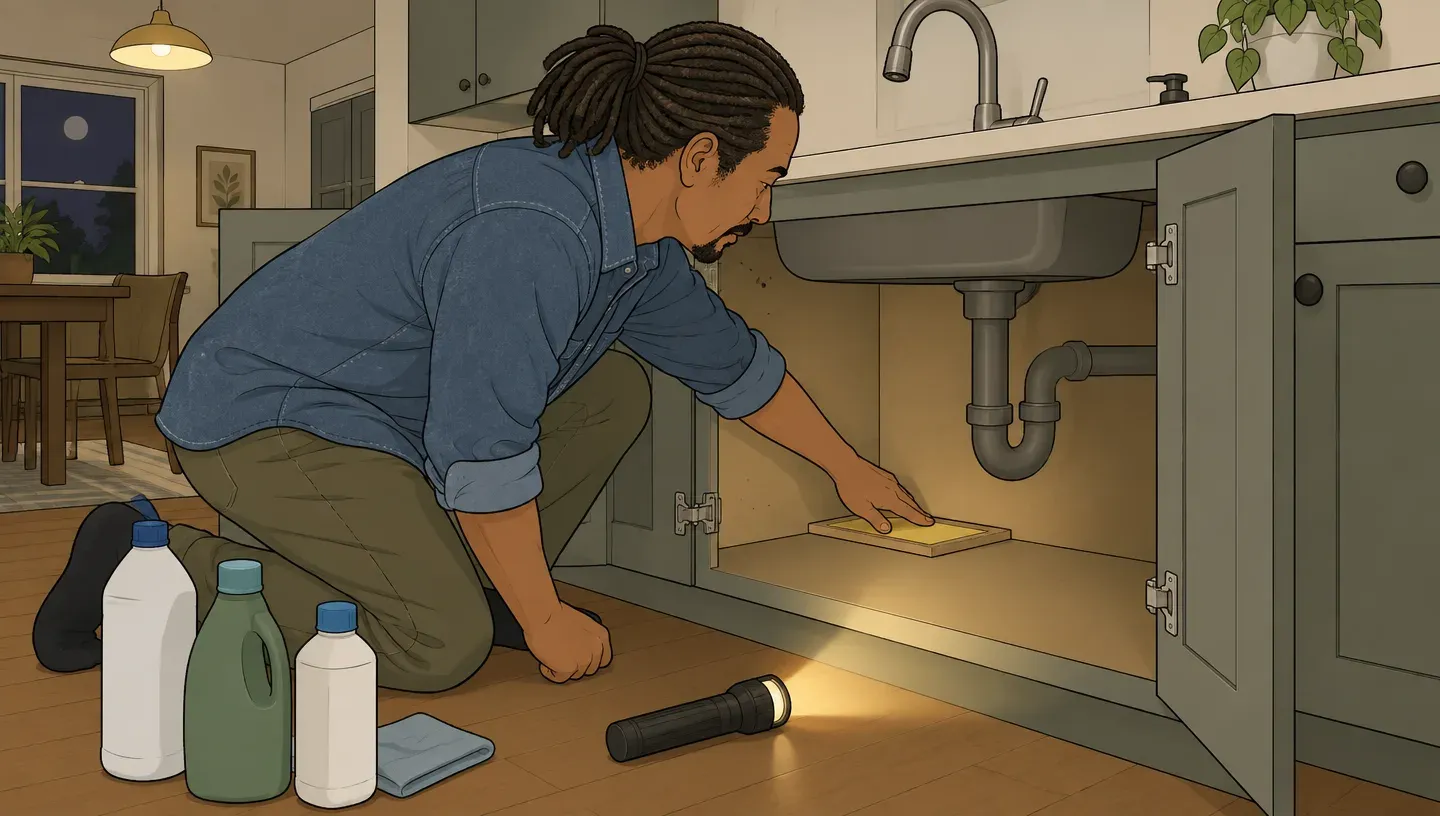
Illustration: a flat sticky trap pressed against the back wall of the cabinet under the sink, lit by a flashlight on the floor.
Roach traps catch roaches but rarely end an infestation on their own. Buy plain sticky traps, about $10 for 12, to find where roaches hide and to check whether your bait works. Lay them flat against walls under the sink and behind appliances, add beer-soaked bread, then bait beside the busiest ones. Skip sprays and bug bombs.
Cost: about $10–22 in supplies. Difficulty: moderate. Call a pro if your traps still catch roaches after two rounds of baiting, or roaches keep coming in from a neighboring apartment.
This guide compares the four kinds of roach traps, shows where to put them and how to read the catch, and covers kids, pets and big “water bugs.” We haven’t tested these traps ourselves. It rests on UC IPM, Rutgers, Purdue and other extension guidance, a 2006 trap study, and list prices.
Saw a roach tonight? One or a few adults usually means newcomers. Set a jar trap (below) or sticky traps under the sink with a bit of bread, seal up food and use a lidded trash can. Don’t spray.
Traps find roaches; insecticide bait, usually a gel, kills them. The full plan for getting rid of roaches covers both.
How We Compared These Traps
We rated each type of roach trap on five things:
- What it does: catches, kills or just shows where roaches are.
- Colony impact: whether it can wipe out a hidden population.
- Catch rate: from a 2006 lab study comparing traps and lures.
- Safety around kids and pets: glue, insecticide or neither.
- Cost per trap: list prices from October 2026.
Sources are listed at the end.
Which Roach Trap Type Works
It depends on the job: to find roaches and check progress, a sticky trap; to kill a colony, bait. One brand is shown as an example of each, not a ranking.
| Type | Example | What it does | Kills the colony? | Cost per trap |
|---|---|---|---|---|
| Sticky trap or glue board | Catchmaster glue boards | Catches roaches that walk in; best for monitoring | No, only the ones caught | About $0.30–0.90 |
| Glue trap with a food lure | Catchmaster lured roach traps | Same, with higher catches | No, only the ones caught | About $2 |
| Roach bait station | Combat bait stations | Holds insecticide bait; roaches eat it and die later | Can, slowly | About $0.80 |
| Homemade jar trap | A greased jar | Catches roaches in a jar; a free monitor | No | Free |
Per-trap costs come from the pack prices in the cost table below; the bait station figure is an 18-count Combat pack at about $14 (Target list price, October 2026), our math.
Do Roach Traps Work?
For finding roaches, yes. For wiping them out, usually not. UC IPM calls sticky traps and glue boards the best way to detect and monitor cockroaches: they show which rooms and cabinets are worst, so you know where to bait, and whether the bait is working.
Traps clear roaches only when there are very few and the traps are baited. They catch only roaches that walk in; the rest keep breeding in cracks and wall voids. A trap that fills up isn’t failing. It’s telling you where to bait.
Sticky Traps and Glue Boards: Best for Finding Roaches
Sticky traps and glue boards are the same thing: a cardboard strip coated with glue, sometimes scented, often folding into a small box. Buy plain glue boards from the pest aisle; a dab of bread does the job of a pre-baited lure.
Best for: monitoring every room, about $10 for 12.
Main limitation: catches only the roaches that walk across it.
Lured Glue Traps: More Catches, Higher Price
A lured trap is a glue board with a food attractant built in. In a 2006 lab study by Wang and Bennett, bread dampened with beer raised catches 34-fold over an empty trap, beating store-bought lures, so a plain board plus bread does the same job.
Best for: people who’d rather not add their own bait.
Main limitation: about $2 a trap, several times a plain board.
Roach Bait Stations: They Kill, Slowly
Roach bait traps aren’t really traps: they’re plastic stations with insecticide inside, and nothing gets caught. Purdue says they’re safer than gel bait around children and pets, but slower and pricier. For cracks out of reach, roach gel bait is the usual killer.
Best for: homes with kids or pets where gel would be in reach.
Main limitation: slow, and it can’t tell you whether it’s working; sticky traps do that.
How to Make a Homemade Roach Trap
A jar trap costs almost nothing: roaches climb in for the bait and can’t climb out.
Step 1: Choose a smooth glass jar. A pint jar works; so does a baby food jar.
Step 2: Grease the inside. Smear a 2-inch band of petroleum jelly around the inside of the rim, or dust the inside with talcum powder.
Step 3: Bait it. Use bread soaked in a little beer, a slice of apple or potato, or a banana peel, which UMaine calls the most attractive bait for German cockroaches.
Step 4: Stand it against a wall. Put it inside a cabinet or behind an appliance, out of reach of kids and pets. If nothing turns up in 2 to 3 days, move it, and empty catches into hot water.
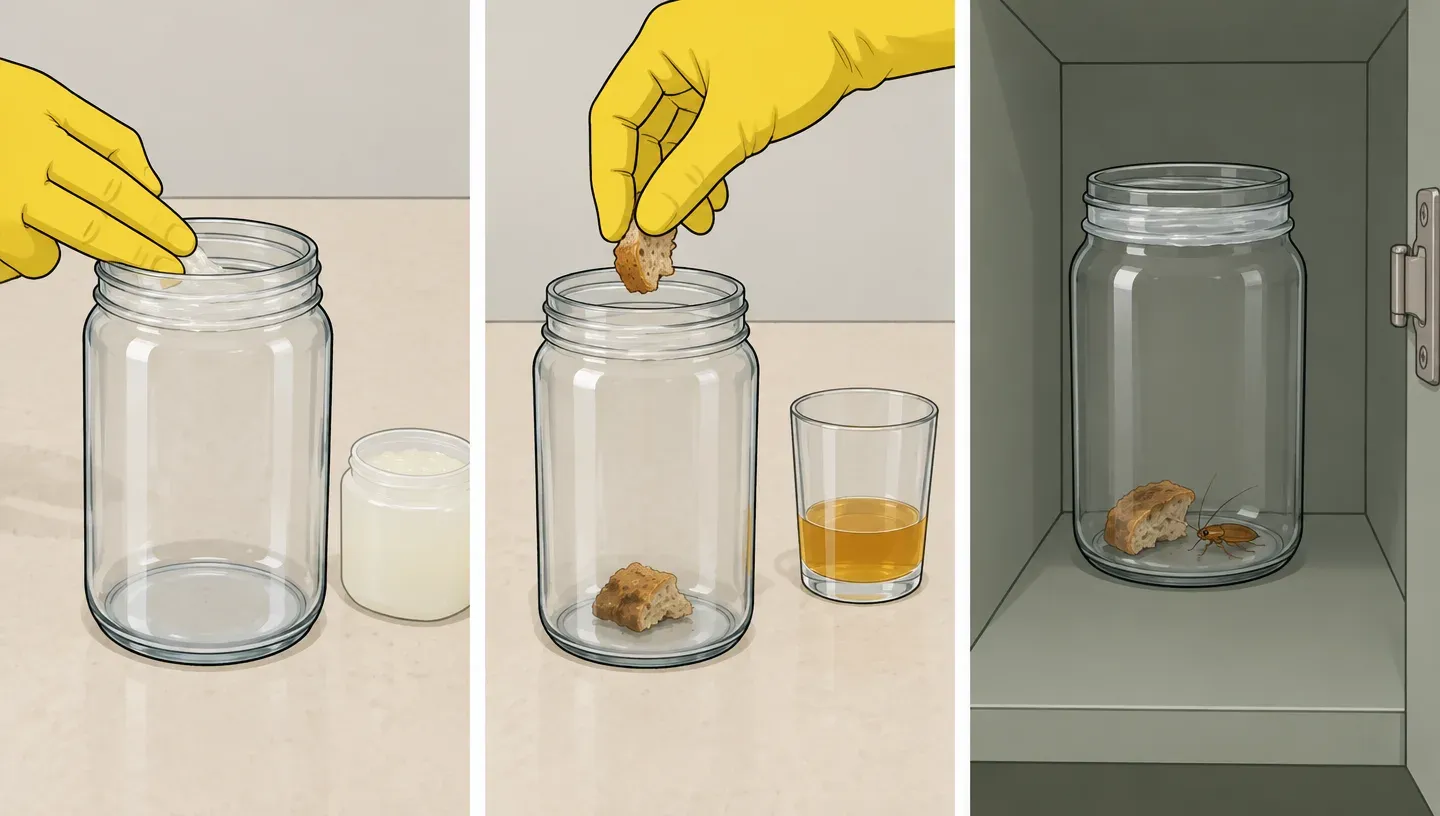
Illustration: petroleum jelly smeared inside the rim of a glass jar, a piece of bread dropped in, and the jar standing against the back wall of a cabinet.
Best for: tonight, before you can buy traps.
Main limitation: sticky traps catch more small babies, so keep a few out too.
How to Use Roach Traps
Roaches rarely cross open floor unless they’re heading for food, so a trap against the baseboard sits right in their path.
Step 1: Put traps along edges. Set them where floor meets wall: under the sink, behind the fridge and stove, by the trash can, behind the toilet and next to droppings or egg cases. Purdue suggests at least six traps in a home; number each one.
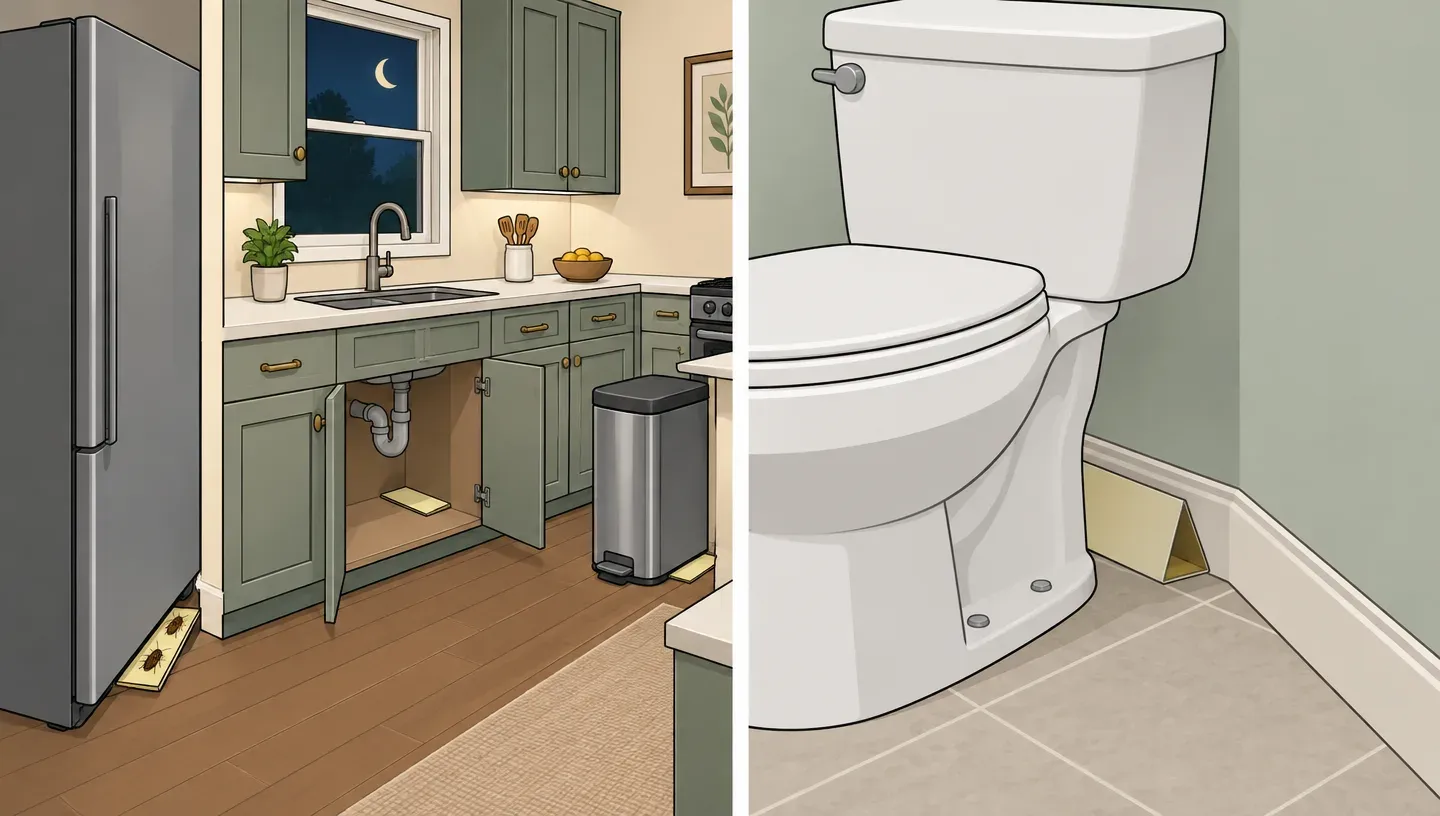
Illustration: sticky traps where the wall meets the floor behind the fridge, in the back corner under the sink and beside the trash can (left), and behind the toilet (right).
Step 2: Lay them flat, not tented. In the 2006 study, a flat trap caught significantly more roaches than the same trap folded into a tent. Models varied widely too: the best caught 36 to 78 times as many German cockroaches as the worst, so switch brands if one stays empty.
Step 3: Add bread and beer. Put a small piece of bread dampened with beer in the center of each trap, as Rutgers recommends. No beer? Peanut butter also raised catches.
Step 4: Count daily for a week. Write each trap’s count in a phone note; many catch roaches within 24 hours. One or a few adults usually means newcomers, while adults plus nymphs of every size mean an established infestation. More in the signs of a roach infestation.
Step 5: Bait near the two or three busiest traps. Bait may take 7 days or longer to cut the numbers, UC IPM says, so keep counting.
Step 6: Re-check every 2 to 4 weeks. Rutgers advises re-treating until traps stay empty for at least a month, then leaving a few out as an early warning.
Water Bug Traps for Big Roaches
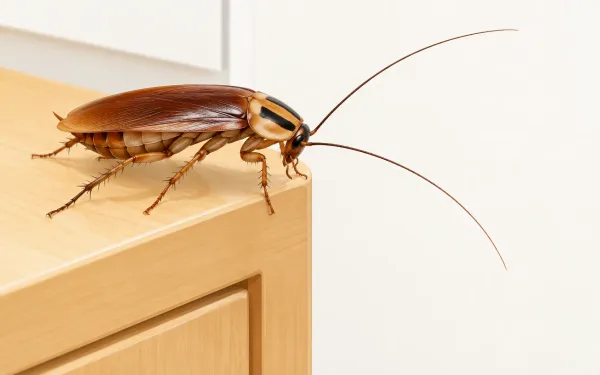
“Water bug” usually means a big roach: the oriental cockroach, or the American cockroach, about 1½ inches according to the University of Kentucky. German cockroaches, the usual kitchen roach, are 1/2 to 5/8 inch with two dark stripes behind the head. Big roaches usually live in basements, sewers or outdoors and wander in; compare a water bug vs. a cockroach.
Put traps near exterior doors, floor drains and the water heater. A few big adults now and then are visitors: traps won’t keep them out, but door sweeps, weather stripping and sealed cracks will.
Are Roach Traps Safe Around Kids and Pets?
Sticky traps contain no insecticide; the risk is getting stuck. Keep flat traps inside closed cabinets and behind appliances, and fold any trap that has to sit in the open. If a pet or a child’s hand gets stuck, don’t rip it off: massage kitchen, baby or mineral oil into the glue around the edges until it slides free.
Bait is where the insecticide is. If a child gets into bait, call Poison Control at 1-800-222-1222; for a pet, call your vet.
Which Trap Fits Your Situation
| Situation | What to use | Why |
|---|---|---|
| Saw one roach, want to know more | 6+ sticky traps with bread, counted daily | Shows whether it’s a visitor or an infestation. |
| Traps filling up in the kitchen | Gel bait near the busiest traps | Traps find roaches; bait kills the colony. |
| Kids or pets at home | Traps in closed cabinets, bait stations | Glue and gel stay out of reach. |
| Big roaches near drains or doors | Traps by doors and drains, plus door sweeps | They’re visitors; sealing keeps them out. |
| You rent | Sticky traps, plus a written note with photos | Catch counts back up a request to the landlord. |
| No money for traps tonight | Homemade jar trap | A jar, petroleum jelly and bread you already have. |
What It Might Still Cost
| Item | Price |
|---|---|
| 12 insect glue boards, no lure | $10.49 |
| 10 cockroach glue traps with a food lure | $19.99 |
| 25 monitor boards (tear into 75 small traps) | $21.99 |
| Homemade jar trap | A jar, petroleum jelly and bread you already have |
| Pro cockroach visit, 25 shared quotes (middle half) | $200–$400 |
| Pro cockroach treatment, price-guide range | $100–$600 a round |
| Pro full treatment with follow-ups, 10 shared quotes (middle half) | $450–$1,500 |
DIY: list prices from Catchmaster and HomeandGardenSupply, October 1, 2026, before tax and shipping. Pro: the middle half of 25 single-visit and 10 full-treatment quotes homeowners shared on Reddit. Price-guide range and annual plans: This Old House (March 2026). The full DIY kit, with the 25 monitor boards, gel bait (about $27) and caulk (about $5), runs about $54. If you hire someone, keep your trap log: counts before and after show whether the treatment worked.
Before You Set Traps: A Quick Checklist
- Buy plain glue boards, at least six for a home.
- Number each trap and lay it flat against a wall.
- Add beer-soaked bread to the center of each one.
- Count the catch daily for a week.
- Bait beside the busiest traps, not the whole house.
- Keep traps and bait inside cabinets if kids or pets roam.
- Re-check every 2 to 4 weeks until traps stay empty a month.
When Traps Aren’t Enough
If the counts don’t fall, bait the hot spots with pea-sized dabs of gel in nearby cracks, and skip sprays and bug bombs, which miss the cracks where roaches breed. Renting? Tell your landlord in writing, with photos of your trap catches. Call a pro if traps still catch roaches after two rounds of baiting, or roaches keep coming from next door.
Common questions
No. A trap catches roaches already in your home and walking past it. If catches stay high for weeks, the hiding spots near that trap haven’t been treated yet.
They don’t need to be. Roaches rarely cross open floor, so a trap in the open gets skipped. Refusing bait is a separate problem, covered in the plan for getting rid of German roaches.
The Bottom Line
Roach traps are a measuring tool, not a cure. Lay plain sticky traps flat along walls, add beer-soaked bread, count for a week, and put gel bait beside the busiest ones. Keep counting until the traps stay empty for a month.
Sources and further reading · 10
- UC IPM: Cockroaches (Pest Notes 7467)
- NC State Extension: German Cockroach Surveillance and Management
- Rutgers NJAES: German Cockroach (FS1322)
- Purdue Extension: A Practical Guide to Cockroach Control in Multi-Family Housing Units (E-241)
- University of Maine Cooperative Extension: Cockroaches (5011e)
- Wang, C. and Bennett, G.W. (2006), Comparison of Cockroach Traps and Attractants for Monitoring German Cockroaches, Environmental Entomology 35(3)
- University of Kentucky: Cockroach Elimination in Homes and Apartments (ENTFACT-614)
- Poison Control: Is Ant Bait Safe Around Children?
- University of Florida IFAS: German Cockroach (IN1190)
- This Old House: Roach Exterminator Cost