Drain Flies vs. Fruit Flies: How to Tell Them Apart
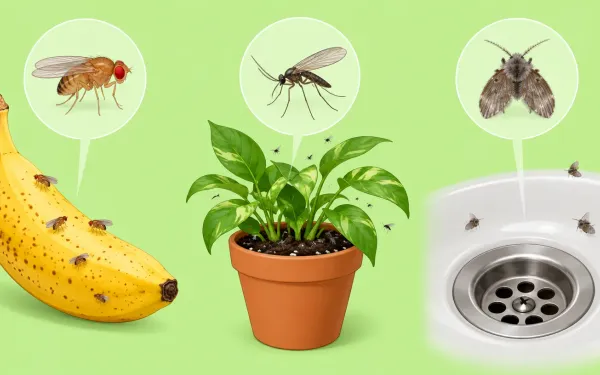
Drain flies are fuzzy, gray and moth-like, with wings held like a little roof. They sit on bathroom walls and breed in the slime inside drains. Fruit flies are tan with red eyes, and they hover around ripe fruit, trash and recycling. Both are about 1/8 inch long, so look at where they gather first. Then confirm the source with one overnight test, because fruit flies can breed in drains too.
Difficulty: easy. Call a pro if every drain is scrubbed and the tape still catches flies after two weeks, or flies come up through floor cracks, loose tiles or a sewer backup; that’s usually a job for a plumber.
A third look-alike, the fungus gnat, hangs around houseplants. All three are below with real photos, plus how to confirm which one you have and what to do about each.
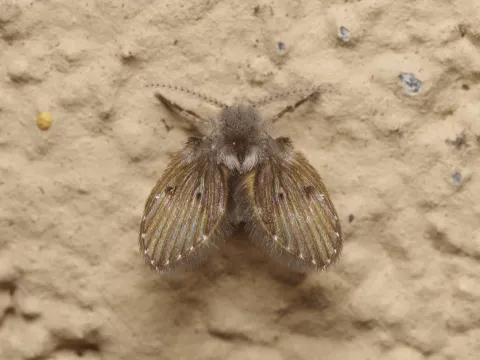 HarmlessDrain flyFuzzy, moth-like; rests on walls.
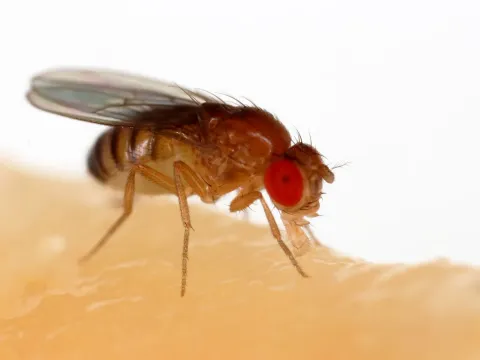 HarmlessFruit flyTan, red eyes; around fruit.
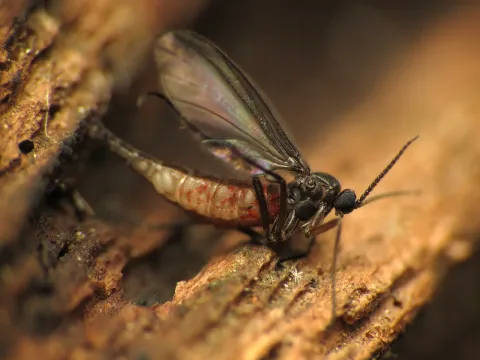 HarmlessFungus gnatDark, long legs; near houseplants.
Drain Flies vs. Fruit Flies vs. Fungus Gnats
| Drain fly | Fruit fly | Fungus gnat | |
|---|---|---|---|
| Looks | Fuzzy, moth-like, dark gray; wings held like a roof | Tan front, black rear, usually red eyes | Slender and dark, with long legs and antennae |
| Size | 1/16 to 1/4 inch | About 1/8 inch | 1/16 to 1/8 inch |
| Where you see it | Resting on bathroom walls and ceilings | Hovering over fruit, trash, wine and recycling | On houseplants, soil and windows |
| Where it breeds | Slime inside drains; any water that sits a week or more | Ripe or fermenting produce; also drains, disposals, bottles, mops and rags | Wet potting soil, compost and mulch; sometimes drains |
| Larvae | Legless, about 3/8 inch, pale in the middle and dark at the ends | Tiny, in the surface of fermenting food | Clear to whitish and legless, with a shiny black head |
Sources: University of Kentucky (drain flies, fruit flies), University of Maryland Extension (drain fly size; fungus gnats in drains), Texas A&M AgriLife (drain fly larvae), UC IPM (fungus gnats).
Fruit flies go from egg to adult in about a week, drain flies in about 10 to 15 days at 70°F (University of Kentucky), so a missed source shows up again fast.
None of the three bites people; see do gnats bite for the outdoor gnats that do. Phorid flies, which run instead of flying, also turn up in kitchens; see how to get rid of gnats.
A Closer Look at Each Fly
Drain flies (also called moth flies, sewer flies or drain gnats) look like tiny moths:
- Fuzzy: the body and wings are covered in fine hairs.
- Roof-shaped wings: held over the body at rest, so the fly looks like a little heart or leaf.
- Dark gray to black, 1/16 to 1/4 inch (University of Maryland Extension).
- Still most of the time: they rest on walls or ceilings and make short, hopping flights if disturbed (University of Kentucky).
A fruit fly is smooth, not fuzzy, with a tan body and usually red eyes (University of Kentucky). If you can see red eyes, it isn’t a drain fly. More drain fly photos are in the Pest Library.
How to Confirm the Source Overnight
Where you see the flies is a clue, not proof: fruit flies also breed in drains, garbage disposals, mops and cleaning rags (University of Kentucky), and fungus gnats can breed in drains with moist debris (University of Maryland Extension). Test each suspect spot:
- Drains: tape. Lay a strip of tape across each drain without covering it completely, so air still flows (Texas A&M AgriLife). Flies stuck to it in the morning mean that drain is breeding them. An upside-down clear cup with a light coat of vegetable oil inside works too (University of Kentucky).
- Look at what’s on the tape. Fuzzy, moth-like flies are drain flies. Tan flies with red eyes are fruit flies breeding in the drain.
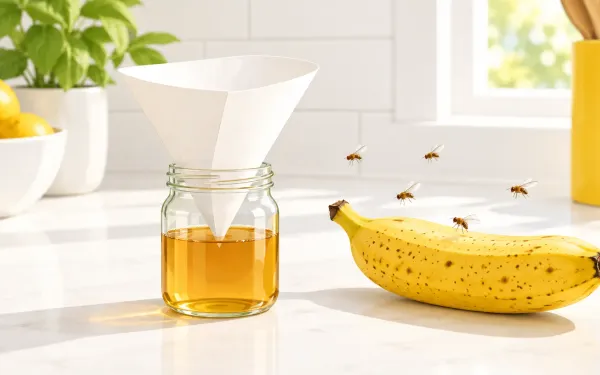
- Fruit and trash: a vinegar jar. Bait a jar with a few ounces of cider vinegar and put a paper funnel in the top (University of Kentucky). A jar full of red-eyed flies points to fruit, trash or recycling nearby. The drain fly fact sheets we read use tape or an oiled cup, not vinegar.
- Houseplants: a potato chunk. Push a chunk of raw potato, cut side down, into the soil (UC IPM). After a few days, tiny clear larvae with black heads under it mean fungus gnats.
How to Get Rid of Each One
Drain flies: scrub the slime out of the drain with a stiff, long-handled brush, then flush with boiling water. Texas A&M AgriLife says chlorine bleach or ammonia adds no benefit. Step by step: how to get rid of drain flies. Bleach, vinegar and other pour-down remedies are compared in drain fly home remedies.
Fruit flies: throw out overripe produce, rinse bottles and cans, empty the recycling and let mops and rags dry. Then trap the adults that are left with the vinegar jar. Full plan: how to get rid of fruit flies.
Fungus gnats: let the potting soil dry out between waterings; the larvae don’t survive in dry conditions (Texas A&M AgriLife). Full plan: how to get rid of fungus gnats.
Skip the bug spray for all three: it only kills the adults, and new ones keep coming from wherever they’re breeding.
Common questions
No. They’re different families of small flies. Drain flies are fuzzy and moth-like and breed in drain slime; fruit flies are smooth, tan and red-eyed and breed in fermenting food (University of Kentucky). The same fix rarely clears both.
Yes. The University of Kentucky lists drains and garbage disposals among fruit fly breeding sites. Tape over the drain catches either kind, so check whether the flies on it are fuzzy (drain flies) or red-eyed (fruit flies).
They breed in different places, so two sources are likely: a slimy drain and ripe fruit or a dirty bin, for example. Clear each one; a fruit fly trap won’t touch a drain that’s breeding drain flies.
No. The University of Kentucky calls drain flies non-biting, and the small flies in your kitchen and bathroom don’t bite people. More in do gnats bite.
Sources and further reading · 6
- University of Kentucky: Drain Flies or Moth Flies (EF615): non-biting, resting on walls, short hopping flights, where they breed, life cycle, oiled cup.
- University of Kentucky: Fruit Flies (EF621): size, color, red eyes, breeding sites including drains and mops, life cycle, cider vinegar trap.
- University of Maryland Extension: Drain Flies: drain fly size.
- University of Maryland Extension: Fungus Gnats: fungus gnats breeding in drains.
- Texas A&M AgriLife Extension: Drain Flies (E-184): larvae, tape test, brush and boiling water, no benefit from bleach or ammonia, fungus gnat larvae and dry soil.
- UC IPM: Fungus Gnats: adult and larva description, size, weak fliers, breeding sites, potato test.