Hornet vs. Wasp: How to Tell Them Apart (Plus Black and Red Wasps)
All hornets are wasps. In North America, though, only one true hornet lives here: the European hornet, an introduced species (Penn State Extension). The well-known “bald-faced hornet” is actually a yellowjacket (Penn State).
Difficulty: easy. Call a pro if the nest is a large gray paper ball, sits inside a wall, attic or the ground near where people walk, needs a ladder to reach, or anyone in the house is allergic to stings.
So the useful question is which wasp you have. Size, color and the nest answer it. That tells you how risky it is: paper wasps are not very aggressive, while hornets and yellowjackets defend their nests hard (University of Kentucky). The chart below covers eight common types, including the black and red wasps people ask about most.
In this guide:
- Hornet vs. Wasp at a Glance
- Hornets: European Hornet and Bald-Faced Hornet
- Paper Wasps, Including Red Wasps
- Black Wasps
- Other Types of Wasps
- Stings: Which Are Most Dangerous?
Hornet vs. Wasp at a Glance
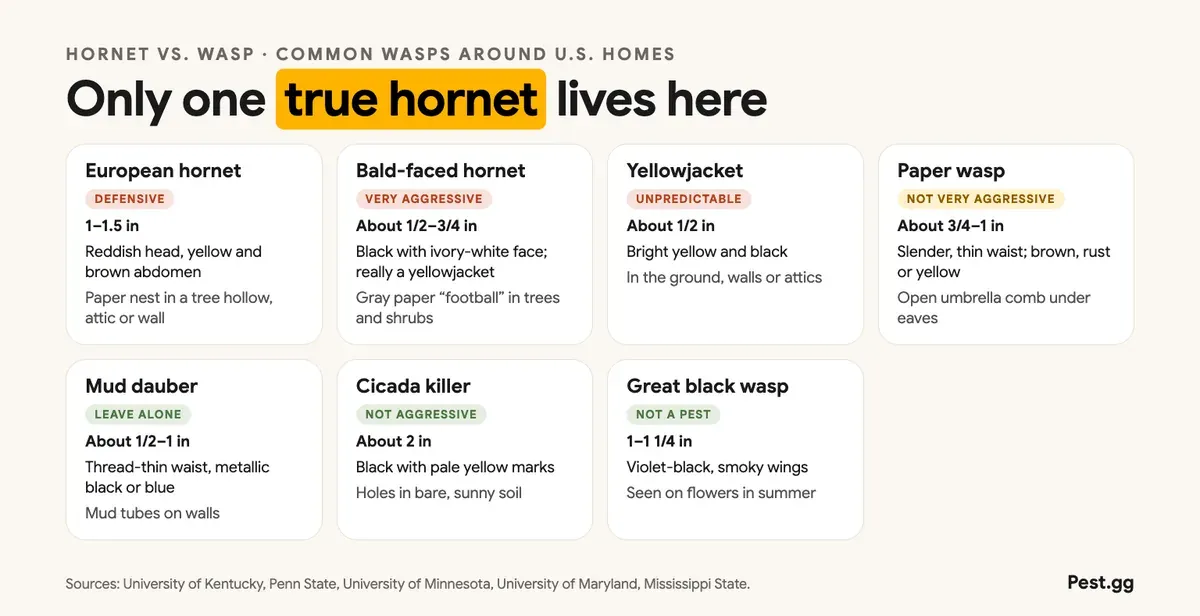
Infographic: the common wasps around U.S. homes, by size and nest. Sources: University of Kentucky, Penn State, University of Minnesota, University of Maryland.
| Wasp | Size | Looks | Nest | Temper near the nest |
|---|---|---|---|---|
| European hornet | 1–1.5 in | Reddish head, yellow and brown abdomen | Paper, in a tree hollow, attic or wall | Defensive (Univ. of Kentucky) |
| Bald-faced hornet | 13–20 mm (about 1/2–3/4 in) | Black with ivory-white face and marks | Gray paper “football” in trees and shrubs | Very aggressive (Univ. of Kentucky) |
| Yellowjacket | About 1/2 in | Bright yellow and black, stocky | In the ground, walls, attics | Unpredictable (Univ. of Kentucky) |
| Paper wasp | About 3/4–1 in | Slender, thin waist, brown, rust or yellow | Open umbrella-shaped comb under eaves | Not very aggressive (Univ. of Kentucky) |
| Mud dauber | About 1/2–1 in | Thread-thin waist, often metallic black or blue | Mud cells or tubes on walls | Leave alone unless in the way (Univ. of Maryland) |
| Cicada killer | About 2 in | Black with pale yellow marks | Holes in bare, sunny soil | Not aggressive (Univ. of Maryland) |
| Great black wasp | 1–1 1/4 in | Violet-black with smoky wings | Seen on flowers, July to September | Not a pest to people (Univ. of Minnesota) |
Sizes: University of Kentucky, Penn State, University of Minnesota, University of Maryland and our Pest Library pages.
Hornets: European Hornet and Bald-Faced Hornet
European hornet. The only true hornet in North America (Penn State). Workers are about 1 inch long and queens about 1.5 inches, with a dark red head and thorax, a yellow abdomen with dark brown marks and brown-tinted wings (University of Kentucky). They usually nest in tree hollows, sometimes in walls or attics. In fall they may strip bark from lilacs and birches to get at the sap (University of Kentucky). See European hornet.
Bald-faced hornet. Black with ivory-white markings on the face, thorax, legs and abdomen, 13 to 20 mm long (Penn State). It builds the large gray, football-shaped paper nest you see in trees and shrubs, sometimes under eaves. Penn State says these nests can reach 24 inches tall. The University of Kentucky says hornet nests may hold hundreds of wasps that are extremely aggressive when disturbed. See bald-faced hornet.
Is it a murder hornet? Almost certainly not. The northern giant hornet has only been found in the Pacific Northwest in North America. It is a half inch to an inch bigger than a European hornet, and its head is a uniform yellow-orange instead of red on top (University of Kentucky).
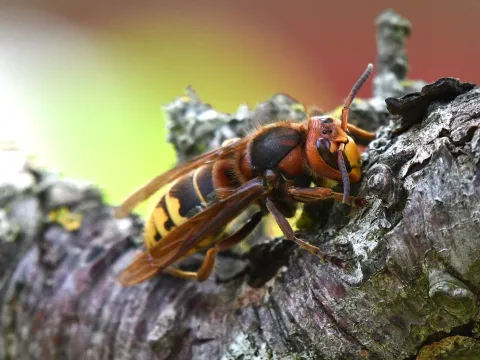 StingsEuropean hornetAbout 1–1.5 inches; the only true hornet here.
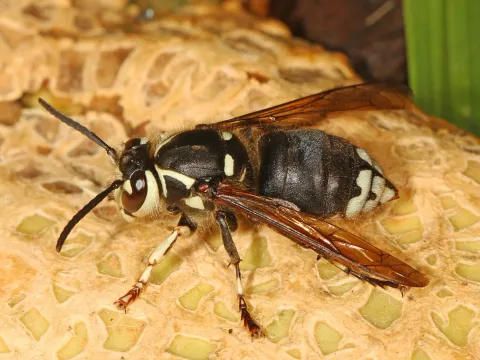 StingsBald-faced hornetBlack and white; really a yellowjacket.
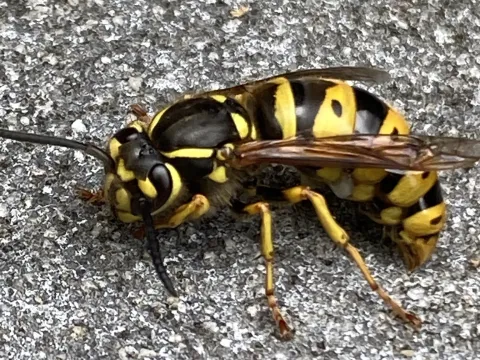 StingsYellowjacketAbout 1/2 inch; nests in the ground.
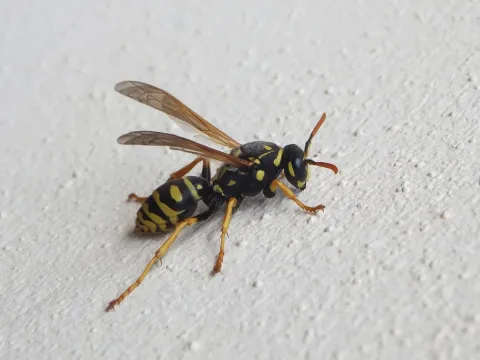 Paper waspSlender, thin waist; open comb.
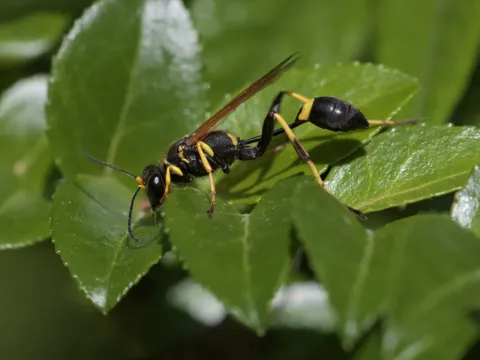 Mud dauberThread-thin waist; mud nests.
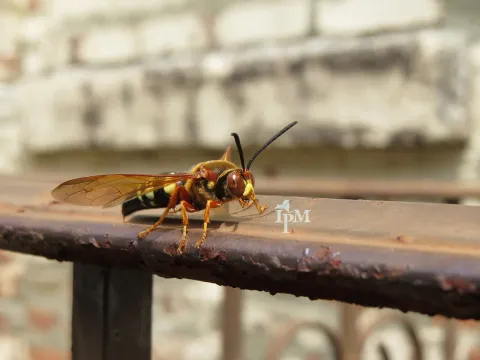 Not aggressiveCicada killerAbout 2 inches; holes in bare soil.
Paper Wasps, Including Red Wasps
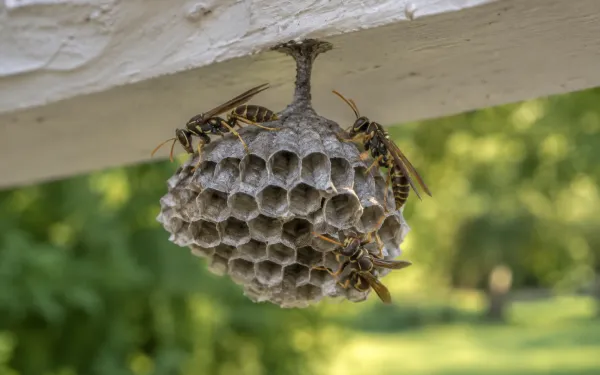
Paper wasps have a very thin waist, which sets them apart from hornets and yellowjackets (University of Kentucky). Most are brown or rust-colored. The European paper wasp is yellow and black, like a yellowjacket. They build open, umbrella-shaped nests under eaves, gutters and ledges, and inside grills, mailboxes and porch lights (University of Kentucky).
Red wasps. Rust-red wasps around eaves in the eastern U.S. are usually paper wasps. The University of Florida names Polistes carolina and Polistes perplexus as the only mostly rust-colored paper wasps in the eastern states, and suggests “red wasp” as a common name. They range from New York and Ohio south to Florida and west to Texas (University of Florida).
How risky they are depends on the species. Mississippi State says most paper wasps, including the ones it calls red wasps, usually sting only when the nest is seriously threatened. But the orange Carolina paper wasp is more aggressive: its guards may fly out to sting someone who walks within about 10 feet of the nest (Mississippi State).
Black Wasps
A “black wasp” is usually one of these:
- Great black wasp. Big, 1 to 1 1/4 inches, iridescent violet-black with smoky wings that shine violet (University of Minnesota). It visits flowers in midsummer. The University of Minnesota says it’s alarming because of its size but is not a pest to people.
- Mud daubers. Dark, often metallic black or blue, with a long, thin waist (University of Maryland). They build mud nests on walls and stock them with paralyzed spiders.
- Bald-faced hornet. Black, but with ivory-white marks on the face and body (Penn State). This is the one to be careful around.
Other Types of Wasps
Wasps around homes fall into two groups.
Social wasps live in colonies and defend the nest. Paper wasps, yellowjackets and hornets all build paper nests and can launch a group attack when the nest is threatened (University of Kentucky).
Solitary wasps don’t live in colonies. The common ones around homes:
- Mud daubers: knock down the nest if it’s in the way; otherwise leave them alone (University of Maryland).
- Cicada killers: about 2 inches, black with pale yellow marks, nesting in bare, sunny soil. The University of Maryland says they are not aggressive and usually won’t bother people.
- Great black wasps: see above.
Nest shapes for all of these are compared side by side on wasp nests.
Stings: Which Are Most Dangerous?
The University of Kentucky calls yellowjackets arguably the most dangerous stinging insects in the U.S. because they are unpredictable and usually sting if the nest is disturbed. Hornets are also far more dangerous to control than paper wasps. Unlike honey bees, hornets have a straight stinger, so each one can sting many times (University of Kentucky).
Most stings cause pain, itching, redness and swelling. The University of Kentucky says an ice pack and washing with soap and water help.
Call 911 for trouble breathing, swelling anywhere on the face or in the mouth, or throat tightness after a sting (MedlinePlus). The University of Kentucky lists breathing or swallowing trouble and swelling of the face, throat or mouth, along with hives, widespread itching, dizziness and a rapid pulse, as signs of a possibly life-threatening allergic reaction. It says to get medical help right away and not wait to see if symptoms go away. Not a medical diagnosis.
What to Do About a Nest
- Far from where people go? Leave it. In states with cold winters, colonies die off when the weather turns cold, and old nests aren’t reused (University of Kentucky).
- Small paper wasp nest you can reach from the ground? That’s often a DIY job. See how to remove a wasp nest.
- Hornet ball, ground nest, nest in a wall or up a ladder? The University of Kentucky says it’s often best to call a pro.
- Don’t pour gasoline on a nest or blast it with a hose. The University of Kentucky says these rarely work and can lead to many stings.
Common questions
The European hornet, about 1 to 1.5 inches, is bigger than yellowjackets and most paper wasps (University of Kentucky). But cicada killers, about 2 inches, are bigger still (University of Maryland). Size alone isn’t enough; check the color and the nest.
Than paper wasps, yes. The University of Kentucky says hornet nests may contain hundreds of wasps that are extremely aggressive when disturbed, while paper wasps are not very aggressive. Yellowjackets are the most unpredictable of all.
The bald-faced hornet is a yellowjacket, just black and white instead of yellow and black (Penn State). Yellowjackets usually nest in the ground or in walls; bald-faced hornets build hanging gray nests in trees and shrubs.
Yes, they can. The University of Florida says paper wasps defend the nest with painful stings, but are not aggressive and usually sting only when the nest is disturbed. The orange Carolina paper wasp is more aggressive (Mississippi State).
Sources and further reading · 8
- University of Kentucky: Controlling Wasps, Hornets and Yellowjackets (EF620): paper wasps vs. hornets and yellowjackets, nests, temper, removal, sting first aid and allergy signs.
- University of Kentucky: European Hornets (EF600): size, colors, nests, stinger, bark stripping, northern giant hornet.
- Penn State Extension: Baldfaced Hornet: not a true hornet, only true hornet in North America, size, markings, nest size.
- University of Florida: Paper Wasp, Red Wasp (EENY640): rust-colored paper wasps, range, stings.
- Mississippi State University Extension: Carolina Paper Wasp: red wasps vs. the more aggressive Carolina paper wasp.
- University of Minnesota Extension: Great Black Wasp: size, color, not a pest to people.
- MedlinePlus: Insect Bites and Stings: when to call 911.
- University of Maryland Extension: Mud Daubers and Cicada Killer Wasps.