Tick Bites: What They Look Like and How to Remove a Tick
Most tick bites are harmless (MedlinePlus), but you may not feel one, and the tick can stay attached for several days. If you find one, remove it right away: grip it with fine-tipped tweezers as close to the skin as you can and pull straight up with steady, even pressure. Then clean the spot and watch it, and how you feel, for the next 30 days.
Difficulty: easy. Call a pro if you keep finding ticks on people or pets after mowing, clearing leaf litter and treating pets.
Below are real photos, the removal steps, what a Lyme disease rash looks like according to MedlinePlus, and the symptoms that mean you should call a doctor. This page can’t diagnose a bite.
How to Remove a Tick
MedlinePlus and the University of Kentucky give the same steps:
- Grip it at the skin. Use fine-tipped tweezers or a tick removal device, and grab the tick as close to the skin as possible. If you have no tweezers, MedlinePlus says gloved or protected fingers will do.
- Pull straight up with steady, even pressure. Don’t twist or jerk it, and don’t squeeze or crush its body, since its fluids may carry germs (MedlinePlus).
- Clean the bite and your hands with rubbing alcohol or soap and water.
Mouthparts left in the skin? Try to remove them; if they don’t come out easily, leave them (MedlinePlus). They usually work their way out on their own, though the spot can get infected.
Keep the tick in a sealed plastic bag with the date and where you were. The University of Kentucky says your local Cooperative Extension office can identify it.
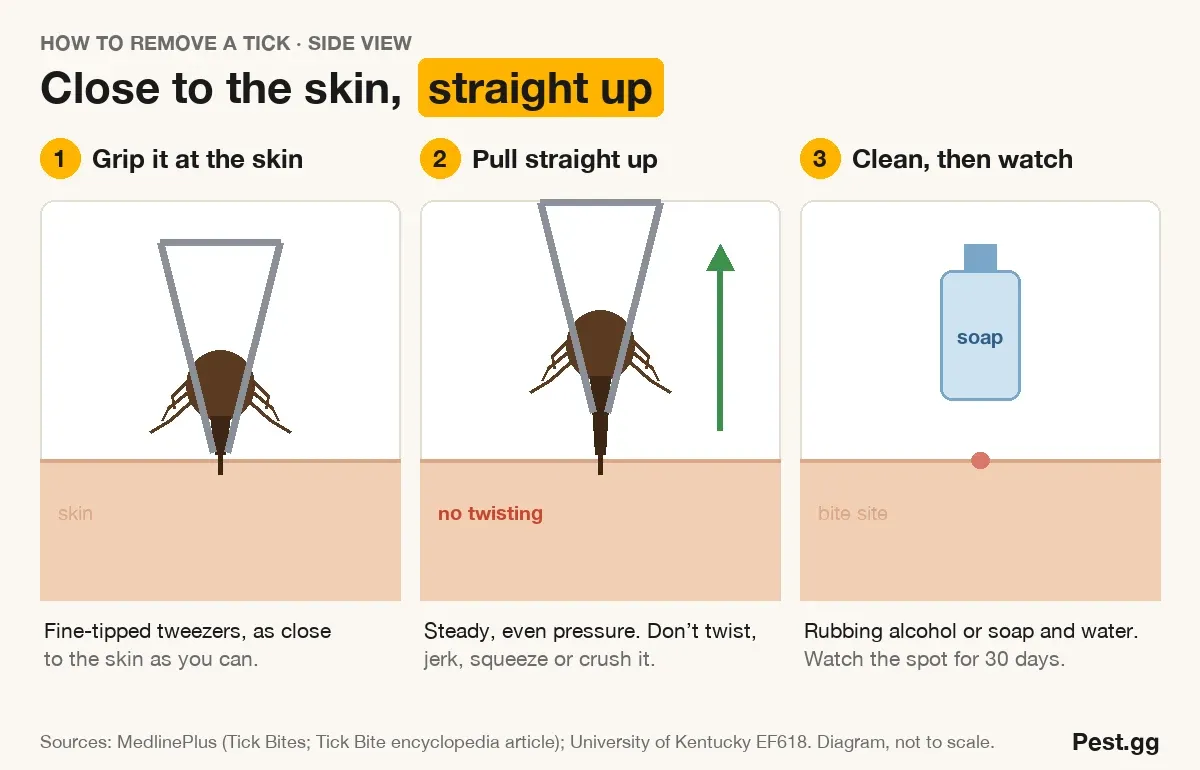
Diagram: removing a tick. Sources: MedlinePlus, University of Kentucky.
Why Speed Matters
An infected tick passes germs once it starts feeding, and catching it before it has filled up on blood makes infection less likely (MedlinePlus). Lyme disease takes a while: a tick usually has to be attached for 2 to 3 days before it transmits Lyme (MedlinePlus); the University of Kentucky puts it at about 36 hours of feeding for the blacklegged tick. Other infections can pass sooner (MedlinePlus).
What Does a Tick Bite Look Like?
Often you find the tick itself, still attached. Ticks range from about the size of a pencil eraser to so small they’re almost impossible to see, and once on you they tend to move to warm, moist places like the armpits, groin and hair (MedlinePlus). Check behind the ears, the neck, the legs and around the waist too (University of Kentucky).
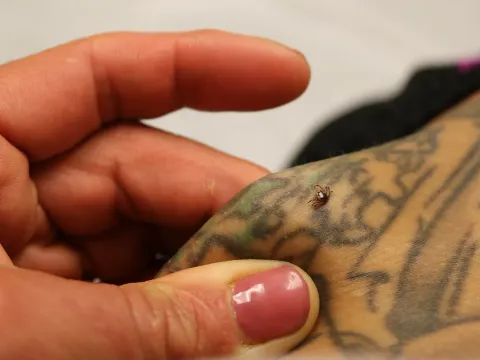 Still attachedOften you find the tick itself.
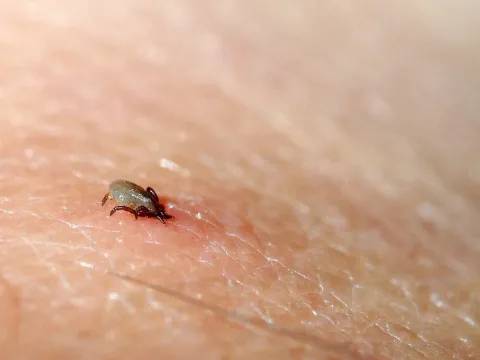 Tiny and easy to missYoung ticks are very small.
MedlinePlus lists these effects of the bite itself, some only from certain kinds of ticks:
- a rash or blisters;
- swelling at the site;
- severe pain at the site that lasts several weeks.
What a Lyme Disease Rash Looks Like
MedlinePlus describes the Lyme disease rash, called erythema migrans, this way:
- It starts 3 to 30 days after an infected tick’s bite, at the site of the bite.
- It’s a flat or slightly raised red spot that gets bigger over several days and may feel warm. It’s usually not painful or itchy.
- There’s often a clear area in the center, and as it starts to fade, parts of it can make it look like a bull’s-eye.
A rash like this is a reason to call your health care provider right away, not something to diagnose yourself; MedlinePlus says to watch the bite site for up to 30 days after removing a tick.
Which Tick Was It?
The tick matters, because not every tick carries every disease. A lone star tick, for example, can’t transmit Lyme disease (University of Kentucky). Compare yours with the Library pages:
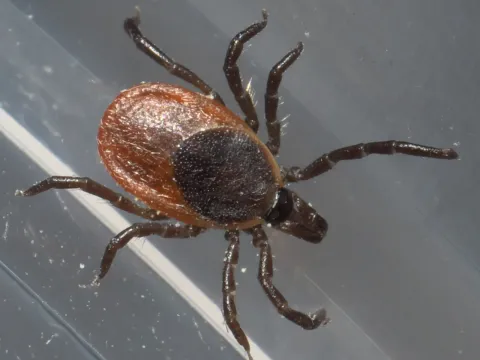
- Blacklegged (deer) tick: black legs, dark shield.
- Lone star tick: one white spot on the female’s back.
- American dog tick: large, with a mottled white pattern.
When to Get Medical Help
Call 911 for trouble breathing, wheezing or shortness of breath, swelling anywhere on the face or in the mouth, throat tightness or trouble swallowing, feeling weak, or turning blue (MedlinePlus).
Contact your health care provider:
- if you get a fever, chills, aches and pains or a rash within several weeks of removing a tick (MedlinePlus);
- right away if a rash develops at the bite site in the 30 days after (MedlinePlus);
- if you develop weakness, numbness, tingling or heart problems after a tick bite (MedlinePlus).
Tell the provider when and where you were bitten, and bring the tick if you kept it.
How to Prevent Tick Bites
From MedlinePlus and the University of Kentucky:
- Use repellent with DEET, picaridin or another EPA-registered ingredient; the EPA’s search tool helps you pick one.
- Treat clothing and gear with products containing 0.5% permethrin.
- Cover up: light-colored clothing, pant legs tucked into socks, shirt tucked into pants.
- Check often: in tick areas, check yourself and your children every 2 to 3 hours and again when you get home (University of Kentucky). Check pets daily.
- Wash and dry clothes at high temperatures after being outdoors.
Ticks in the yard? How to get rid of ticks covers mowing, clearing leaf litter and the barrier strip between lawn and woods.
Common questions
It can help. The University of Kentucky suggests sealing it in a plastic bag with the date and location; your local Cooperative Extension office can identify it, and it’s useful to show a doctor if you get sick.
No. Most tick bites are harmless (MedlinePlus), and only some ticks carry Lyme bacteria; the lone star tick can’t transmit it (University of Kentucky).
Try to remove the mouthparts with tweezers, but if they don’t come out easily, leave them. MedlinePlus says they usually come out on their own, though the spot can get infected.
Sources and further reading · 7
- MedlinePlus: Tick Bites: removal steps, mouthparts, when to contact a provider, prevention.
- MedlinePlus: Tick Bite (Medical Encyclopedia): where ticks attach, size, effects of the bite, not crushing the tick, watching for a rash for 30 days, 2 to 3 days for Lyme.
- MedlinePlus: Lyme Disease and Lyme Disease (Medical Encyclopedia): the erythema migrans rash, symptoms, when to contact a provider.
- MedlinePlus: Insect Bites and Stings: when to call 911.
- University of Kentucky: Ticks (EF618): removal, keeping the tick, identification, 36 hours for Lyme, lone star ticks and Lyme, checking every 2 to 3 hours.
- EPA: Find the Repellent That Is Right for You.
- Cover photos: deer tick and lone star tick on grass by xpda (CC BY-SA 4.0, CC BY-SA 4.0); lone star tick by James Gathany, CDC (public domain); via Wikimedia Commons.