If You See One Mouse, Are There More? How to Tell
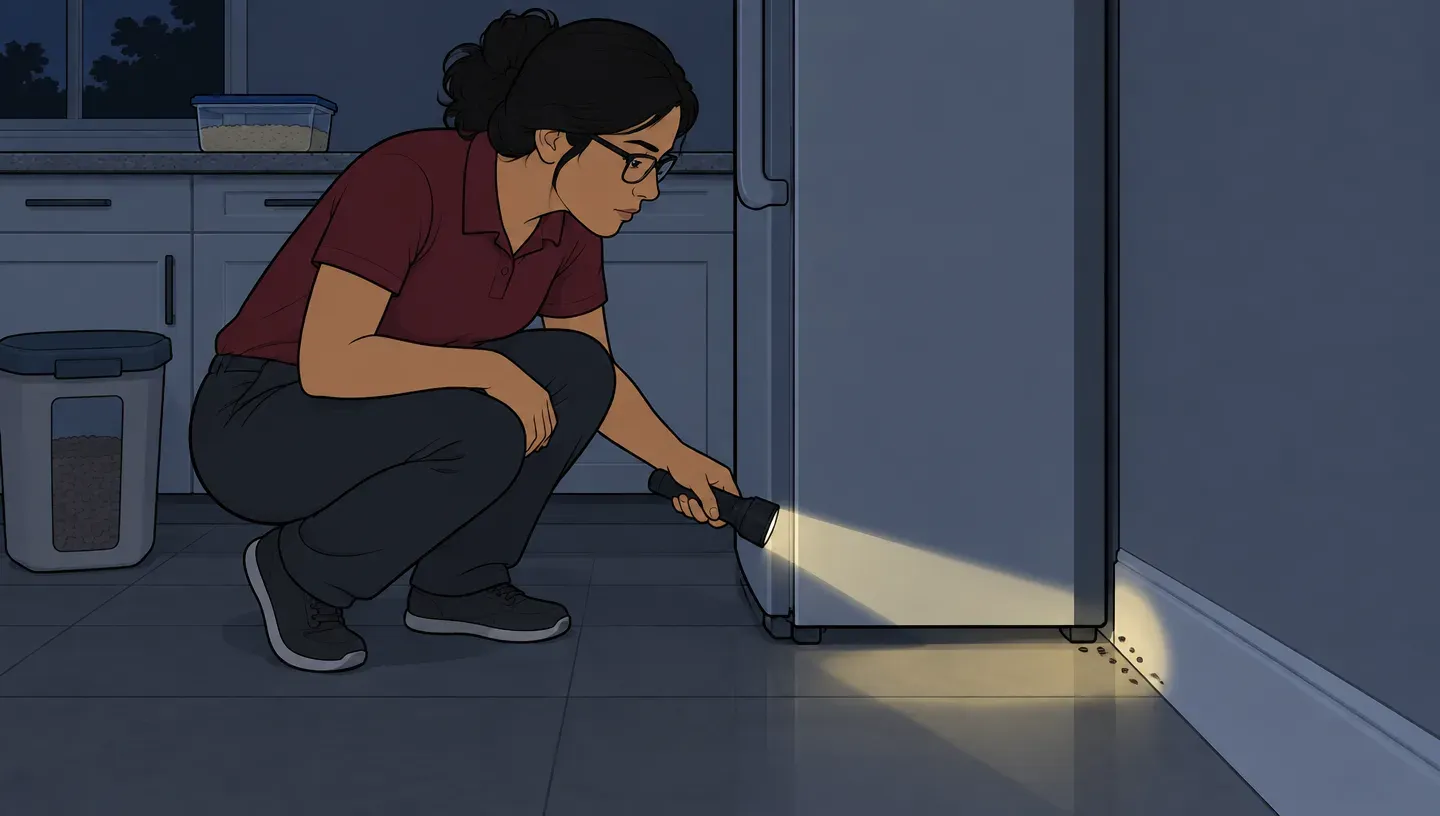
Illustration: checking behind the appliances for droppings with a flashlight.
If you see one mouse, are there more? Often, but not always. One mouse can wander in alone, but house mice live in family groups and breed fast, so it’s worth checking. Look for fresh droppings, set snap traps along the walls tonight, and keep trapping until a full week passes with no catches or new signs.
Cost: about $14–27 in supplies. Difficulty: moderate. Call a pro if you see rats in daylight or three or more at night, or fresh signs keep turning up after 15 days of steady trapping and re-baiting.
This guide covers how to tell one mouse from many, how many traps to set, and what changes if it was a rat. We haven’t tested this ourselves; it rests on CDC, UC IPM, Nebraska Extension and Internet Center for Wildlife Damage Management (ICWDM) guidance, plus store and cost-guide prices.
One Mouse or Many: What Your Signs Suggest
| What you find | What it suggests |
|---|---|
| One sighting; no droppings; clean flour patches | Possibly a lone newcomer. Still trap that room |
| Fresh droppings or tracks around one area | Mice living nearby, likely nesting within about 30 feet |
| Tracks in many patches; droppings in several rooms | Mice spread through the house. Plan on about two dozen traps |
| Musky smell, nests of shredded material, gnawing in many spots | A large or long-term infestation |
This is our reading of the extension guidance below, not a formula from any one source.
Does One Mouse Mean More Mice?
Sometimes it’s one, but often others are nearby. House mice living around people form family groups: one dominant male shares his territory with several females and their young.
A few can become many. In a single year a female can have 5 to 10 litters of about 5 or 6 pups each, and the young can breed 5 to 6 weeks after birth (UC IPM). That’s why it pays to trap now, even if it turns out to be one.
A daytime sighting doesn’t necessarily mean a large population; see when mice and rats are most active.
Do Mice Travel in Packs?
Not the way people picture it. Mice share a territory as a family, but they don’t move around together, and UC IPM says house mice seldom venture more than 30 feet from their nest and food.
So a mouse’s signs cluster near its nest. Fresh droppings in the kitchen and an upstairs bedroom on the same night are hard to explain with one mouse.
Is One Mouse Dangerous? Mostly Through What It Leaves Behind
The main risk is droppings, urine and nesting material. The CDC says rodent diseases mainly spread when people breathe in contaminated air, so never sweep or vacuum them; spray with disinfectant, let it soak 5 minutes and wipe up with paper towels, as in how to clean mouse droppings.
Worried about hantavirus? Nebraska Extension says house mice are not known to carry it, but advises care with all cleanup, since few people can tell which rodent they have.
With kids and pets, put traps behind the stove and refrigerator, not in the open. Skip poison, which the CDC warns can be dangerous for people and animals, and skip glue and live traps: they can scare a mouse into urinating, which raises your chance of getting sick. Don’t count on the cat either; cats and dogs rarely control mice.
How Many Mice Are in My House? 4 Ways to Tell
Look for fresh droppings. Clean up old ones so new ones stand out. Nebraska Extension says one house mouse leaves about 50 to 75 droppings a day, so a few dozen can still be one mouse; fresh droppings in several separate spots point to more.
Lay flour patches. A kitchen may need only two or three thin patches along the walls (the ICWDM suggests one every 20 to 30 feet). After 24 hours, more tracked patches and more tracks per patch mean more mice. Skip this where a toddler or pet will walk through it.
Use your nose. A musky odor is common in large or long-term infestations.
Let the traps count. Snap traps are the surest way to confirm mice; note each morning’s catches and where.
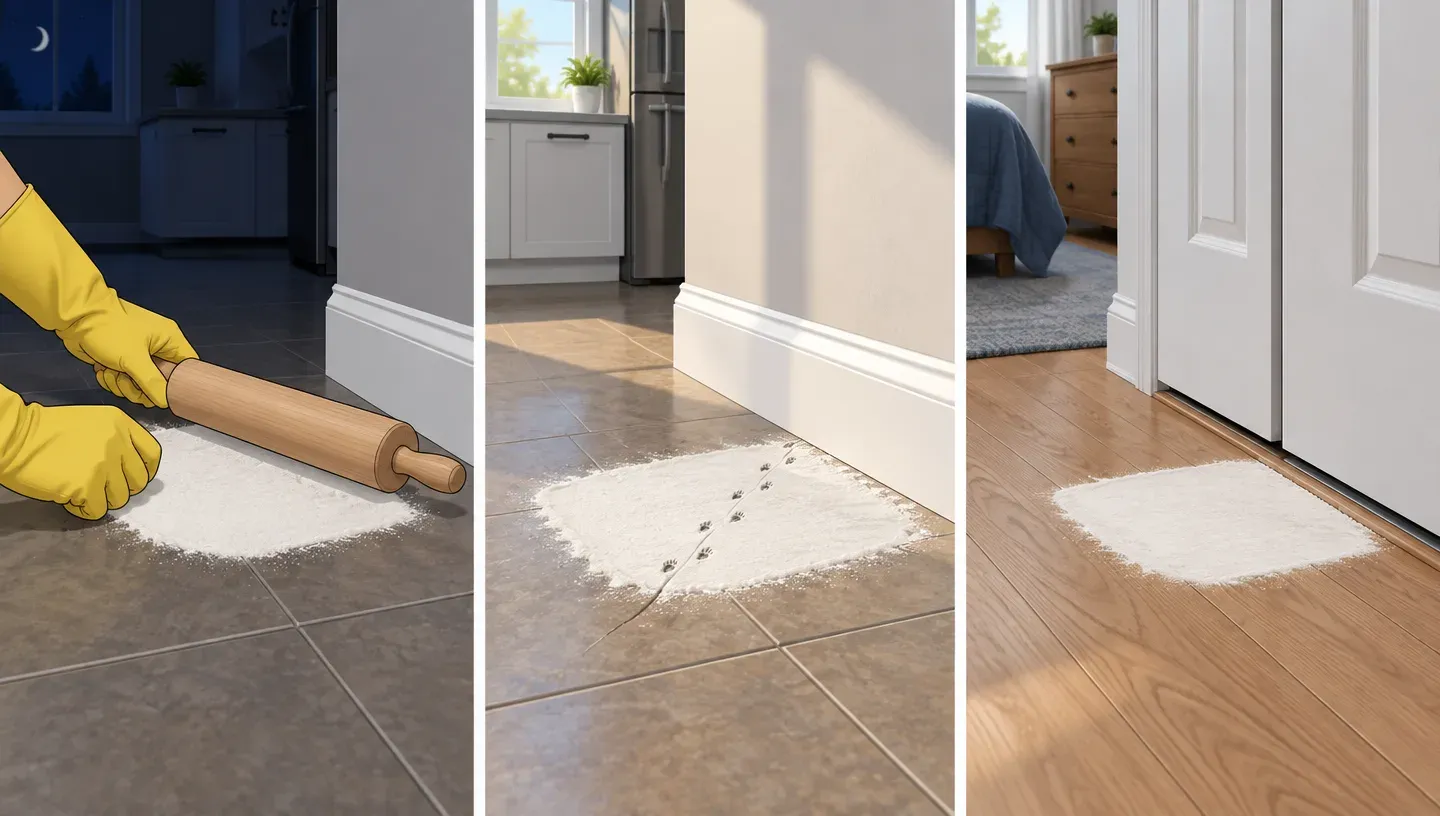
Illustration: flour patches laid at night (left) show tracks by morning in one spot (middle) but not in another room (right).
How Many Traps: About 12 for One Room, 24 for Several
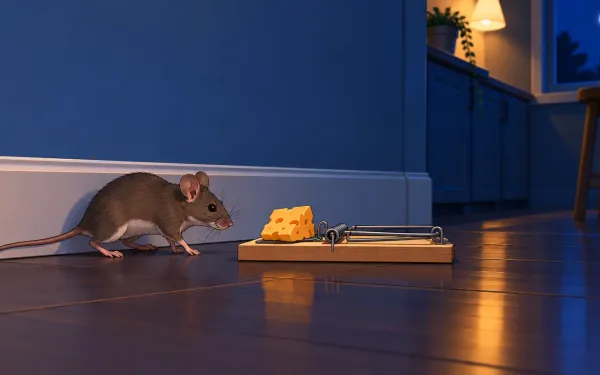
UC IPM says to use enough traps to make trapping “short and decisive,” spaced no more than about 10 feet apart where mice are active. Pairs set 1 to 2 inches apart, baited ends against the wall, catch mice that jump over obstacles. Even a long 30-foot wall takes only four pairs, so one 12-pack covers a kitchen (our math).
Signs in several rooms? Work up to about two dozen snap traps, Nebraska Extension’s rough guide for a new infestation in a 1,500-square-foot house. Bait with a small dab of peanut butter (chocolate if anyone has a peanut allergy); setup is in how to set a mouse trap.
Bait gone but no catch? Move the traps near fresh droppings; more fixes are in why mouse traps don’t work.
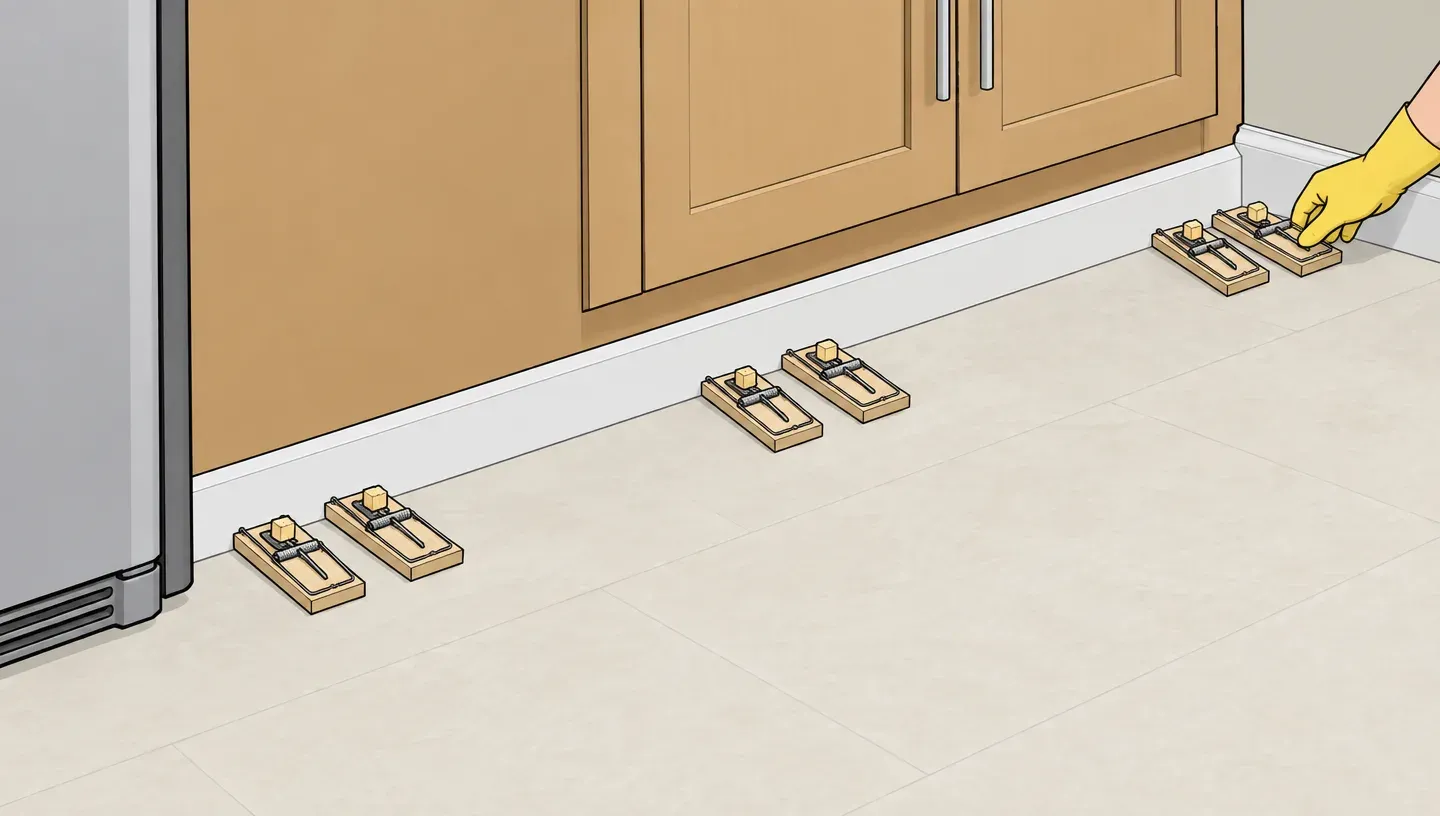
Illustration: pairs of traps along the wall every few feet, baited ends against the baseboard.
Caught One Mouse? Keep the Traps Out
One catch doesn’t mean you’re done. Reset the trap in the same spot, since others use the same runways, and dispose of the mouse with gloves and disinfectant (removing a dead mouse). Wear gloves to empty traps; mice may bite when handled.
No source gives a formula for how many more there are, so let the traps tell you. Keep them out for at least 15 days, check each morning, and stop only after a full week with no catches and no new droppings, urine spots or gnawing: the CDC’s test for when rodents are gone (not the 5-day mouse rule you may see online).
If catches stall after the first few, add new or disinfected traps: Nebraska Extension says female house mice avoid traps that have caught dominant males. Size is a clue too. Young mice start short trips out of the nest at about 3 weeks (ICWDM), so catching very small mice suggests a litter close by.
How Many Rats Live Together?
Saw a rat instead? The math changes. The ICWDM says rats are wary of people, “resulting in many more rats present than may be seen.” Its rules for telling how many rats are in your house:
| What you see | Likely numbers |
|---|---|
| No signs | None, or a few that arrived recently |
| Old droppings and gnawing; one or more rats at night; none by day | Moderate numbers |
| Fresh droppings, tracks and gnawing; three or more rats at night, or any by day | Large numbers |
In the wild, where food allows, a 2020 review in eLife describes colonies of more than 150 sharing one burrow system, and each female Norway rat has her own nest chamber for litters of 6 to 12. Rats are slow to approach traps, so bait them unset at first; the full plan is in getting rid of rats in your house.
What to Do Next
Trapping clears the mice inside; sealing stops the next one. The CDC says a mouse can fit through a hole the width of a pencil, about ¼ inch, so fill small holes with steel wool or copper mesh (which doesn’t rust). How mice get in shows where to look, and the full plan is in how to get rid of mice.
- Store food and pet food in containers with tight lids.
- Set a pair of snap traps against the wall where you saw it, out of reach of kids and pets.
- Check traps every morning and note where you catch.
- Keep trapping at least 15 days, until a week passes with nothing new.
- Seal gaps behind appliances, around pipes and around doors. Renting? Report it to your landlord in writing and ask before sealing.
| Item | Typical cost |
|---|---|
| 12 snap traps (enough to start in one room) | About $14 |
| 24 snap traps (signs in several rooms) | About $27 |
| Full kit for later: traps plus copper mesh for sealing, gloves and bleach for cleanup | About $57–71 |
| Pro inspection only | $100–$200 |
| Pro trap-and-seal job, 53 shared quotes (middle half) | $1,400–$3,000 |
| Pro visit, price-guide range (usually no sealing) | $150–$655 |
DIY: Victor list price ($2.29 per two-pack) plus DoMyOwn and Target list prices, September 30, 2026, before tax and shipping; trap totals are our math. Pro: the middle half of 53 trap-and-seal quotes homeowners shared on Reddit (see the quote table). Price-guide range: This Old House for mice (April 2026) and HomeAdvisor for rats (June 2026); it usually covers a trap-and-bait visit, with sealing extra. Inspection: HomeAdvisor (June 2026).
Call a pro for rats by day or signs that outlast 15 days of trapping, and for a heavy infestation, which the CDC says needs extra precautions to clean up.
Common questions
No agency sets a number. Fresh signs mean mice are living there; a week with no catches or new signs means they’re gone.
The ICWDM gives litters of 5 or 6 young, in nests of fibrous material usually 4 to 6 inches across, often near heat sources like water heaters.
Sources and further reading · 9
- ICWDM: House Mouse Biology, House Mouse Damage Identification, Norway Rat Biology and Norway Rat Damage Identification.
- ICWDM: House Mice, Prevention and Control of Wildlife Damage (PDF hosted by the State of Maine).
- UC IPM: House Mouse.
- Nebraska Extension: Controlling House Mice (G1105).
- Animal Diversity Web (University of Michigan): Mus musculus.
- CDC: Trap Up, Seal Up and Clean Up.
- EPA: Rodent Control, Module 5 (PDF).
- Schweinfurth, “The social life of Norway rats,” eLife (2020).
- Costs: snap trap list price, This Old House: Mice Exterminator Cost and HomeAdvisor: Rodent Removal Cost.