How to Get Rid of Rats: A Step-by-Step Plan for Your House
To get rid of rats, confirm the signs are from rats, seal every gap wider than about ½ inch with metal or mortar, set a dozen or more rat-size snap traps along the walls where you find droppings, and take away food and water. Skip poison, glue and ultrasonic gadgets. Stop after a week with no catches or fresh signs.
Cost: about $65–87 in supplies. Difficulty: moderate. Call a pro if you can’t safely reach or clear rats in the attic, walls or crawl space after trying the steps in section 6 yourself, or you still find fresh droppings after two weeks of trapping and sealing.
This plan covers the signs, the two kinds of house rat, sealing, trapping, clean-up and what it costs: about $65–87 in supplies if you do it yourself, against a $2,000 median across 53 pro trap-and-seal quotes homeowners shared on Reddit (see the quote table), or $189–$655 for trapping alone in price guides. We haven’t tested these methods ourselves; this rests on CDC, UC IPM, ICWDM and state health and extension guidance, plus store list prices.
Saw a rat tonight? Put food, pet food and garbage in closed containers, and don’t leave pet bowls out. Don’t sweep or vacuum any droppings. Buy rat-size snap traps tomorrow; sealing and clean-up can wait a day.
What Works and What Doesn’t Against Rats
Metal sealing plus snap traps clears rats; repellents, pets and poison don’t.
| Method | Works? | Cost | Main limitation |
|---|---|---|---|
| Rat-size snap traps with a wide trigger | Yes, the core of the plan | $3.59 each | Rats avoid new objects, so traps need a few days unset with bait first. |
| Steel wool, copper mesh, hardware cloth, mortar | Yes, stops new rats | $28.80 for 20 ft of copper mesh | Doesn’t remove the rats already inside, so trap the same week. |
| Removing food, water and shelter | Yes, as support | Containers you already have | Rats get by on about an ounce a day, so it won’t clear them alone. |
| Foam or caulk alone | No | — | Rats chew through plastic, foam, wood and caulk. |
| Glue traps and live traps | No | — | The CDC advises against both; a live rat must legally be euthanized or released where caught. |
| Poison bait | Last resort only | — | The CDC suggests bait stations only for infestations that persist; pets and wildlife can be poisoned. |
| Ultrasonic units and smells | No | — | UC IPM says rats quickly get used to ultrasonic sounds (our review). |
| A cat or dog | Rarely | n/a | UC IPM says pets rarely control a rodent population. |
1. Signs of Rats in Your House
Rats are mostly nocturnal, so you’ll find what they leave behind before you see one. Check baseboards, behind the stove and fridge, under the sink, and the garage and attic.
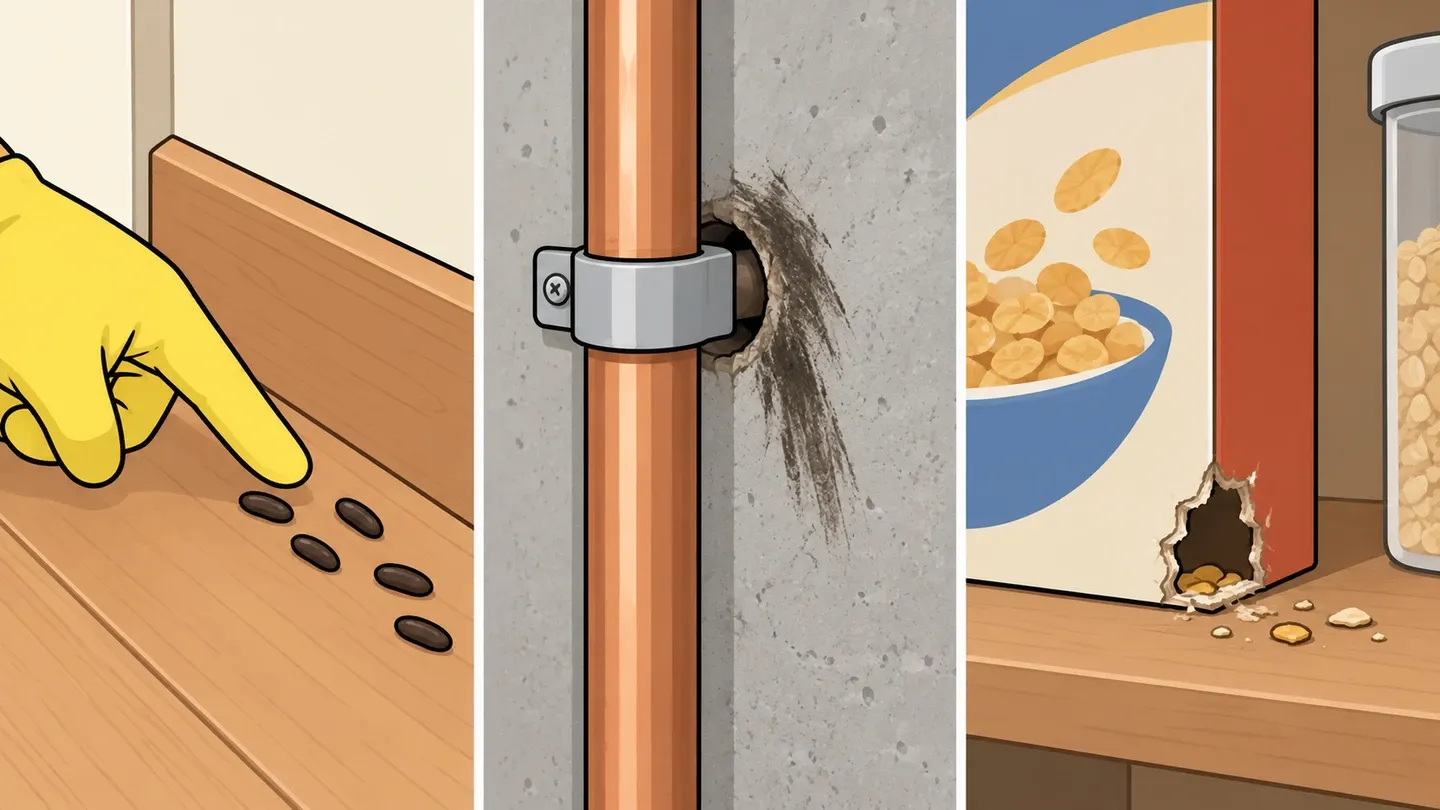
Illustration: droppings, a rub mark by a pipe hole and a gnawed cereal box.
| Sign | What to look for |
|---|---|
| Droppings | ½–¾ inch, dark. Mouse droppings are about ¼ inch |
| Rub marks | Greasy dark smears on walls, pipes and beams |
| Gnaw marks | Chewed doors, baseboards, packages, wiring |
| Noise | Scratching and gnawing after dark; could also be mice or squirrels |
Unsure? The New York State Department of Health suggests dusting flour along a suspected route and checking for tracks. Outdoors, look for burrows by the foundation or under a shed.
Droppings only about ¼ inch long are mouse droppings, not rat droppings; for those, follow how to get rid of mice instead.
2. Norway Rat or Roof Rat?
Two species cause almost all rat problems in U.S. homes: the Norway (brown) rat and the roof (black) rat. Which one you have decides where your traps go.
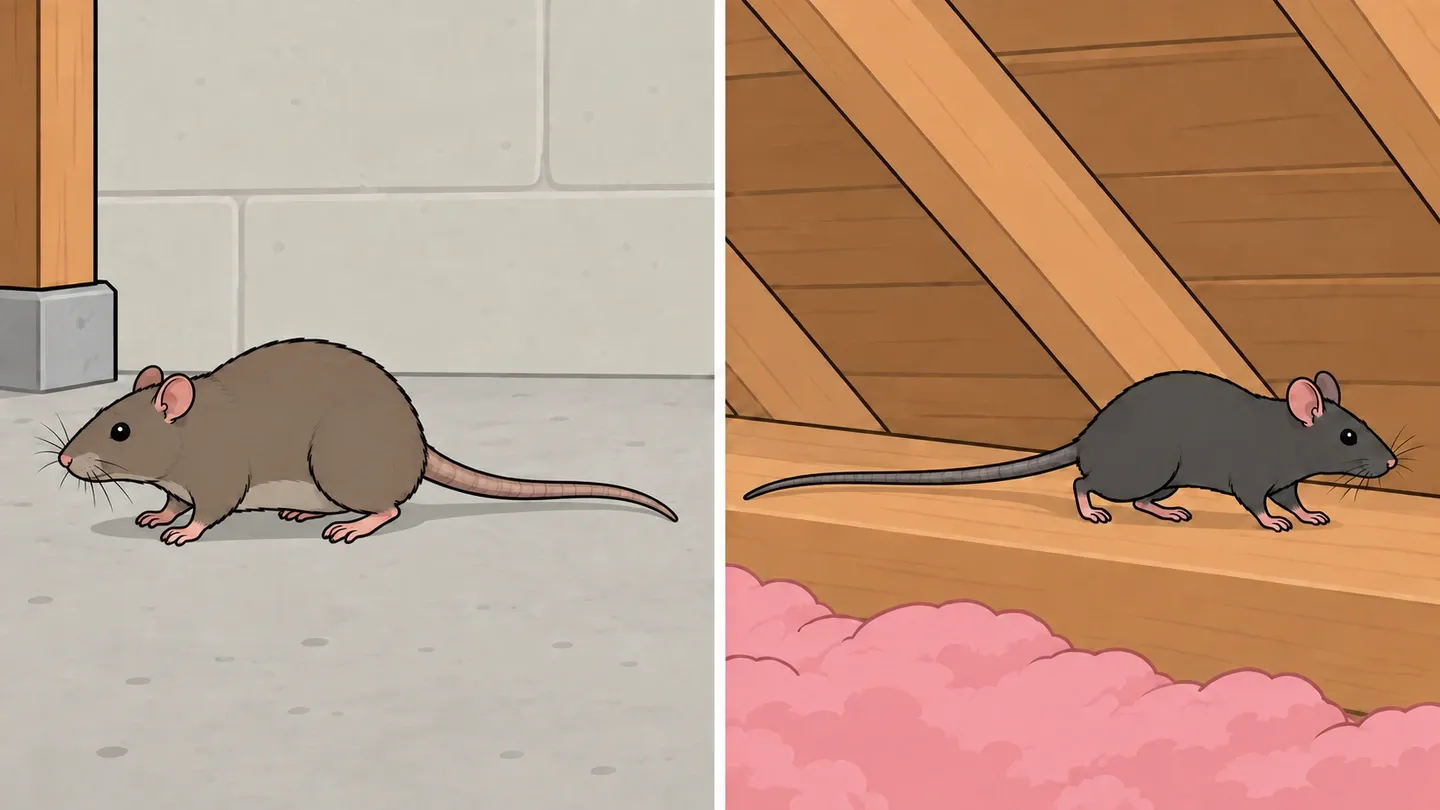
Illustration: the Norway rat (left) is heavier, with small ears; the roof rat (right) is sleeker, with large ears and a tail longer than its body.
| Rat | Build and weight | Where it lives indoors | Where it lives outdoors |
|---|---|---|---|
| Norway rat | Stocky, 7–18 oz, tail shorter than body | Basements and the ground floor | Burrows by the foundation |
| Roof rat | Slender, 5–10 oz, tail longer than body | Attics, walls and ceilings | Trees, shrubs, fences and wires |
Roof rats also forage on the ground, so trap wherever fresh activity appears, and seal high as well as low.
3. Find How Rats Get In and Seal the Gaps
Walk the outside of the house first: the roofline (eaves, soffits, gable and roof vents), gaps around pipes and the air-conditioning line, foundation and crawl-space vents, garage door corners, and branches or vines that reach the roof. Then check behind appliances, under sinks, and in the attic, basement and crawl space (CDC checklist).
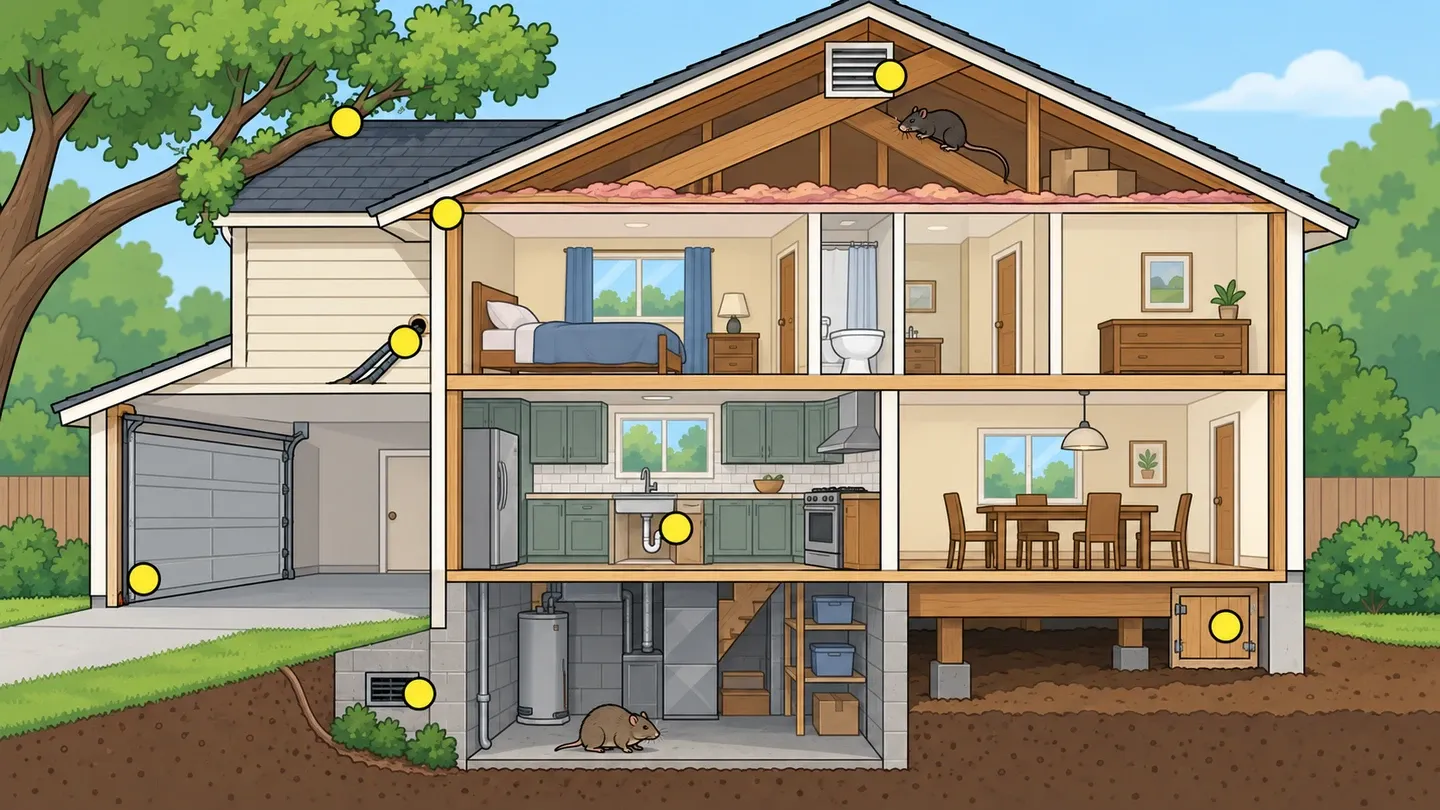
Illustration: entry points marked from the roofline down to the foundation.
Seal ½ inch, not just big holes. Young rats can squeeze under a door with a ½-inch gap, according to UC IPM; going down to ¼ inch keeps mice out too. To test a hole, stuff it with crumpled paper; if it’s chewed or pushed out within a day or two, it’s active.
Use metal or mortar, not foam. Rats chew through plastic, foam, wood and caulk:
- Small gaps and pipe holes: pack with steel wool or copper mesh, then seal over it.
- Vents and larger holes: galvanized hardware cloth, sheet metal or concrete mortar. Chicken wire is too open.
- Roof rat routes: trim branches 3 to 6 feet back from the roof (UC IPM) and pull vines off walls.
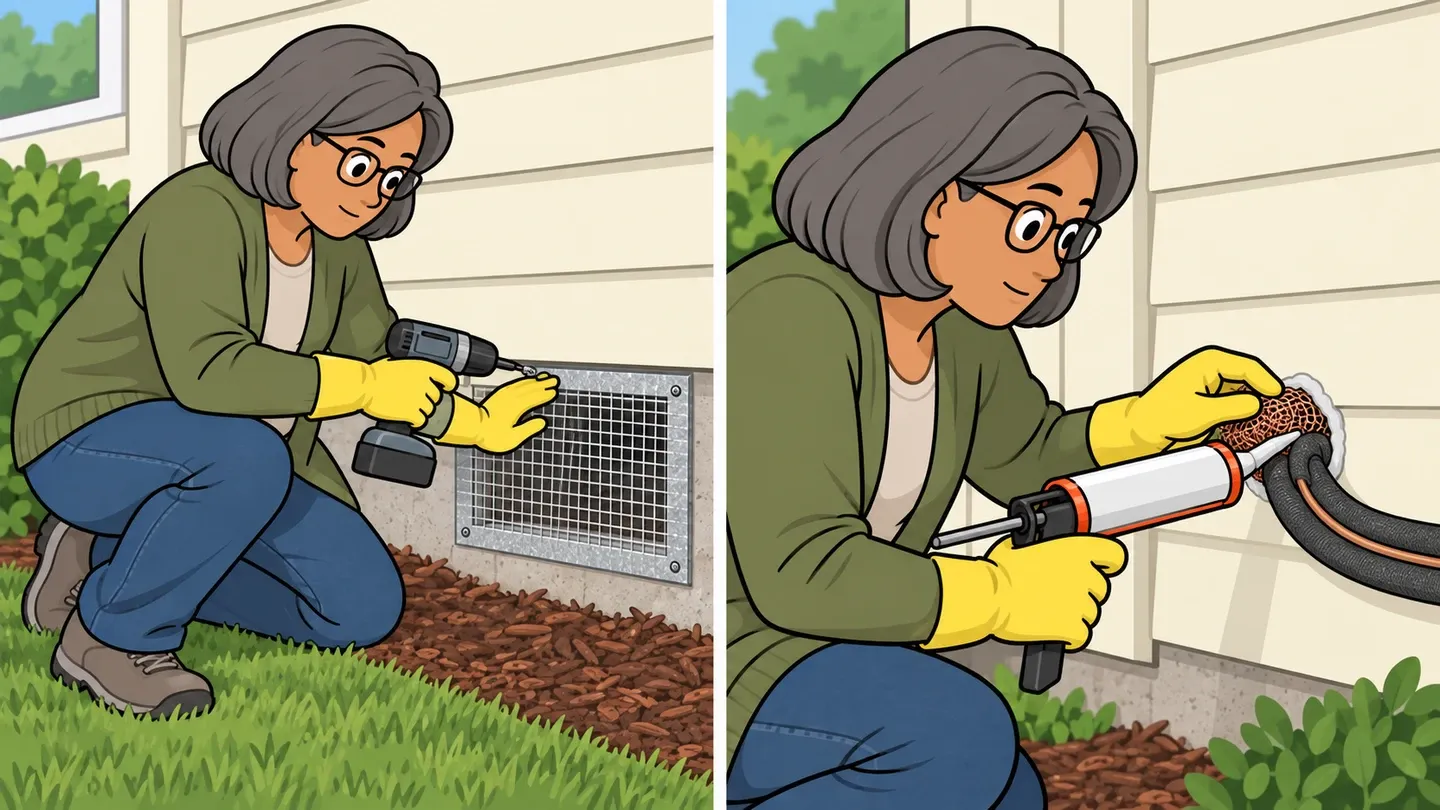
Illustration: hardware cloth over a vent, copper mesh around an AC line.
Seal and trap the same week. Sealed-in rats chew a new way out, and trapping alone lets new rats replace the ones you catch. Trap from day one, seal each hole as you confirm it, and keep traps set a week after the last hole is closed.
4. Trap the Rats Already Inside
Use rat-size snap traps. The CDC recommends snap traps for homes. Pick ones with a wide trigger plate: in research the ICWDM cites, expanded-trigger traps caught almost twice as many rats.
Set a dozen, not two. UC IPM says a heavily infested home may need a dozen or more, about 10 to 20 feet apart.
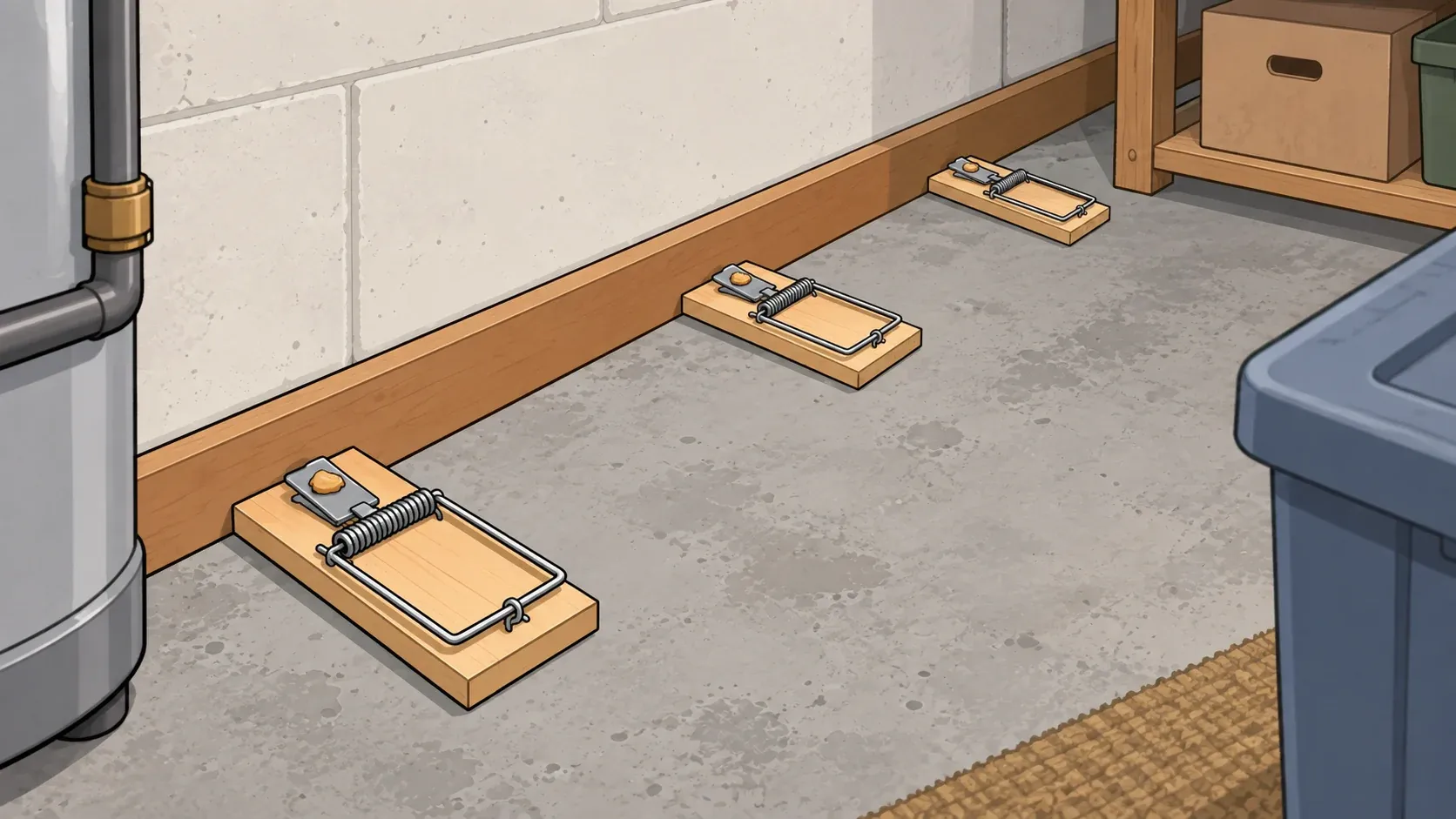
Illustration: three rat-size snap traps along a basement wall, trigger ends at the baseboard.
Place them along the run.
- Set each trap at a right angle to the wall, trigger end nearly touching it. Traps set parallel to the wall go in pairs facing opposite ways.
- Put them behind boxes and appliances, where you found droppings or rub marks.
- Norway rats: start at floor level. Roof rats: rafters, beams, shelves and pipes near activity, plus the ground where you see signs.
- Screw, nail or wire traps down so a rat caught by a leg can’t drag one into a wall.
Bait with a pea-sized amount. Nuts, dried fruit, bacon, peanut butter or something the rats already eat, tied on or pressed into the trigger; the best bait for rat traps compares them.
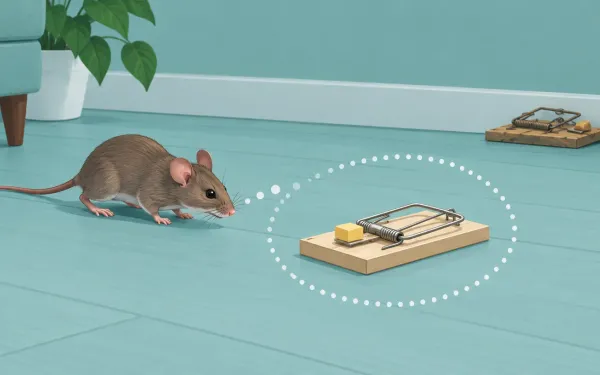
Pre-bait before you set. Rats avoid new objects for days, so leave traps baited but unset until the bait is taken, then set them all the same night; see why rats avoid traps and how to catch a rat. Keep traps away from children and pets and check them daily, as the CDC recommends.
5. Take Away Food, Water and Shelter
Rats get by on about an ounce of food and water a day, according to the New York State Department of Health, so “mostly clean” isn’t enough:
- Store food, pet food and birdseed in thick plastic, metal or glass containers with tight lids.
- Don’t leave pet bowls out overnight, and fix dripping taps.
- Use garbage bins with tight lids; pick up fallen fruit and spilled birdseed.
- Move woodpiles off the ground, and thin shrubs to leave 2 feet of space along the walls.
Oregon State University Extension notes problems often return when people ease off, so talk to your neighbors too.
6. Rats in the Walls, Attic or Crawl Space
Handle these yourself first: rats come out to eat, so trap where they come out.
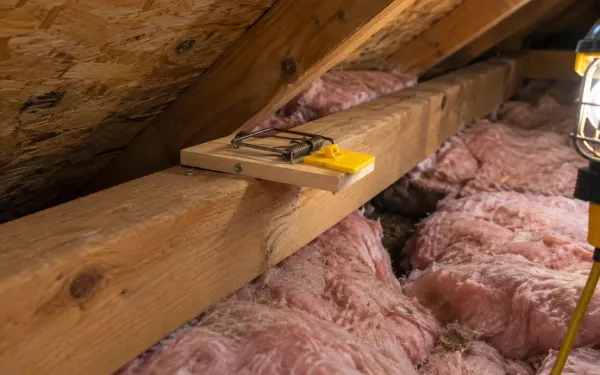
- Attic or ceiling (usually roof rats): trap on rafters and beams near the signs, then seal the roofline and vents; rats in the attic has the step-by-step.
- Inside walls: trap where the wall opens into the attic, basement or space behind appliances, and never put poison bait in a wall. Trapping at those openings means the wall rarely needs to be opened.
- Crawl space (usually Norway rats): trap along the inside walls, then screen the vents and close the access door.
- Parked cars: rats also nest under the hood and chew engine wiring, which UC IPM notes can be expensive to repair. Check under the hood of a car that sits for long stretches and trap nearby; keeping rodents out of a car covers the rest.
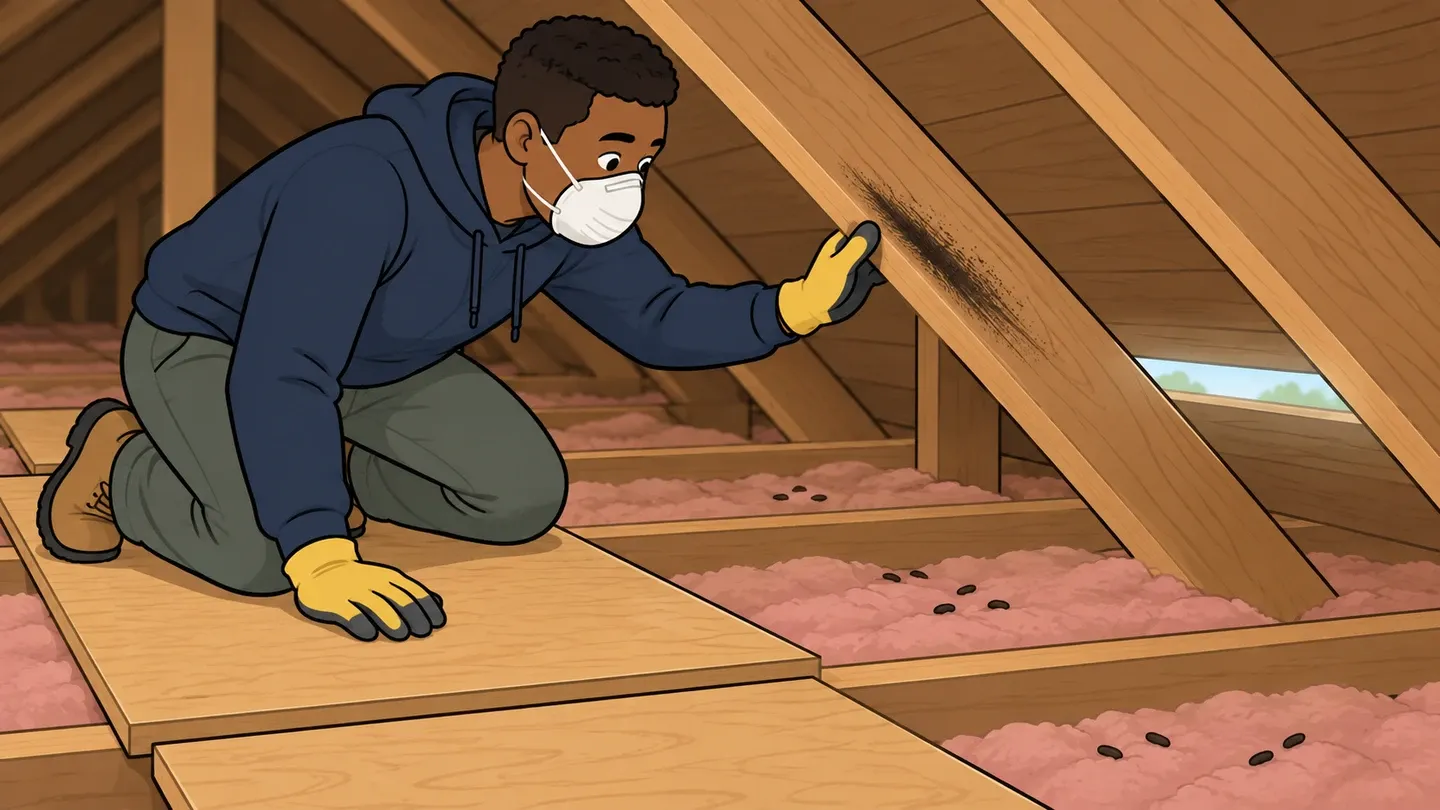
Illustration: a rub mark on a rafter and droppings on attic insulation.
7. Clean Up and Skip the Poison
Soak droppings, never sweep them. Rat droppings and urine can spread disease: the CDC says germs mainly reach people when they breathe in contaminated air. Its steps: air the room out, put on gloves, soak droppings with disinfectant or a 1-to-9 bleach solution for 5 minutes, then wipe them up with paper towels.
Skip poison indoors. Bait doesn’t close the gap, and a pet can be poisoned by the bait or by eating a poisoned rat. See rat poison dangers.
How to Tell the Rats Are Gone
Plan on at least two weeks. The CDC’s finish line is a week with no rats caught and no new signs. To check:
- Clean up all droppings, then check the same spots every few days; new ones mean rats are still active.
- Fill outdoor burrows with soil. A reopened burrow means rats are still around. Not sure a hole is a rat’s? Compare it in what’s digging holes in my yard.
- Listen for a week of quiet nights, with bait left untouched.
Which Plan Fits Your Situation
Your home changes where the traps go and who seals.
| Situation | What to do | Why |
|---|---|---|
| You rent | Trap, store food and clean inside your unit; tell the landlord in writing, with photos, and keep a copy | Sealing outside, trimming trees and opening walls are the landlord’s call. |
| Kids or pets at home | Snap traps behind appliances or inside a covered box, screwed down; no poison | The CDC says to keep traps out of reach; pets can be poisoned by bait or a poisoned rat. |
| Noises in the attic or walls | Trap rafters, beams and wall openings, then seal the roofline (section 6) | Usually roof rats, which come out of the wall to eat. |
| Basement, crawl space or yard burrows | Floor-level traps along inside walls; screen vents and fill burrows | Usually Norway rats, which live low. |
| Droppings everywhere or rats out in daylight | A dozen or more traps at once, then an inspection quote | A heavy infestation needs volume, and daytime rats are a warning sign. |
| You can’t find the way in | Dust flour along routes and test holes with paper; then call a pro | Roof and utility-line gaps are hard to find and reach safely. |
What It Might Still Cost
| Item | Typical cost |
|---|---|
| DIY: 6 rat snap traps, 20 ft copper mesh, gloves, bleach | $65 |
| DIY, heavy infestation: 12 traps instead of 6 | $87 |
| Pro trap-and-seal job, 53 shared quotes (middle half) | $1,400–$3,000 |
| Pro visit, price-guide range (usually no sealing) | $150–$655 |
| Pro attic insulation cleanup, if upsold | $7,500–$14,000 |
| Pro: inspection only | $100–$200 |
DIY: U.S. list prices from Victor, DoMyOwn and Target on September 30, 2026, before tax and shipping. Pro: the middle half of 53 trap-and-seal quotes homeowners shared on Reddit (see the quote table). Price-guide range: This Old House for mice (April 2026) and HomeAdvisor for rats (June 2026); it usually covers a trap-and-bait visit, with sealing extra. Attic cleanup: the middle half of 35 shared quotes that included new insulation. Inspection: HomeAdvisor, June 2026. The exterminator vs. DIY cost page breaks the kit down item by item.
Before You Start: A Quick Checklist
- Confirm it’s rats: droppings ½–¾ inch, not ¼ inch.
- Walk the outside and mark every gap ½ inch or wider.
- Seal with metal or mortar, not foam or caulk alone.
- Buy a dozen rat-size snap traps with wide triggers, and screw them down.
- Pre-bait them unset with a pea-sized dab, then set them all the same night.
- Lock up food, water and pet bowls every night.
- Clean droppings wet with gloves and disinfectant, never a broom.
When to Call a Professional
Call a licensed pro if:
- The rats are somewhere you can’t safely reach, like a tight attic or low crawl space.
- You can’t find the entry points, or they’re on the roof or around utility lines.
- Fresh droppings or catches continue after a couple of weeks of good trapping.
- There’s a large clean-up, or rodents in your heating and cooling ducts.
Judge the quote by its inspection. A good service shows where rats get in and says how many follow-up visits and what sealing warranty the price covers. One renter on Reddit was quoted $15,000 to $30,000 for an attic job; for numbers like that, get an itemized list and a second opinion.
Common questions
Set a dozen or more traps at once, not one or two, and seal gaps that same week. Rats often avoid new traps for several days, so pre-bait them unset and set them all the same night.
It happens, but it’s not common. UC IPM lists toilets and broken drains among rat entry routes; if you suspect one, have a plumber check the sewer line.
The Bottom Line
Seal every gap ½ inch or wider with metal, set a dozen pre-baited rat-size snap traps along the walls, and lock up food and water, all in the same week. That runs about $65–87 in supplies; call a pro if fresh signs keep turning up after two weeks.
Sources and further reading · 9
- CDC: How to Trap Up to Remove Rodents
- CDC: How to Seal Up to Prevent Rodents
- CDC: How to Clean Up After Rodents
- UC IPM: Pest Notes — Rats
- ICWDM: Norway Rat and Roof Rat Prevention and Control
- Cornell NYS IPM: Mouse and Rat Biology and Behavior
- New York State Department of Health: Controlling the Rat
- Oregon State University Extension: keeping rats away
- University of Georgia IPM: rats and mice in the house and yard