Are Mice Nocturnal? When Mice and Rats Are Most Active
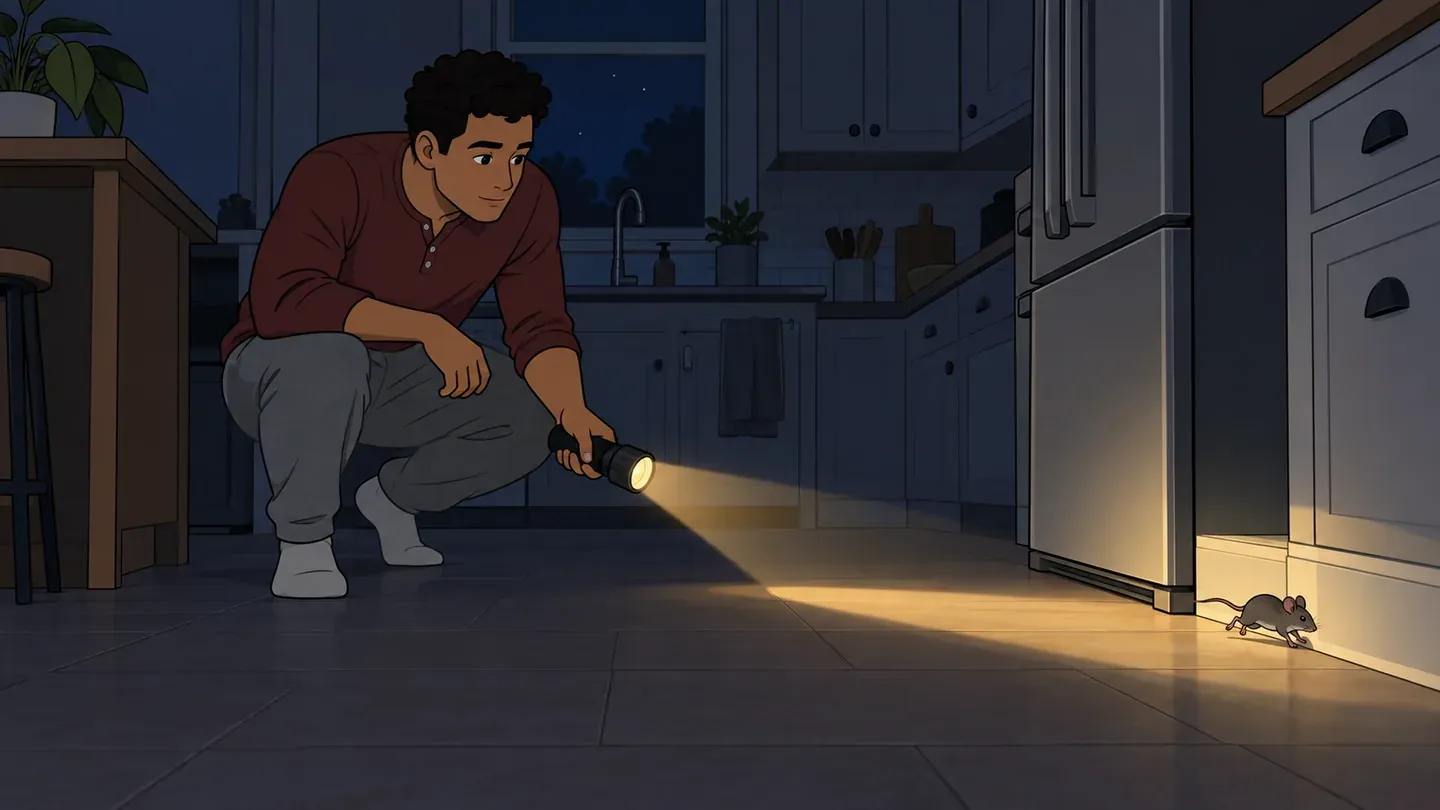
Illustration: after dark, a flashlight beam along the kitchen baseboard catches a mouse running beside the wall.
Yes, mice are mostly nocturnal: house mice peak after dusk and again before dawn, but they come out by day wherever food is easy to reach. Rats are nocturnal too, and a rat seen in daylight is the bigger warning. Set snap traps along walls before dark, check them each morning, and stop after a week with no catches (CDC).
Call a pro if you keep seeing rats in daylight, which usually means a large population, or new droppings and gnaw marks keep appearing after at least 15 days of steady trapping.
This guide covers when mice and rats are active, what a daytime sighting means, where they hide by day, and how to time traps around their schedule. We haven’t tested this ourselves; it rests on CDC, university extension and Internet Center for Wildlife Damage Management (ICWDM) guidance, plus Victor’s list price for snap traps.
Mice vs. Rats: When Each Comes Out
| House mice | Norway rats | Roof rats | |
|---|---|---|---|
| Peak activity | After dusk and again before dawn | Around dusk | Shortly after sunset |
| Seen by day means | Not necessarily many mice | Usually a large population | Usually a large population |
| Where they spend the day | A nest within 10–30 feet of the signs | Burrows along foundations; basements and ground floors | Shrubs and trees; attics, walls and false ceilings |
| First clue you’ll find | Droppings, sounds and damage | Droppings, gnaw marks, burrows | Rats on utility lines or fences at night |
When Are Mice Most Active?
House mice are most active after dusk and before dawn, according to Nebraska Extension. That’s why homeowners rarely see them, and droppings, sounds and damage are the usual clues. The extension guides don’t give a clock time; they describe it by light: dusk, darkness and the hours before dawn.
Once it’s dark, a mouse may visit food 20 to 30 times a night, according to University of Kentucky entomologists. Hearing one near your bed? Set traps along the bedroom wall behind furniture, where kids and pets can’t reach them. The sounds mice make help you place them.
What Time Do Mice Come Out at Night?
Mice come out around dusk and stay busy through the night until shortly before dawn. There’s no fixed clock time: they follow the light, not the clock, so the start moves with sunset through the year (Nebraska Extension).
In practice, expect the first activity soon after it gets dark, whether that’s 5 p.m. in December or after 8 p.m. in June, and the last trips in the hours before sunrise. A quiet, dark house can bring them out earlier. Set traps before dark and check them first thing in the morning; the trap timing section below has the routine.
When Do Rats Come Out?
Rats come out at night, and Norway rats usually start around dusk, according to UC IPM. Roof rats are often seen at night running along utility lines or fences.
Except in heavily infested areas, people don’t often see rats at all; droppings, gnaw marks or burrows usually turn up first. Rat droppings are much bigger than a mouse’s, and mouse poop vs. rat poop shows how to tell them apart.
Do Mice Come Out During the Day?
Yes. The ICWDM says considerable mouse activity may occur during the day, and that a daytime sighting does not necessarily mean a large population.
A pattern matters more than one sighting. When nocturnal animals are frequently seen by day, they may have young and be feeding more often, or the population may be high. Mice in daylight day after day, not once, is a bigger problem.
After a daytime mouse, look for droppings the same day behind the stove and refrigerator and in the backs of cabinets. Pick up pet food, crumbs and open bags, and set traps that evening.
Do Rats Come Out During the Day?
They can, and it’s a stronger warning. The ICWDM says a daytime sighting doesn’t necessarily mean a large mouse population, “though this usually is true for rats.” Some Norway rats are also active by day when populations are high, or to avoid people at night.
Don’t wait for a second sighting. Start with getting rid of rats in your house, with rat-size traps and a slower start.
Where Do Mice Go (and Sleep) During the Day?
Mice spend the day close to their nests, leaving and returning up to 40 times a day, the ICWDM says. Nests turn up in garages, closets, attics, basements and outbuildings: fibrous balls about 4 to 6 inches across, often near compressors, pilot lights and water heaters.
One mouse’s daily range averages only 10 to 30 feet across, so the nest is usually close to the signs you find. Scratching overhead usually means a nest in the attic, so trap along the joists and eaves. Sounds inside a wall? Mice come out to eat, so set traps where they come out, such as under the sink and behind the refrigerator.
Rats depend on the species (UC IPM). Norway rats burrow along foundations, under trash piles and in woodpiles, and indoors stay in basements or on the ground floor. Roof rats nest in shrubs, trees and dense vegetation, and indoors favor attics, walls, false ceilings and cabinets.
How to Confirm Mice or Rats at Night
Use a flashlight after dark. Sit quietly for a while, then sweep the baseboards with a flashlight or spotlight.
Listen for squeaks, gnawing, scampering and climbing in walls, ceilings and under cabinets. Noise alone can’t tell you which animal it is.
Lay a tracking patch. The ICWDM suggests flour rolled smooth on a suspected pathway overnight; footprints or tail marks by morning show the route.
Watch outside at dusk. Rats on utility lines or fence tops at dusk, or soon after, are a sign of infestation.
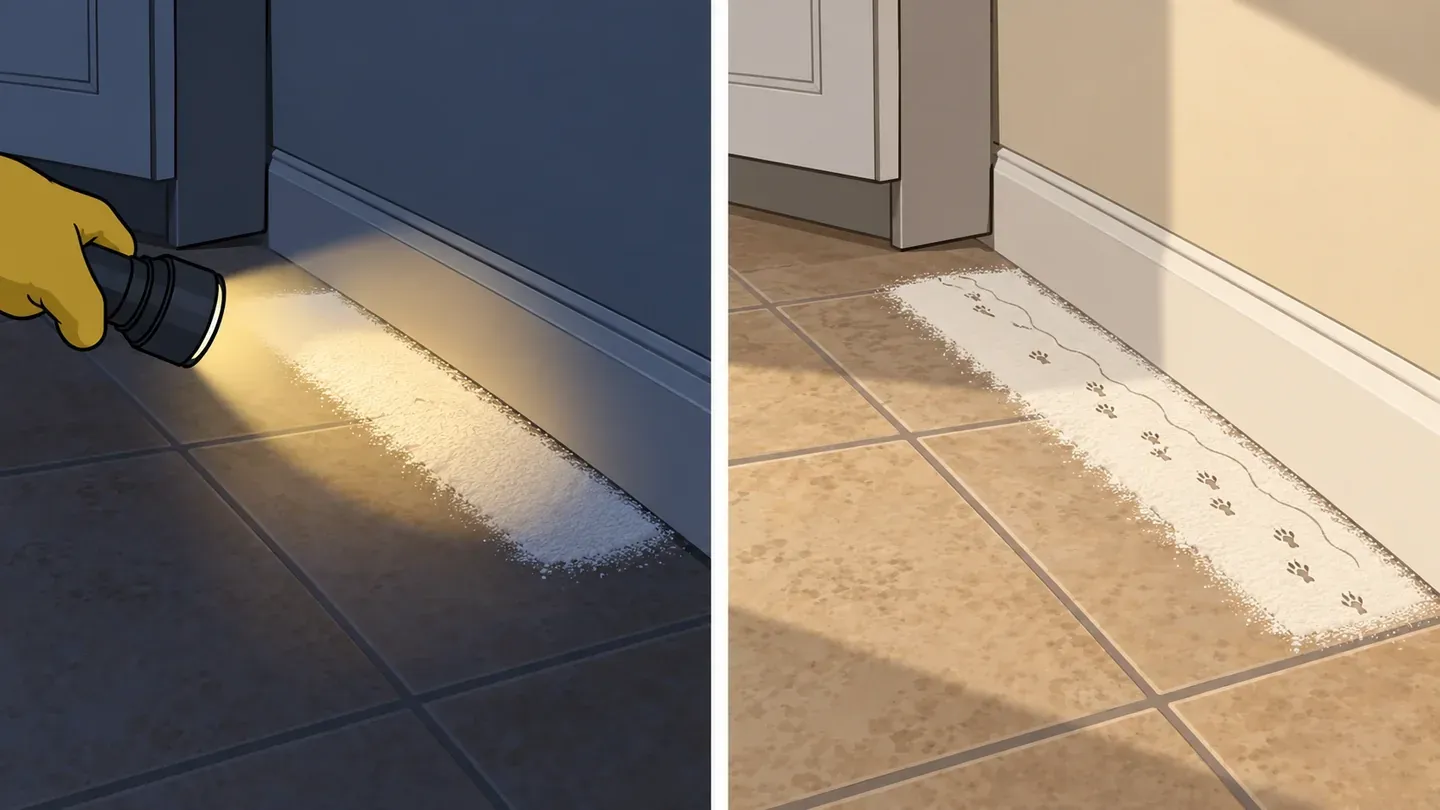
Illustration: a flour patch laid in the evening (left) shows tiny footprints by morning (right).
Trap Timing: Set Before Dark, Check at Dawn
Set traps in the evening and check them first thing in the morning, not the other way round: mice are most active before dawn. The CDC recommends snap traps against the wall so the baited end and the wall form a “T,” because rodents run next to walls for safety. Throw out dead rodents right away.
Use more traps than one, not a single trap by the sighting. Nebraska Extension says about two dozen snap traps handle a new mouse infestation in a 1,500-square-foot house, and UC IPM says pairs set 1 to 2 inches apart catch more mice that jump over obstacles.
Give rats a few nights, not one. Rats are very cautious and may take several days to approach a trap, so bait the traps without setting them until the bait is being eaten, then set them. More in why rats avoid traps.
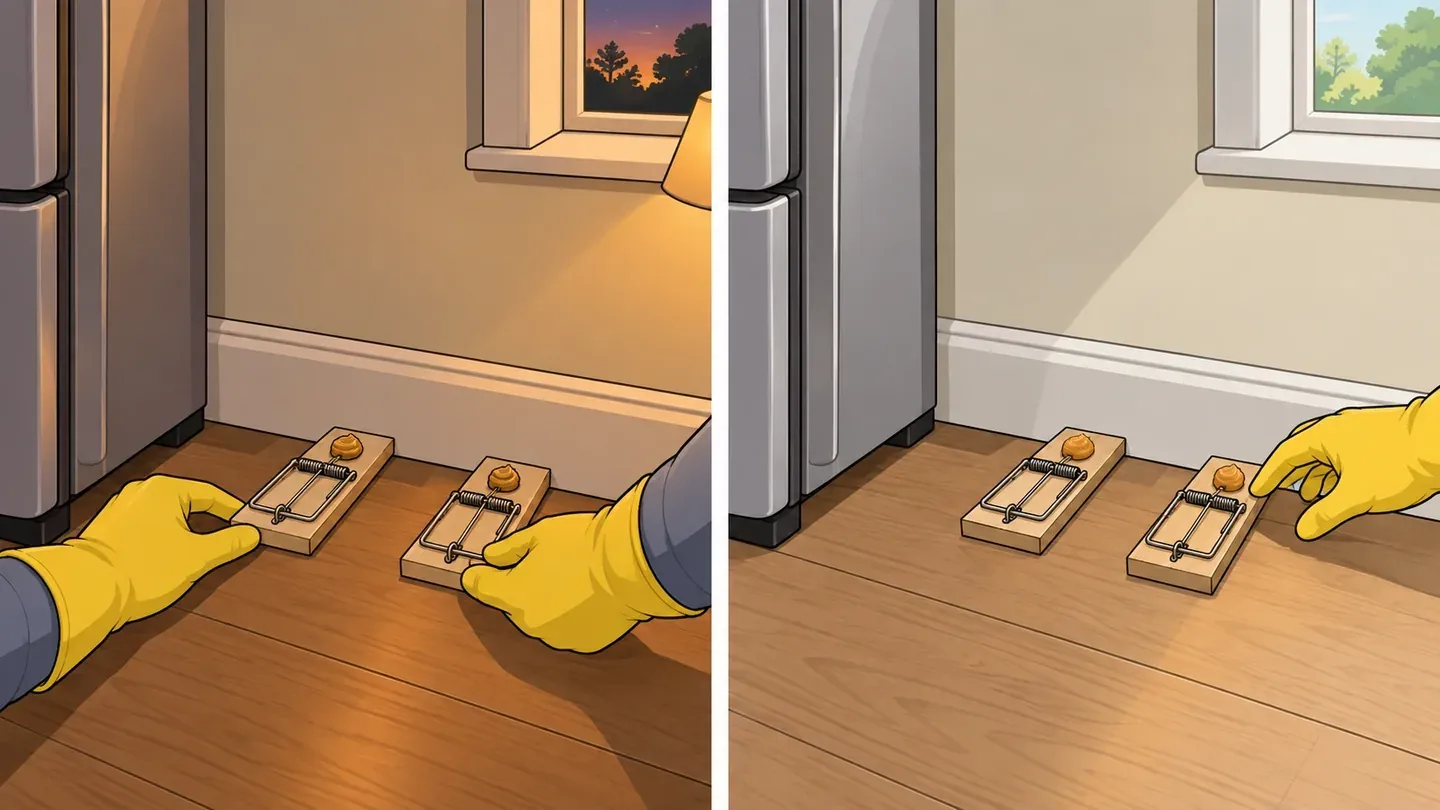
Illustration: two snap traps against the baseboard in the evening (left), and a gloved hand checking them the next morning (right).
What it costs: a dozen wooden snap traps cost $13.74 and two dozen $27.48, at Victor’s list price of $2.29 per two-pack (September 30, 2026, before tax and shipping; the totals are our math).
What to Do Next
The full plan, including sealing entry holes, is in how to get rid of mice. Setup details are in how to set a mouse trap and the best mouse trap bait.
- Look for droppings the same day you see a mouse, behind appliances and in cabinet backs.
- Remove night food: pet food, crumbs and open bags.
- Set traps before dark, baited end against the wall, in pairs where signs are heaviest.
- Check traps every morning and dispose of catches right away.
- Pre-bait for rats for a few nights before setting the traps.
- Stop when a week passes with no catches and no new signs.
Call a professional if you keep seeing rats in daylight, or if new droppings keep appearing after at least 15 days of trapping and re-baiting, the CDC’s minimum before considering a pro. Ask what they will seal and with what, and how many visits the price covers.
Common questions
Yes. A dark, quiet house after dusk is when mice are most active, so most of their feeding happens while you sleep, and that’s when you hear scratching in walls or ceilings. Set traps before bed and check them first thing in the morning.
They don’t hibernate: house mice and rats are active year-round. What changes is where they are: mice are most likely to move into buildings in the fall, as temperatures cool.
They can. The University of Kentucky lists the sounds of mice running, gnawing or squeaking among the most obvious signs they’re in the house.
Back to their nests: burrows along foundations and under woodpiles for Norway rats; trees, shrubs, attics and walls for roof rats.
Sources and further reading · 6
- Internet Center for Wildlife Damage Management (ICWDM): House Mouse Biology, House Mice, Norway Rat Biology, Roof Rat Biology, Inspection and Noises — activity times, daytime sightings, nests, night checks and tracking patches.
- UC IPM: House Mouse and Rats — night activity, activity when food is available, trap pairs, year-round activity, where each species lives, signs of infestation.
- Nebraska Extension: Controlling House Mice (G1105) — dawn and dusk activity, morning trap checks, trap numbers.
- University of Kentucky Entomology: Control of Mice (EF617) — why mice are rarely seen, nightly food visits.
- CDC: How to Trap Up to Remove Rodents — trap placement, daily checks, pre-baiting for rats, when you’re done.
- Victor Metal Pedal Mouse Trap — trap price.