Mice in Your Couch? How to Get Rid of Them and Save the Sofa
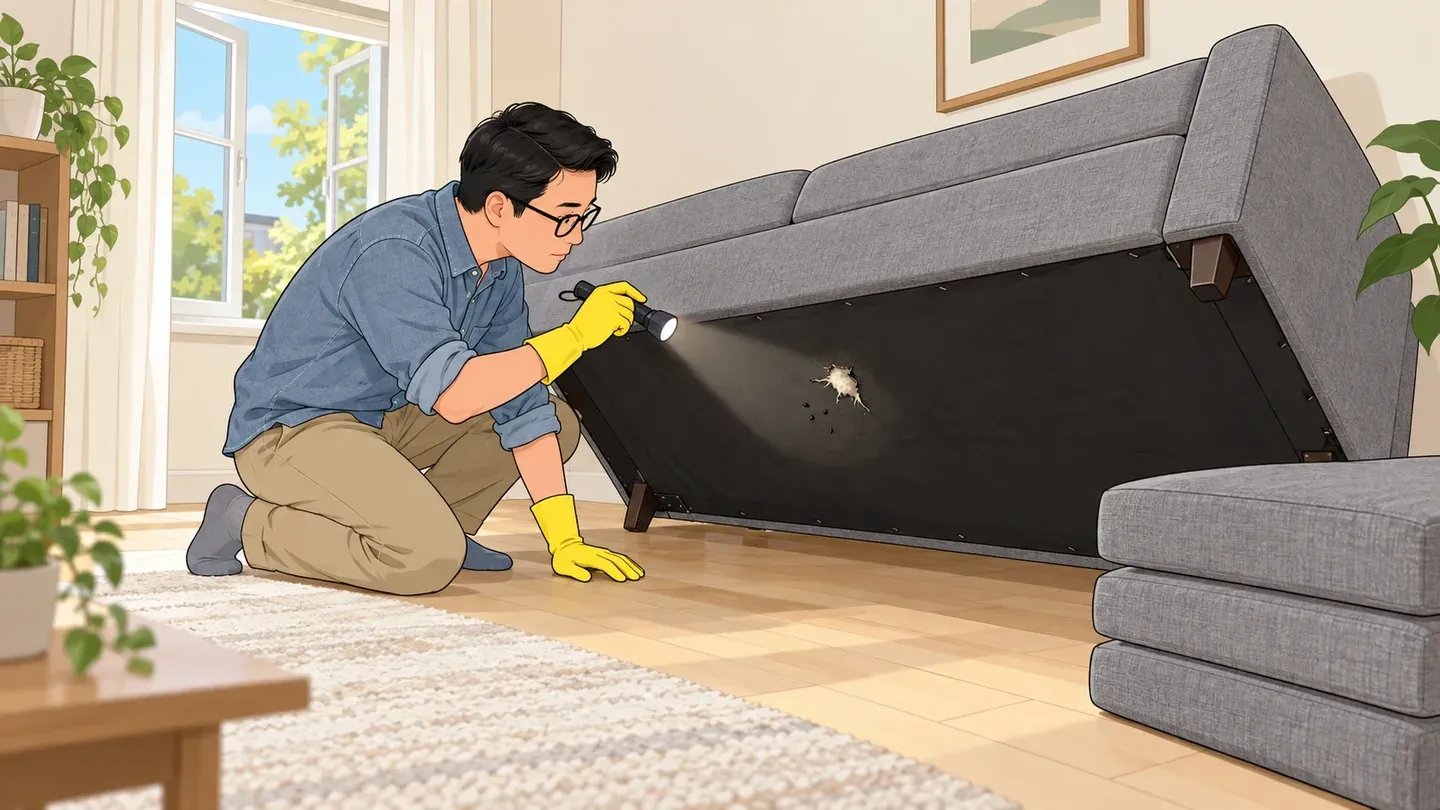
Illustration: a flashlight on the underside of a tipped-back sofa, where shredded stuffing pokes through a small hole in the bottom fabric.
Mice in your couch nest in the stuffing and eat crumbs between cushions. Don’t vacuum or shake it. The CDC’s method: glove up, set snap traps along the wall beside it, soak droppings with bleach solution, then shampoo or steam clean. A week with no catches or new signs means they’re gone. Heavily contaminated couches may need to go.
Cost: about $57–71 in supplies. Difficulty: moderate. Call a pro if droppings and nests cover a large area, you see signs of deer mice in a rural home or cabin, a power recliner’s wiring has been chewed, or steady trapping hasn’t stopped them.
This guide covers checking the couch safely, trapping, cleaning, deciding whether to keep it and keeping mice out. We haven’t tested these methods ourselves; this rests on CDC, UC IPM, Nebraska Extension and National Park Service guidance and 2026 list and platform prices.
Tonight: keep kids and pets off the couch, don’t vacuum or shake it, and set two or three snap traps along the wall behind it and at each end. Cleaning can wait until tomorrow. For the rest of the house, follow our plan for getting rid of mice.
What Works and What Doesn’t for Mice in a Couch
| Method | Works? | Cost | Main limitation |
|---|---|---|---|
| Snap traps along the wall behind it | Yes | Part of the $57–71 kit | Keep out of reach of kids and pets |
| Bleach soak, then shampoo or steam | Yes, the CDC’s method | Part of the kit | Hard to reach a nest deep inside |
| Pro upholstery cleaning | Yes | $100–$300 | Doesn’t remove live mice |
| Vacuuming, shaking, flipping | No | — | Puts contaminated dust in the air |
| Poison | Skip | — | A mouse can die inside the couch |
| Glue and live traps | No | — | Scared rodents urinate more |
Can Mice Live in Couches?
Yes. House mice can survive in very small spaces on little food (UC IPM), live behind furniture, feed on crumbs and nest in finely shredded fibrous material; couch batting fits the bill. Deer mice also damage upholstered furniture to build nests.
House mice seldom go more than 30 feet from their nest (UC IPM). If you keep finding droppings on the couch, the nest is likely inside it or close by.
Signs of Mice in Your Sofa
- Droppings in the cushion creases or on the floor beneath: ⅛ to ¼ inch with pointed ends, 50 to 75 a day from one mouse (Nebraska Extension). Compare with rat poop vs. mouse poop.
- Shredded stuffing or fabric near a hole in the bottom fabric, the back or the arms. That’s nest material.
- Fresh gnaw marks about 1/32 inch wide (Nebraska Extension).
- A musky smell, common in long-term infestations (getting rid of the smell).
- Scratching or squeaks at night, when mice are most active (what mice sound like).
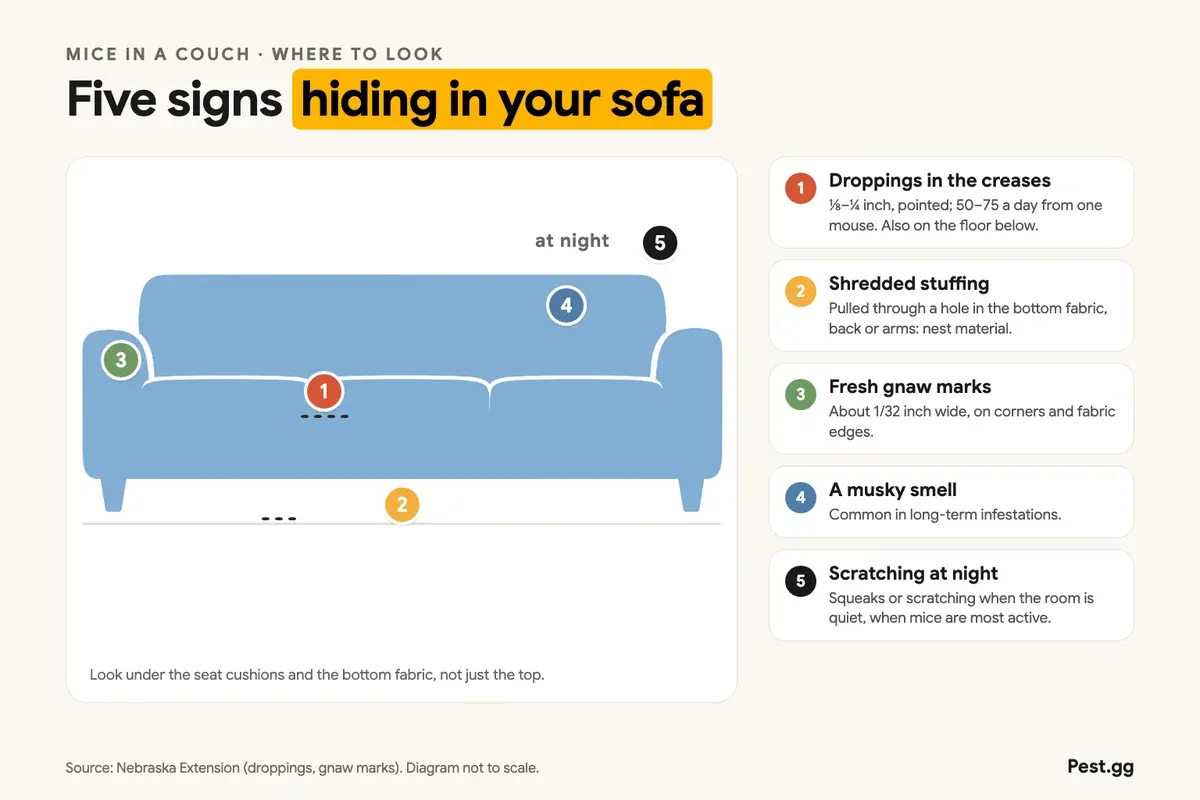
Diagram: where each sign of mice shows up on a couch. Source: Nebraska Extension.
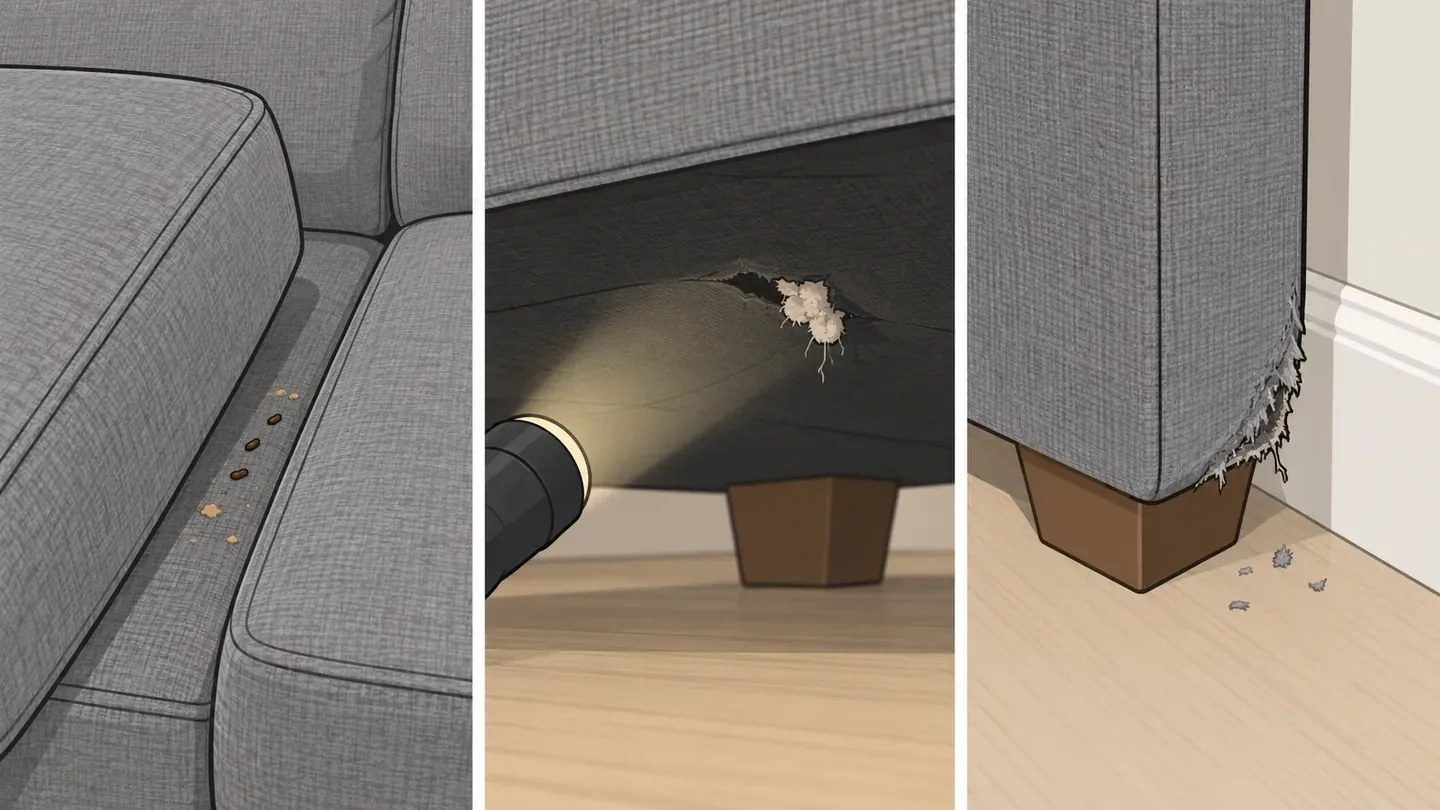
Illustration: droppings in the cushion crease, stuffing pulled through the bottom fabric, and a chewed corner at the back.
Don’t Vacuum or Shake the Couch
Rodent diseases mainly spread when people breathe contaminated air, the CDC says, so don’t vacuum or sweep droppings, urine or nesting material, or beat cushions indoors. Already vacuumed? The CDC says to simply follow its cleanup steps from here.
Safety: In a rural home or cabin, check trapped mice for a white belly and a tail that’s dark on top, white underneath. That’s a deer mouse, which spreads the most common U.S. hantavirus (CDC); avoid sleeping in infested areas until they’re controlled. House mice spread LCM, which can be serious for pregnant women and people with weakened immune systems. If that’s you, let someone else clean up.
Step 1: Check the Couch Without Stirring Up Dust
Air out the room first. Open doors and windows for 30 minutes and stay out, then put on rubber or plastic gloves.
Lift cushions one at a time. Spray any droppings with disinfectant until very wet before moving on. Removable cushions can go outside for a closer look; the CDC says to handle contaminated items outdoors, upwind.
Use a flashlight, not your hands. Check the bottom fabric, frame corners, inside the arms and back, and a recliner’s mechanism. Unplug a power recliner first: mice chew cords, and gnawed wires can start fires.
Tilt the couch back gently; don’t flip or drag it. One Reddit poster “flipped it, shook it, dragged it around”: “completely useless.” Trapping is what gets them out.
Step 2: Trap the Mouse Around the Couch
House mice leave the nest up to 40 times a day (Nebraska Extension), so snap traps right beside the couch catch them on the way out.
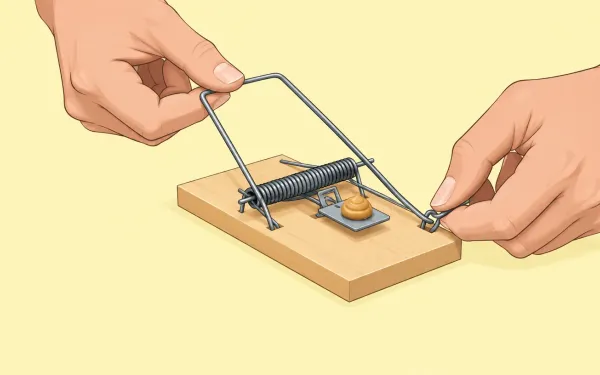
Place them in a “T”. Against the wall behind the couch and at each end, baited end touching the wall, in pairs 1 to 2 inches apart, no more than about 10 feet between sets (UC IPM).
Bait small. A small dab, or a ball of cotton wool as nesting-material bait if allergies rule out peanut butter.
Check every morning. When a week passes with no catches and no new signs, they’re gone. Keep traps behind the couch or in a tamper-resistant station if you have kids or pets. Don’t count on the cat: pets generally don’t control large mouse populations (ICWDM). More in how to set a mouse trap.
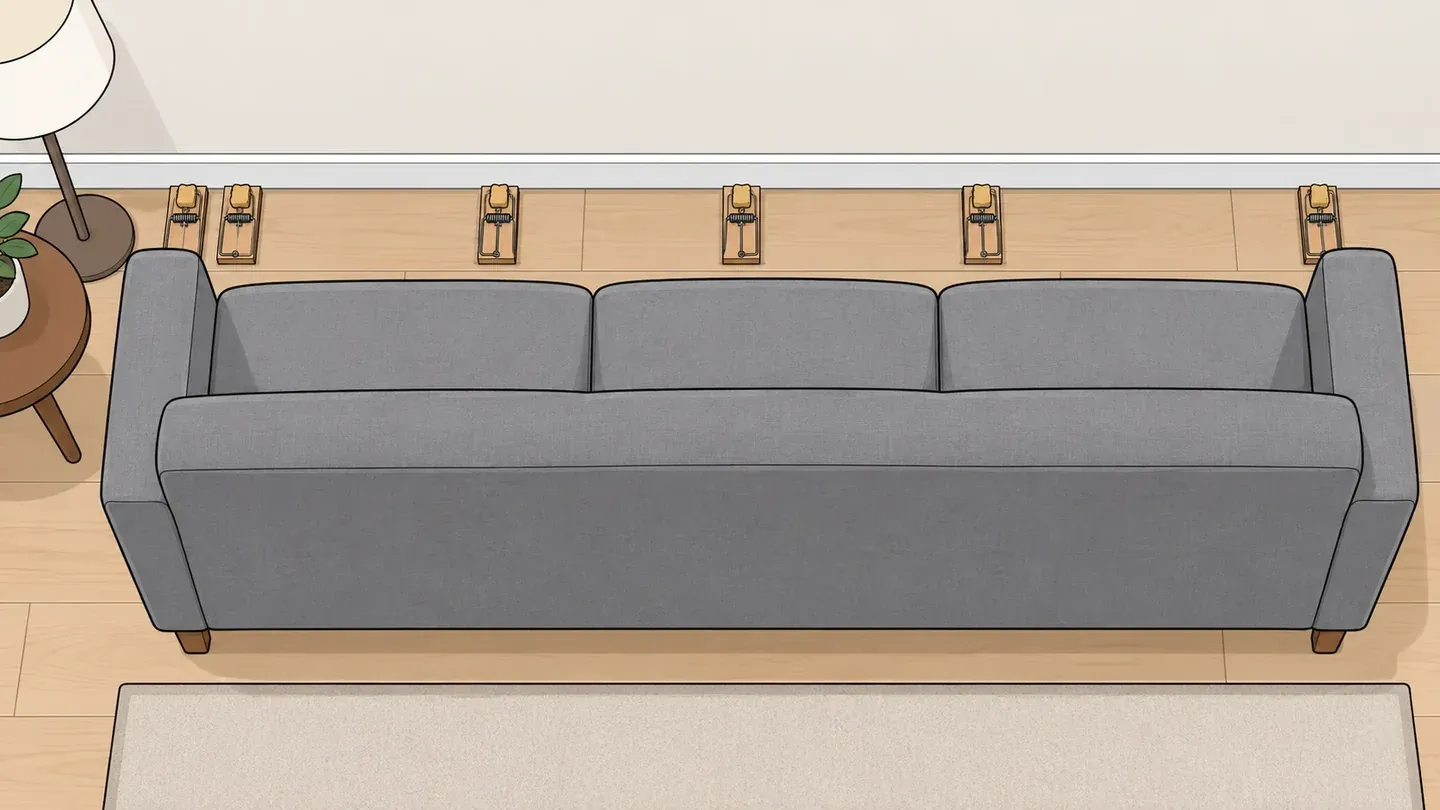
Illustration: a sofa pulled a few inches from the wall, with snap traps along the baseboard behind it and at each end.
Skip poison. Poisoned mice often die inside the building, possibly inside the couch (rat and mouse poison dangers).
Step 3: Clean Mouse Droppings in the Couch
Clean the cushions you use now, and do the full job once trapping is done.
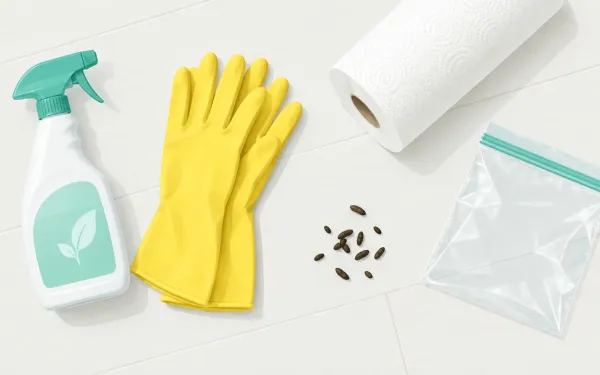
Soak, don’t wipe dry. Spray droppings, urine spots and nest material with disinfectant or bleach solution (1.5 cups of bleach per gallon of water) until very wet, and let it soak 5 minutes. Wipe up with paper towels into a covered garbage can.
Double-bag nests and dead mice. Spray the area around them too. Fleas are common on rodents, so the CDC suggests insect repellent on clothes and hands. Wipe the floor under the couch with disinfectant.
Then the upholstery. Shampoo with a commercial disinfectant or use a commercial-grade steam cleaner. Washable covers can go in hot water, then a hot dryer, if the care label allows. Vacuum crevices only after the waste is disinfected and removed. Full method: how to clean mouse droppings.
Can You Save the Couch, or Should You Throw It Out?
Usually you can clean it: shampoo or steam cleaning is the CDC’s answer for upholstered furniture. A National Park Service hantavirus fact sheet adds “dispose of heavily contaminated items,” but neither source defines heavily contaminated. Our take, since the method depends on soaking the mess:
| What you found | Our take |
|---|---|
| A few droppings on or under the cushions, no nest | Clean it and keep it |
| A nest you can reach and soak, fabric mostly intact | Clean it, then shampoo or steam clean |
| Nest or urine you can’t reach, or a smell that returns | Get a pro cleaning quote or replace it |
A professional cleaning of a standard couch runs $100 to $300, or $200 to $500 for leather (HomeAdvisor, June 2026). Tell the cleaner about the mice. If the couch goes, spray visible droppings first and check your local bulky-trash rules.
Step 4: Keep Mice Out of Your Couch
Exclusion is the most successful and permanent form of house mouse control, says UC IPM.
Check behind the couch. Look where floor meets wall, around pipes and vents, and at the fireplace (CDC). Mice fit through a hole the width of a pencil, about ¼ inch.
Seal with metal, not foam. Steel wool and caulk, or copper mesh plus sealant; foam, plastic and wood alone don’t stop mice (how mice get in).
Remove the food. Keep snacks off the couch for now and clear crumbs from under the cushions. Renting? Send your landlord photos of gaps and ask in writing for them to be sealed.
Which Plan Fits Your Situation
| Your situation | Start with | Then |
|---|---|---|
| A few droppings, no nest | Traps behind the couch tonight | CDC soak, then shampoo |
| A nest inside the couch | Traps for a week with no catches | Pro cleaning quote, or replace |
| Kids or pets | Keep them off; traps in stations | Clean before anyone sits there |
| Renting | Traps and cleaning | Landlord seals gaps behind the couch |
| Rural home, deer mice | Stay off the couch until controlled | A pro with a HEPA respirator |
What It Might Still Cost
| Item | Typical cost |
|---|---|
| DIY kit: 12–24 snap traps, copper mesh, gloves, bleach | About $57–71 |
| Pro upholstery cleaning, standard couch | $100–$300 |
| Pro trap-and-seal job, 53 shared quotes (middle half) | $1,400–$3,000 |
| Pro visit, price-guide range (usually no sealing) | $150–$655 |
| Pro attic insulation cleanup, if upsold | $7,500–$14,000 |
DIY: list prices from Victor, DoMyOwn and Target, September 30, 2026, before tax. Pro: HomeAdvisor (upholstery, June 2026). Mouse jobs: the middle half of 53 trap-and-seal quotes homeowners shared on Reddit (see the quote table); price guides list $150–$550 for a trap-and-bait visit. Attic cleanup: the middle half of 35 shared quotes that included new insulation.
Before You Start: A Quick Checklist
- Keep kids and pets off the couch until it’s cleaned.
- Set two or three snap traps behind it and at each end tonight.
- Air out the room for 30 minutes before you lift cushions.
- Mix fresh bleach solution: 1.5 cups per gallon of water.
- Unplug a power recliner before you look inside.
- Photograph gaps behind the couch for your landlord if you rent.
When to Call a Pro
- Droppings and nests cover a large area; for heavy infestations, the CDC calls for a HEPA-filter respirator.
- Deer mice in a rural home or cabin.
- A power recliner’s wiring has been chewed. Have it checked before you plug it back in.
- Trapping hasn’t solved it after a few weeks; see what an exterminator does before you hire.
Common questions
Clean it first. The main risk is breathing stirred-up droppings and urine (CDC), which the cleanup above deals with. With deer mice, wait until they’re controlled.
Check it outside first: cushions off, then look for droppings, nest material and holes in the bottom fabric. If there’s a nest or urine you can’t reach to soak, leave it.
Sources and further reading · 6
- CDC: Clean Up, Trap Up, Seal Up, Hantavirus and LCM.
- National Park Service: Hantavirus Fact Sheet.
- UC IPM: House Mouse and Deer Mouse — nests, smell, poison, wiring, exclusion, deer mouse ID and safety.
- Nebraska Extension: Controlling House Mice (G1105) — droppings, gnaw marks, activity times, bait, copper mesh.
- ICWDM: House Mice and House Mouse Control.
- HomeAdvisor: Upholstery Cleaning Cost.