What Do Mice Sound Like? How to Tell Mice From Rats
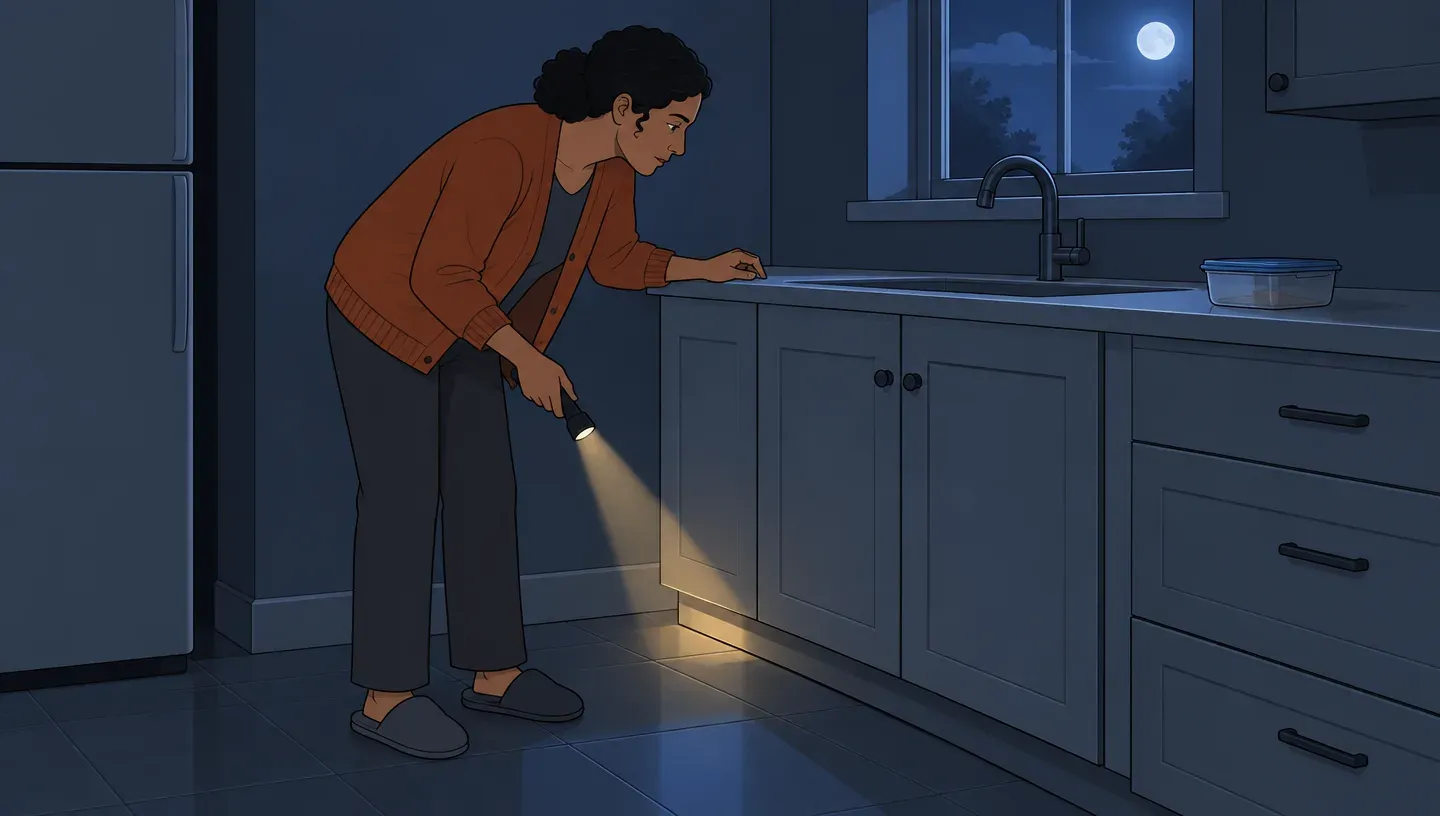
Illustration: listening at the base cabinets with a flashlight after the house goes quiet.
What do mice sound like? Mostly light scratching, quick scurrying and gnawing inside walls, ceilings and cabinets after dark, with an occasional high squeak. Rats sound heavier, but loudness fools people, so let droppings settle it. Then set snap traps along the wall nearest the noise. A quiet week with no new droppings means they’re gone.
Cost: about $14–27 in supplies. Difficulty: moderate. Call a pro if the sounds come from your heating or cooling ducts, you find chewed wiring, or the noises and new droppings keep coming after 15 days of steady trapping.
This guide covers each sound, how mice compare with rats and squirrels, and how to turn the noise into a trapping plan. We haven’t tested this ourselves; it rests on ICWDM, UC IPM, Nebraska Extension, University of Kentucky and CDC guidance plus published research on mouse calls.
What Noise Do Mice Make?
A handful of sounds cover almost everything people report:
| Sound | What it sounds like | Usually where | When |
|---|---|---|---|
| Scratching | Light, fast scrabbling of tiny claws | Inside walls, ceilings, under floors | After dark |
| Scurrying | Quick patter that starts and stops along one route | Along a wall, above a ceiling | After dark, before dawn |
| Gnawing | Steady, fine chewing or nibbling | Cabinets, pantry, wood near a gap | At night |
| Squeaking | Short, high-pitched chirps | Near a nest, or a trapped mouse | Now and then |
| Rustling | Soft shuffling of paper or insulation | Nest spots: wall voids, behind appliances | At night |
| Thumping | A heavier thud or bump | Attic or ceiling; heavy thuds point to rats or squirrels, not mice | Night (rats) or day (squirrels) |
Nebraska Extension notes that people are often surprised house mice make so much noise, and that mice are most active before dawn and after dusk. That’s why you hear them once the house goes quiet.
Do Mice Squeak?
Yes, but you’ll hear only a little of it: a short, high squeak. Most mouse and rat calls are ultrasonic, too high for human ears, and the squeaks you can hear are a normal part of mouse social life.
What Do Mice Sound Like at Night?
Night is when you’ll hear them. Lying in bed, it often sounds like light pattering in the wall or across the ceiling, stopping when you move and starting again a minute later. Sounds that move at night and stop by day point to mice or rats, not squirrels. More on their schedule in are mice nocturnal.
What Do Rats Sound Like?
Rats are bigger and often louder, but our mouse vs. rat guide tells them apart better than noise. Rats make gnawing, climbing in walls, clawing, squeaks and fighting. Scurrying in the attic once the house is quiet is often the first sign of roof rats.
Height is a hint. UC IPM says the rats that stay low, in basements and on ground floors, are usually Norway rats; roof rats favor attics, upper walls, false ceilings and cabinets.
Mouse, Rat or Squirrel? How to Tell the Sounds Apart
Treat sound as a first guess; insulation and walls change what reaches you.
| What you hear | Most likely |
|---|---|
| Light scratching or scurrying in a wall or under cabinets, after dark | Mice or rats; droppings decide (birds can scratch too) |
| Scurrying or gnawing in the attic or ceiling at night | Mice or rats; droppings decide |
| Running overhead in daylight, busiest early and late in the day | Tree squirrels |
| Heavy walking overhead | Something bigger, like a raccoon or opossum |
| A steady, repeating tick or beep | Something mechanical, such as a smoke detector |
| Sounds only on windy days, or late on hot days as vinyl siding heats up | The house itself, not an animal |
Timing beats loudness. Mice and rats mostly move at night, while UC IPM says tree squirrels are active by day, busiest in the early morning and late afternoon; something that “sounds bigger than a mouse” at the same time every afternoon points away from mice.
To tell mice from rats for sure, check droppings. Mouse droppings are ⅛ to ¼ inch long with pointed ends (Nebraska Extension). Much bigger ones mean rats; see rat poop vs. mouse poop.
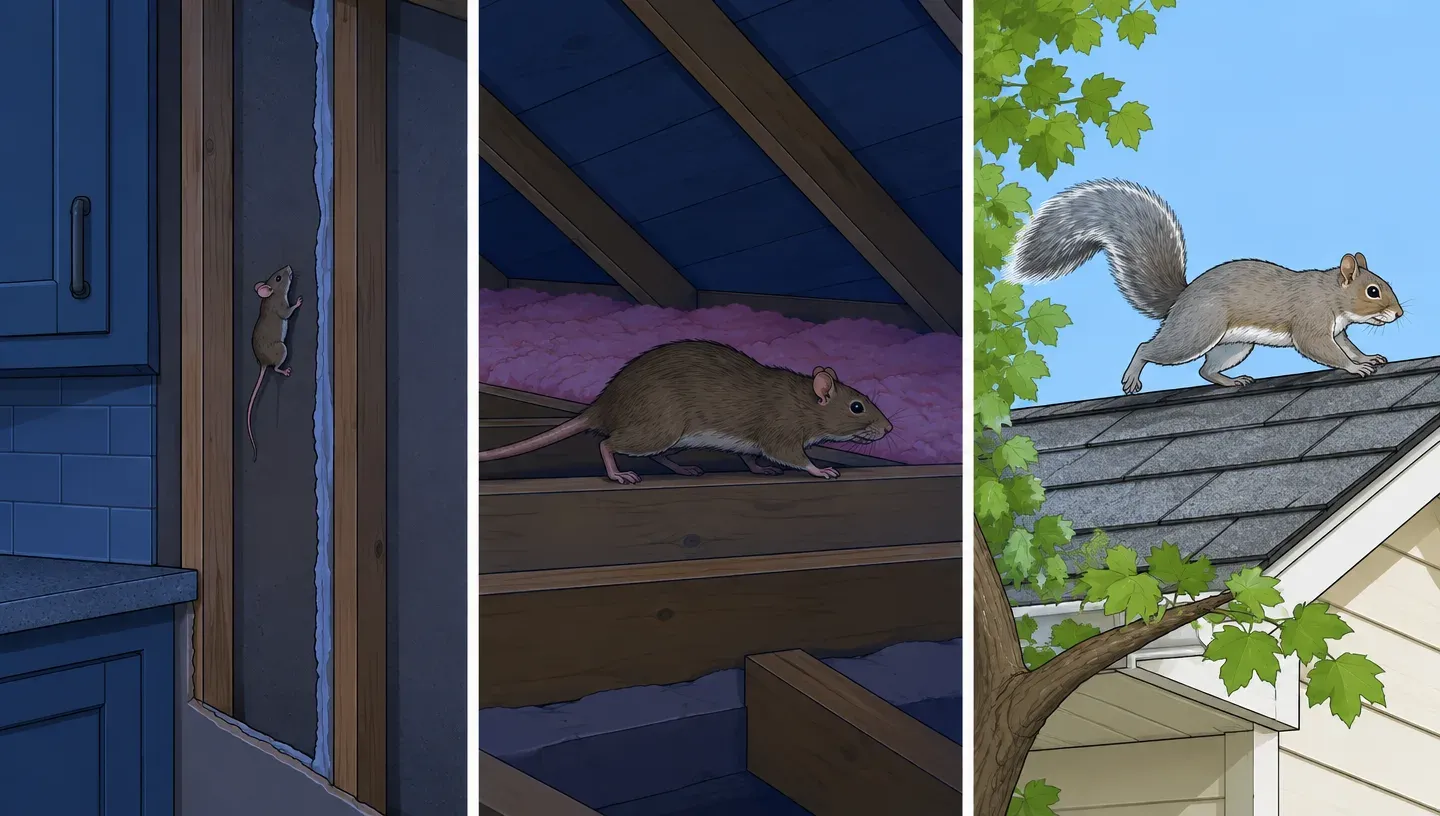
Illustration: a mouse in the wall at night, a rat on the attic joists at night, and a squirrel on the roof by day.
What Do Mice Sound Like in Walls and Ceilings?
In a wall, expect light scratching that moves up or down, or a patter that stops and turns into gnawing. In a ceiling, it’s running and scrabbling along one line. Not sure it’s mice at all? Scratching in walls compares mice, rats, squirrels, raccoons, bats and birds. For mice in the walls, trap in the room nearest the sound, under sinks and behind appliances, rather than opening drywall.
How to Confirm It’s Mice
Check the wall closest to the sound, under the sink, behind the stove and fridge, and in lower cabinets.
Look for droppings, the surest sign (sizes above).
Look for gnaw marks. Mice leave small, scratchy tooth marks; UC IPM puts rat marks at about twice as wide.
Lay a flour line along that baseboard at night and check it for tracks in the morning. With a toddler or pets, lay it inside the cabinet under the sink instead.
Notice a musky smell, common with large or long-term infestations.
Record the sound on your phone with the time, room and height; the same spot every night is a strong lead.
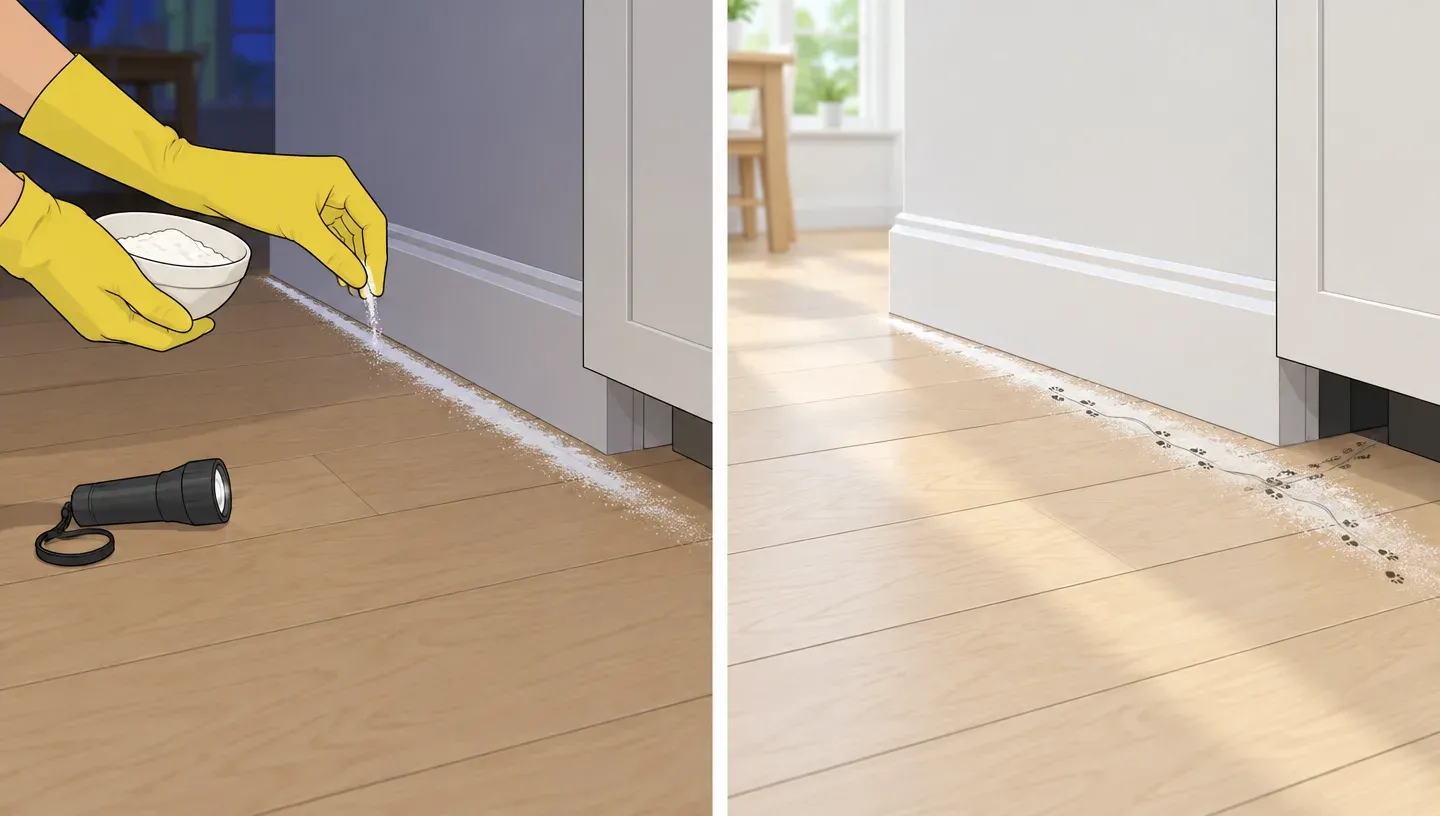
Illustration: a thin line of flour along the baseboard at night, and tiny footprints in it by morning.
Trap Where You Hear Them: The Nest Is Usually Close
Kentucky’s entomology department says mice usually forage no more than 10 to 25 feet from their nest, so the room where you hear them is almost always the room to trap. UC IPM says to space traps no more than about 10 feet apart, so a 10-foot wall takes a pair at each end: 4 traps (our math).
Set them along the wall nearest the sound, plus any spots with droppings or tracks, baited end at the wall, two traps 1 to 2 inches apart to catch mice that jump the first. For noise up high, use attic ledges, pipes or beams, not shelves a child or cat can reach. Skip glue and live traps; the CDC says they scare rodents into urinating, which raises your risk of illness.
Check traps every morning, and plan on more than one mouse: Nebraska Extension says a female can raise 5 to 10 litters a year in ideal conditions. If traps stay empty, move them closer to the sound. Setup is in how to set a mouse trap.
Is It Dangerous to Hear Mice in the House?
The noise can’t hurt you; the risk is in droppings and urine. Nebraska Extension says house mice aren’t known to carry hantavirus, but advises care during cleanup anyway, since few people can tell which rodent they have. Spray droppings with disinfectant or 1½ cups of bleach in 1 gallon of water, let it soak 5 minutes and wipe up; never sweep or vacuum (cleaning mouse droppings).
Look for chewed cords or wires along that wall. If you find any, have an electrician check them: the University of Kentucky notes mouse-gnawed wiring can cause fires and appliance failures.
What to Do Next
The whole-house plan, including sealing gaps the width of a pencil, is in how to get rid of mice.
- Store food in sealed containers and pick up pet food before bed.
- Note the time and wall where the noise is loudest.
- Check that wall for droppings and tracks the next morning.
- Set snap traps in pairs along it, out of reach of kids and pets.
- Keep trapping at least 15 days, until a week brings no catches and no new droppings, even if the noise stopped earlier.
- Seal gaps once catches slow. Renting? Tell your landlord in writing before sealing outside gaps or opening a wall.
| Item | Typical cost |
|---|---|
| 12 wooden mouse snap traps | $13.74 |
| 24 snap traps (enough for a new infestation in a 1,500 sq ft home, per Nebraska Extension) | $27.48 |
| Pro trap-and-seal job, 53 shared quotes (middle half) | $1,400–$3,000 |
| Pro visit, price-guide range (usually no sealing) | $150–$655 |
DIY: Victor list price ($2.29 per 2-pack) on September 30, 2026, before tax; totals are our math. Pro: the middle half of 53 trap-and-seal quotes homeowners shared on Reddit (see the quote table). Price-guide range: This Old House for mice (April 2026) and HomeAdvisor for rats (June 2026); it usually covers a trap-and-bait visit, with sealing extra.
Call a pro for sounds in heating or cooling ducts (CDC), chewed wiring, or noise that outlasts 15 days of trapping; a wall or attic alone isn’t a reason.
Common questions
They can. A mouse that’s caught but not killed may squeak, which means it’s still alive. Check it right away with gloves on, and never pick up a live mouse bare-handed: mice may bite when handled.
Wear gloves, spray the mouse and trap with disinfectant, then seal them in a plastic bag for the trash; dead mouse removal has the full steps.
Sources and further reading · 8
- ICWDM: Noises, Inspection, House Mouse Damage Identification, Norway Rat Damage Identification and Roof Rat Damage Identification.
- UC IPM: House Mouse, Rats and Tree Squirrels.
- Nebraska Extension: Controlling House Mice (G1105).
- University of Kentucky Entomology: Control of Mice (EF617).
- CDC: Trap Up, Seal Up and Clean Up.
- Portfors, Types and Functions of Ultrasonic Vocalizations in Laboratory Rats and Mice, JAALAS (2007).
- Ruat et al., Why Do Mice Squeak? Toward a Better Understanding of Defensive Vocalization, iScience (2022).
- Keesom et al., Hidden in Plain Sound: The Scientific Potential of House Mouse Squeaks, Biology Letters (2025).