Mouse in Bedroom? Will It Bite or Get in Your Bed?
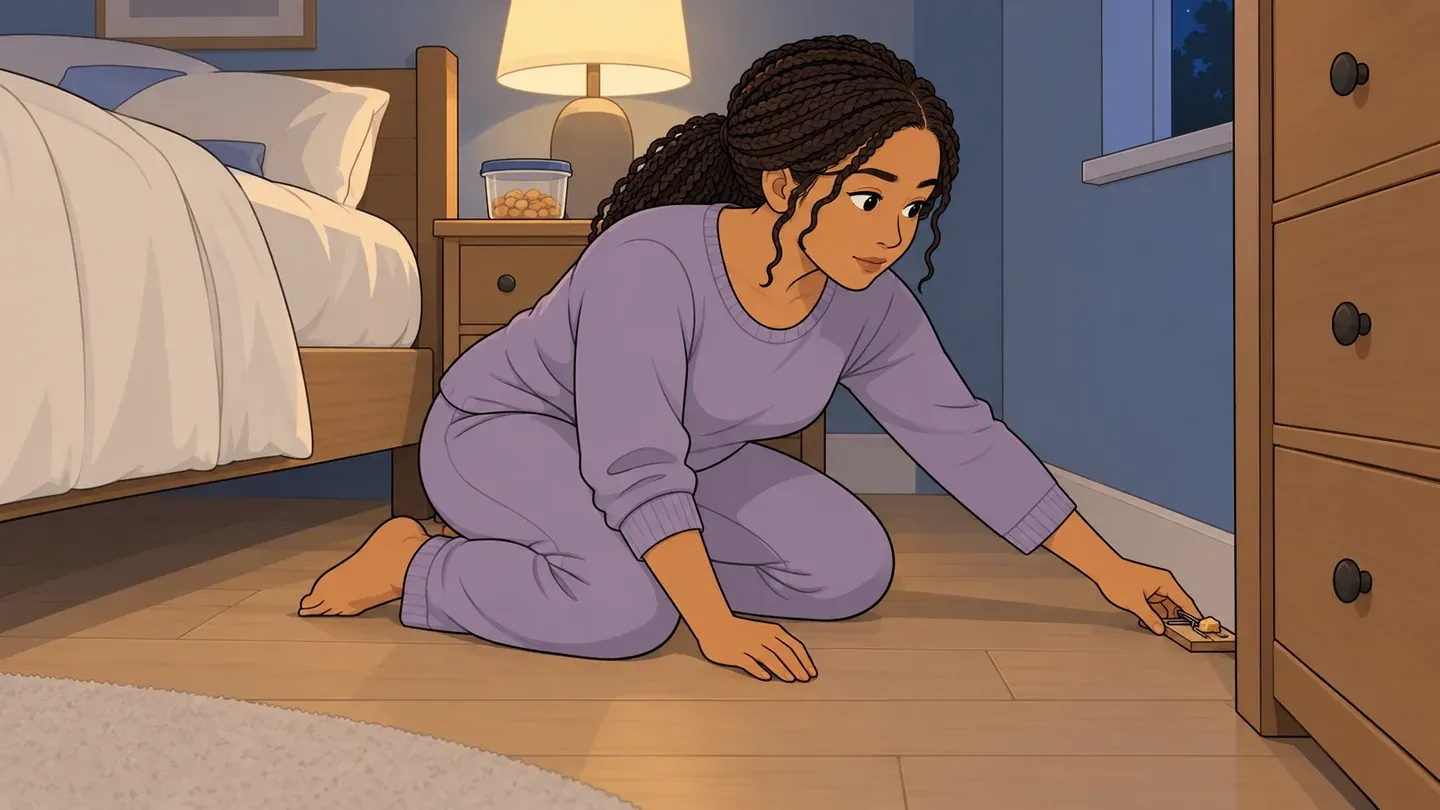
Illustration: a trap tucked behind the dresser, and the bed pulled off the wall with the bedding tucked up.
A mouse in the bedroom is a hygiene problem more than a bite threat: the CDC says rodent diseases mainly spread through air contaminated by their waste. Put food away tonight, pull the bed off the wall and set snap traps along the walls, away from kids and pets. Skip glue traps and plug-ins. It’s gone after a week with no catches or new signs.
Cost: about $57–71 in supplies. Difficulty: moderate. Call a pro if you find signs of deer mice in a rural home or cabin, droppings cover a large area, mice are in your heating or cooling ducts, or steady trapping hasn’t stopped them.
This guide covers whether it’s safe to sleep, what to do tonight, trapping around kids and pets, cleaning bedding and sealing the room. We haven’t tested these methods ourselves; this rests on CDC, UC IPM, Nebraska Extension and Texas A&M AgriLife guidance and September 2026 list prices. For the rest of the house, follow our plan for getting rid of mice.
What Works and What Doesn’t in a Bedroom
| Method | Works? | Cost | Main limitation |
|---|---|---|---|
| Snap traps behind furniture | Yes, the CDC’s pick | $13.74 for 12 | Must stay out of reach of kids and pets |
| Bed off the wall, food out | Yes, cuts routes and draw | Free | Doesn’t remove the mouse |
| Steel wool, copper mesh, door sweep | Yes, the lasting fix | Part of the $57–71 kit | Renters need the landlord’s OK for bigger jobs |
| Glue and live traps | No | — | Scared mice urinate more (CDC) |
| Plug-in sound devices | No | — | Little evidence they drive mice out |
| Poison | Skip | — | A mouse can die and smell inside the wall |
| Chasing it out the door | No | Free | House mice find their way back from half a mile (UC IPM) |
Is It Safe to Sleep With a Mouse in Your Bedroom?
Usually, yes, after the steps below. The main risk is what a house mouse leaves behind:
- Droppings and urine. Rodent diseases mainly reach people through contaminated air (CDC), which is why you shouldn’t sweep or vacuum droppings.
- Allergies. House mouse urine is a major allergen source, and UC IPM notes a link to early-onset asthma in sensitive children.
- Pregnancy or a weak immune system. House mice spread LCM, which the CDC says can seriously harm pregnant women and people with weakened immune systems. Let someone else handle traps and cleanup.
When to Sleep Somewhere Else
Near fields or woods, or in a cabin, check for deer mice: white belly, tail dark on top and white underneath. They spread the most common U.S. hantavirus (CDC), so avoid sleeping in infested areas until the mice are controlled and the area made safe.
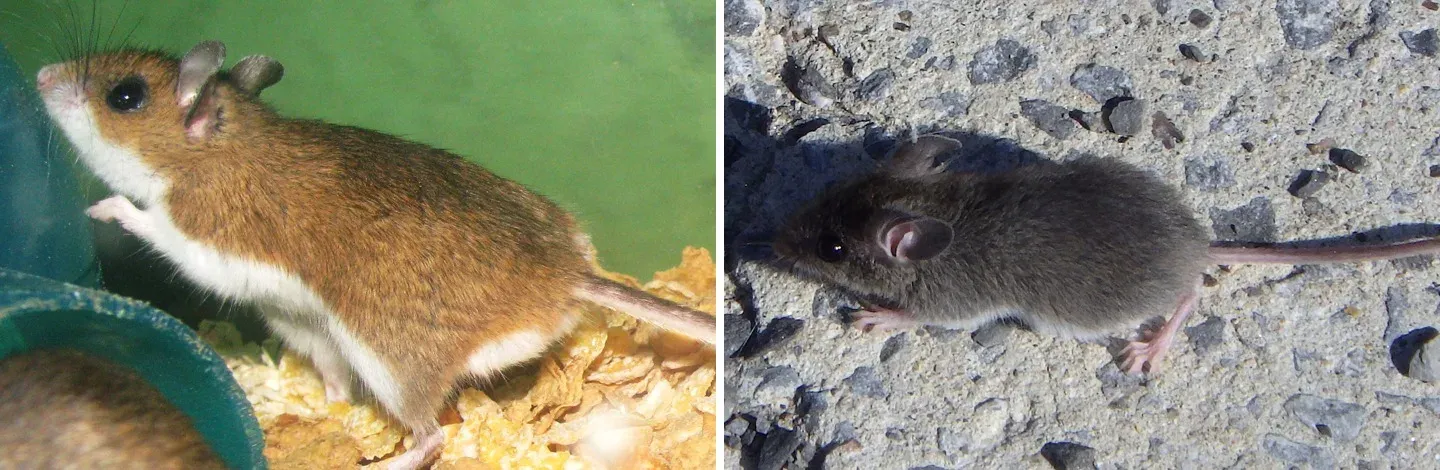
Left: deer mouse, photo by 6th Happiness (CC BY-SA 3.0). Right: house mouse, photo by Ahunt (CC0). Both via Wikimedia Commons.
Will Mice Bite or Crawl on You While You Sleep?
It can happen; the CDC lists bites among the ways rodents spread disease. But no health agency we checked says how often, and their advice centers on droppings and urine. A bed that doesn’t touch the wall or floor, with no food in it, gives a mouse fewer ways up and less reason to climb.
Itchy bites but no mouse in sight? Texas A&M AgriLife says house mouse mites bite people readily, usually in rooms near the nest, sometimes only after the mice are gone (bug bites).
If you are bitten, wash it with soap and water. Rabies isn’t the worry: the CDC’s Yellow Book says rodent exposures, with very rare exceptions, don’t count as rabies exposures. Mice can carry rat-bite fever, though, so see a doctor if fever, vomiting, headache or muscle pain appear within 3 to 21 days.
What to Do Tonight
Put food away. House mice eat about 200 small meals a night (UC IPM). Use lidded containers, and don’t leave pet food or water out overnight.
Pull the bed a few inches off the wall and tuck the bedding up off the floor.
Set two or three snap traps behind the dresser or nightstand and in the closet, where kids and pets can’t reach (Step 1).
Close the door. A mouse fits through a hole about ¼ inch wide (CDC); a rolled towel closes a bigger gap under the door for tonight. Sealing and deep cleaning can wait until tomorrow.
Can Mice Climb Into Your Bed?
They can, if there’s a route. House mice run up any rough vertical surface and jump up to 12 inches onto a flat surface (UC IPM). That usually won’t reach the top of a mattress, so mice in bed most likely climbed whatever touches it: a comforter hanging to the floor, a headboard against the wall, a nightstand or a pile of clothes. More on how they climb walls, pipes and wires.
Where Do Mice Hide in Bedrooms?
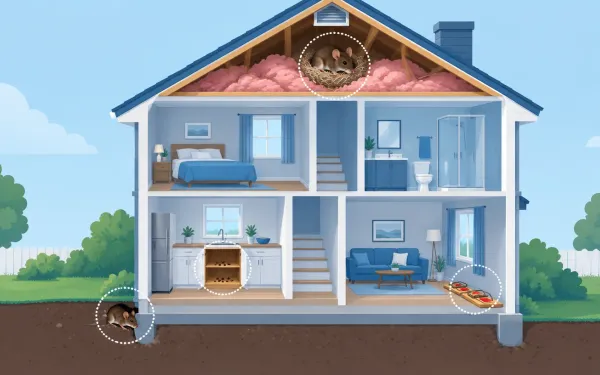
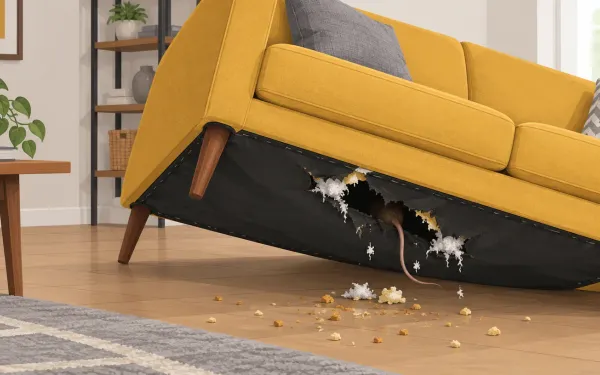
Mice run next to walls and objects for safety (CDC). Check closet floor corners, behind and under furniture (including boxes under the bed), and drawers, where you may find nests of shredded material.
Signs at night: scratching or squeaking in the walls (what mice sound like), droppings ⅛ to ¼ inch long with pointed ends, gnawed cardboard and a musky smell (Nebraska Extension). Compare droppings with rat poop vs. mouse poop.
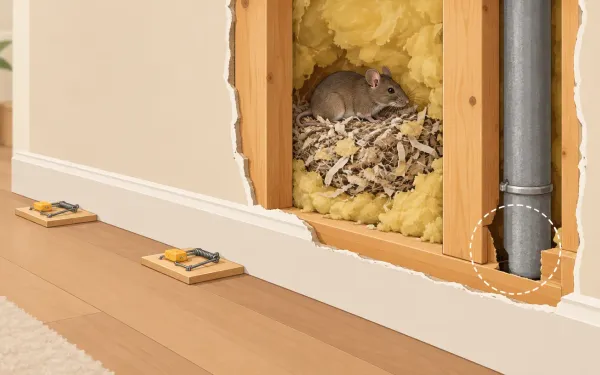
How they get in: closet floors, gaps around windows and doors, floor vents, and pipes and wires through the floor (CDC). Scratching inside the wall or overhead points to mice in the walls or mice in the attic.
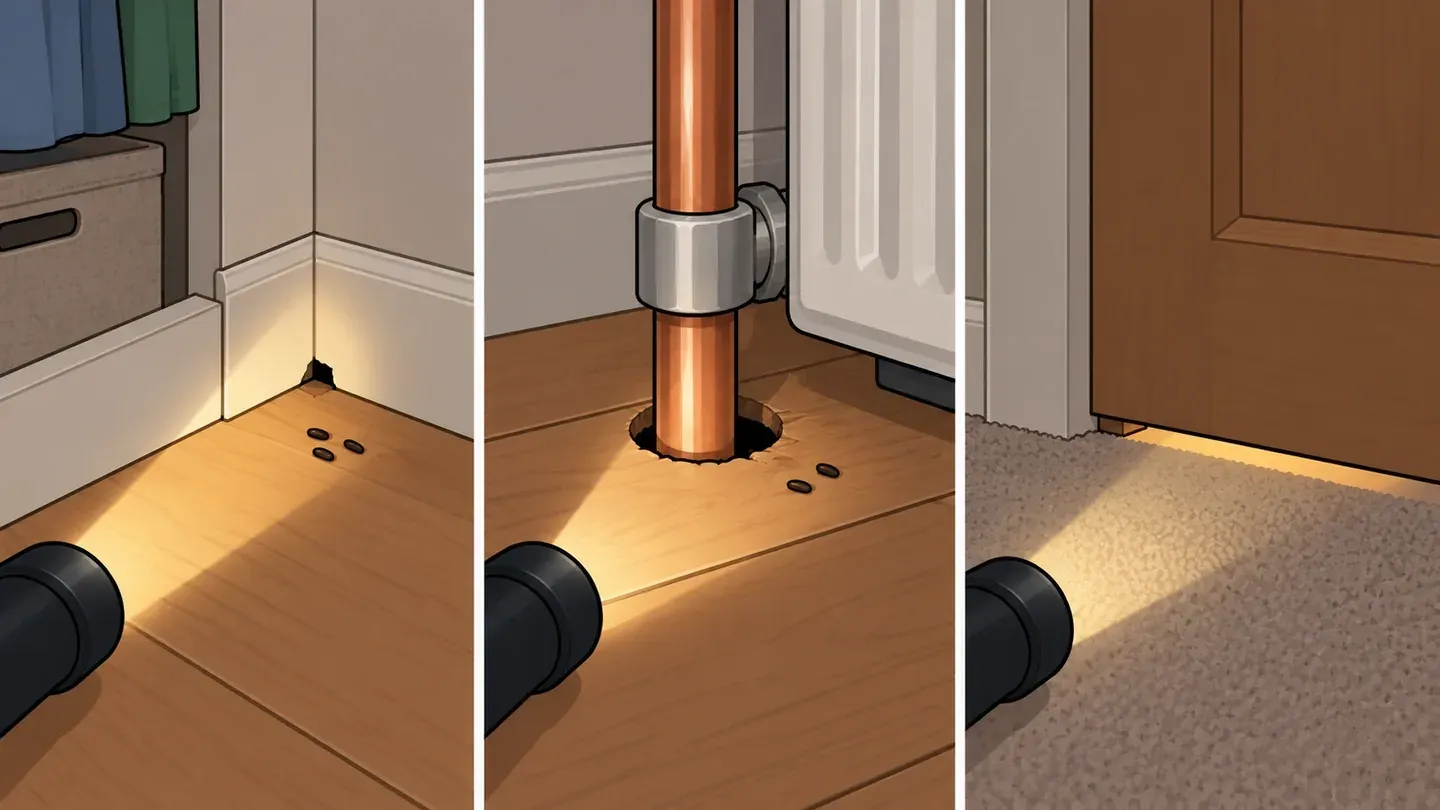
Illustration: droppings by a gap in a closet floor corner, a gap around a heating pipe, and light under a bedroom door.
Step 1: Trap the Mouse in Your Bedroom Safely
The CDC recommends snap traps, kept out of reach of children and pets.
Set a “T” against the wall. Baited end touching the wall, behind the dresser, beside the nightstand, along the closet floor and near droppings.
Use pairs, not singles. Two traps 1 to 2 inches apart catch mice that jump one, with pairs no more than about 10 feet apart (UC IPM).
Hide them from kids and pets. Behind heavy furniture or inside a tamper-resistant station that holds a snap trap.
Bait a pea-sized dab. Allergies? Nebraska Extension lists chocolate, non-allergenic commercial bait or a cotton ball instead of peanut butter. Check every morning; more in how to set a mouse trap.
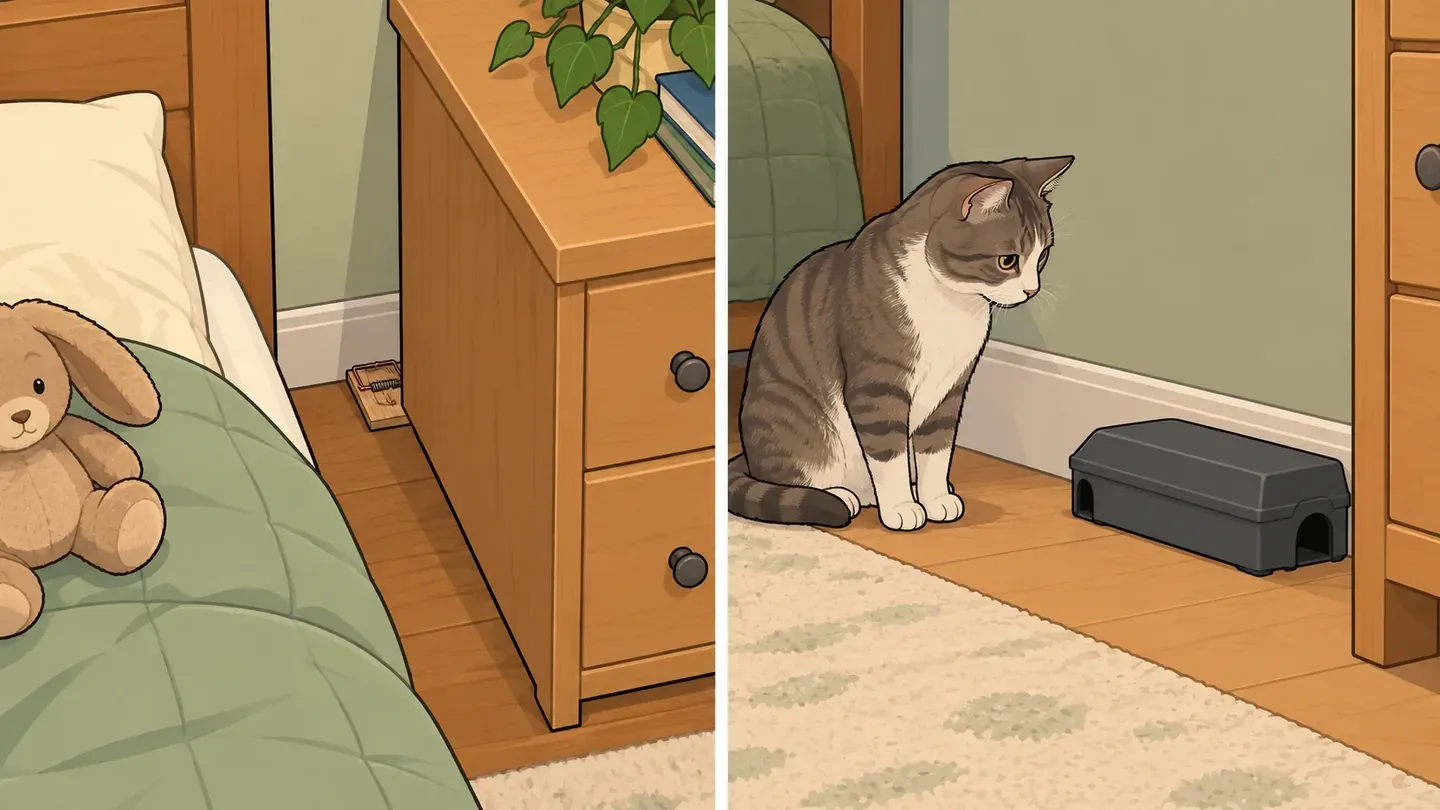
Illustration: a snap trap behind a dresser in a child’s bedroom (left), and a closed trap station along a baseboard with a cat nearby (right).
Keep poison out of the bedroom. If a child may have eaten bait, call Poison Control at 1-800-222-1222; for a pet, call your vet.
Step 2: Clean Mouse Droppings on Your Bed
Deal with droppings on the bed tonight and the rest of the room once trapping is done.
Air the room first. Open the windows for 30 minutes and stay out, then put on rubber or plastic gloves.
Soak, don’t shake. Spray droppings and urine with disinfectant or bleach solution (1.5 cups of bleach per gallon of water) until very wet, soak 5 minutes and wipe up with paper towels. Don’t sweep, vacuum or shake out soiled sheets (how to clean mouse droppings).
Wash fabrics hot. Bedding, clothes and stuffed animals go in hot water and detergent, then a hot dryer or the sun. Shampoo a mattress or rug with a commercial disinfectant or a commercial-grade steam cleaner; the same works for a couch.
Step 3: Keep Mice Out of Your Room
Exclusion is the most successful and permanent form of house mouse control, says UC IPM. Close every gap ¼ inch or bigger:
- Small gaps: copper mesh or stainless steel fiber plus sealant, or steel wool with caulk (CDC), though steel wool can rust.
- Larger holes: hardware cloth, metal sheeting or cement, not plastic, rubber, wood or foam alone.
- Doors: a door sweep fixes the gap underneath.
Renting? Send your landlord photos of the gaps and ask in writing for them to be sealed, especially anything that means cutting, drilling or working outside.
Which Plan Fits Your Situation
| Your situation | Start with | Then |
|---|---|---|
| Renting | Traps and food out tonight | Written request to seal gaps |
| A child’s room or pets | Traps behind heavy furniture or in stations | No poison in the house |
| Pregnant or immune-compromised | Someone else traps and cleans | The same steps, done by them |
| Scratching in the wall or ceiling | Traps along that wall | Walls or attic guide |
| Deer mice, rural home | Sleep somewhere else | A pro |
What It Might Still Cost
| Item | Typical cost |
|---|---|
| 12 wooden snap traps | $13.74 |
| DIY kit: 12–24 traps, copper mesh, gloves, bleach | About $57–71 |
| Pro trap-and-seal job, 53 shared quotes (middle half) | $1,400–$3,000 |
| Pro visit, price-guide range (usually no sealing) | $150–$655 |
| Pro attic insulation cleanup, if upsold | $7,500–$14,000 |
DIY: U.S. list prices from Victor, DoMyOwn and Target, September 30, 2026, before tax. Pro: the middle half of 53 trap-and-seal quotes homeowners shared on Reddit (see the quote table). Price-guide range: This Old House for mice (April 2026) and HomeAdvisor for rats (June 2026); it usually covers a trap-and-bait visit, with sealing extra. Attic cleanup: the middle half of 35 shared quotes that included new insulation.
Before You Start: A Quick Checklist
- Move all food and pet food out of the bedroom tonight.
- Pull the bed off the wall and tuck the bedding up.
- Set two or three snap traps where kids and pets can’t reach.
- Air out the room for 30 minutes before cleaning droppings.
- Wash bedding hot instead of shaking it out.
- Photograph gaps for your landlord if you rent.
When to Call a Pro
- Deer mice in a rural home or cabin, or droppings over a large area (the CDC calls for a HEPA-filter respirator for heavy infestations).
- Mice in your heating or cooling ducts, which the CDC says needs a professional.
- Chewed wiring, a fire risk.
- Trapping hasn’t solved it after a few weeks; see what an exterminator does.
Common questions
The CDC’s rule: a week with no catches and no new signs. Clean up old droppings so new ones stand out, or check a thin patch of flour along a wall for tracks overnight.
Probably not. UC IPM says house mice come out by day when food is available, and a lamp doesn’t remove the food and shelter that drew the mouse in.
Deer mice damage mattresses for nesting (UC IPM). If you find droppings or chewing, shampoo it with a disinfectant or steam clean it (Step 2), or discard it.
Sources and further reading · 7
- CDC: Trap Up, Seal Up, Clean Up and Controlling Wild Rodent Infestations.
- CDC: Hantavirus, LCM, Rat-Bite Fever, Rabies and Yellow Book: Zoonotic Exposures.
- UC IPM: House Mouse and Deer Mouse — deer mouse ID and sleeping in infested areas, nests, sound devices, trap placement near kids and pets, exclusion, wiring.
- Nebraska Extension: Controlling House Mice (G1105) — house mice and hantavirus, droppings, bait, copper mesh.
- Internet Center for Wildlife Damage Management (ICWDM): House Mice and House Mouse Control.
- Poison Control: Mouse and Rat Poisons.
- Texas A&M AgriLife Extension: Biting Mites.