How to Get Rid of Mice in Walls Without Opening the Wall
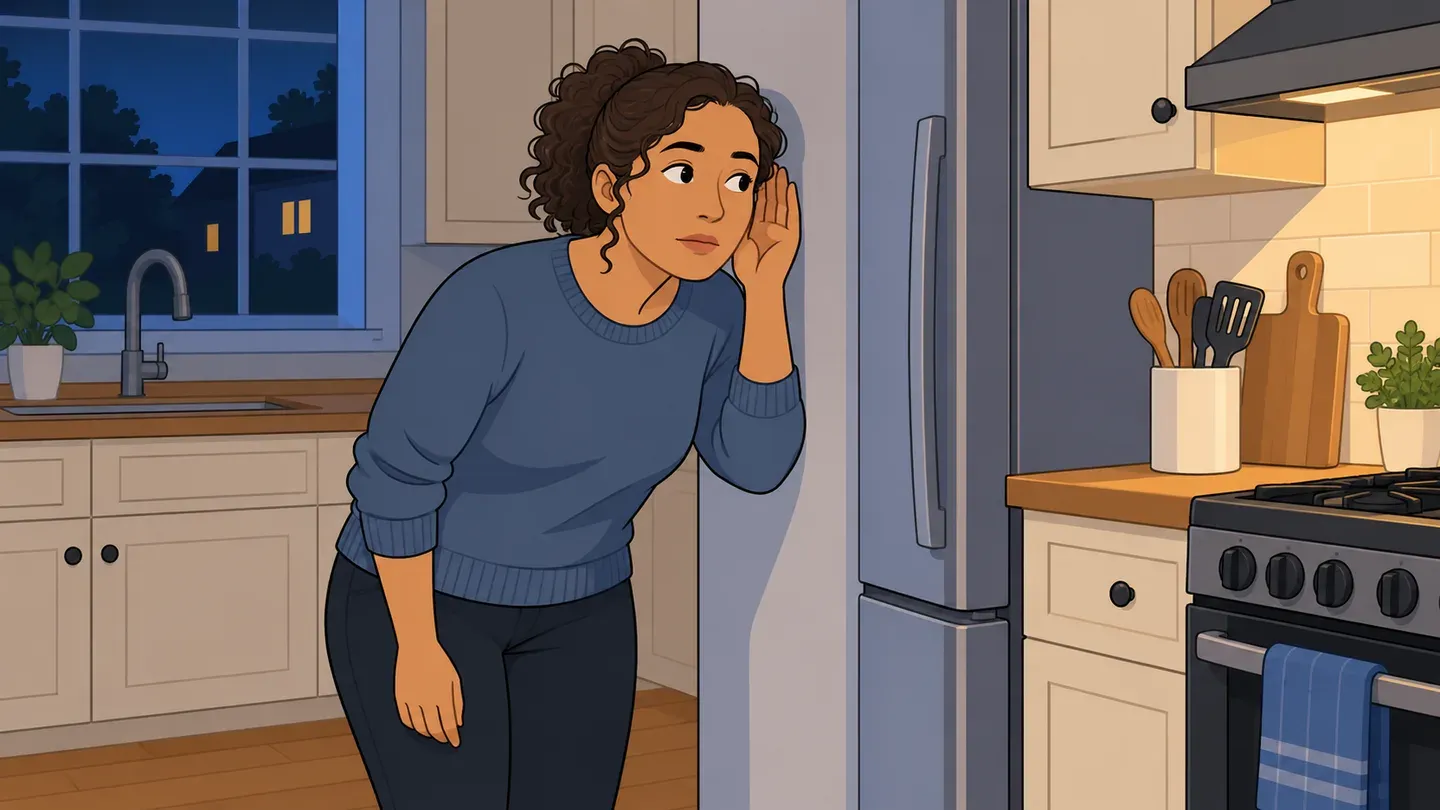
Illustration: a woman listens at the kitchen wall beside the refrigerator at night.
To get rid of mice in walls, you rarely need to open the wall: trap where they come out. Check pipe gaps under the sink, behind the stove or fridge, and baseboard cracks. Set snap traps along those routes, seal the outside entry holes first, skip poison, and keep trapping until a week passes with no catches, noise or droppings.
Cost: about $57–71 in supplies. Difficulty: moderate. Call a pro if you smell a dead animal you can’t locate, find chewed wiring, or the noise continues after two weeks of trapping at every exit.
Mice travel through walls and come out to eat. This page covers how to confirm it’s mice, the three steps, when cutting in makes sense and what it costs; the whole-house plan is in how to get rid of mice. We haven’t tested these methods ourselves; this rests on CDC, university extension and ICWDM guidance, plus store list prices.
Hearing it right now? Don’t cut into the wall tonight. Note where the sound is, put food and pet food away, and check under the nearest sink and behind the nearest appliance for droppings in the morning.
What Works and What Doesn’t for Mice in Walls
Trapping at the exits and sealing from the outside in works; poison and early sealing backfire.
| Method | Works? | Cost | Main limitation |
|---|---|---|---|
| Snap traps at the wall’s exits | Yes, the core | $2.29 a two-pack | You have to find the active exits first. |
| Sealing outside gaps first | Yes, stops new mice | $28.80 for 20 ft of copper mesh | Doesn’t remove the mice already in the wall. |
| Sealing inside exits early | No | — | Shuts mice in, where they may die or chew a new way out. |
| Foam on its own | No | — | The ICWDM notes mice damage rigid foam and insulation. |
| Cutting into the wall | Rarely needed | — | Risky near wiring and plumbing; mice come out to eat anyway. |
| Poison bait | No | — | A poisoned mouse can die inside the wall, where you can’t reach it and the smell lasts. |
What Do Mice in the Walls Sound Like?
Scratching and squeaking from walls and ceilings, mostly at night: Nebraska Extension lists these sounds as a sign of mice, and mice are most active before dawn and after dusk. Sound alone can’t name the animal; the ICWDM offers only rough clues:
| What you hear | Could be |
|---|---|
| Scratching inside a wall | Mice, rats or birds |
| Running in the attic | Squirrels |
| Heavy walking overhead | Raccoon or opossum |
| Regular, repetitive noise | Probably mechanical, not an animal |
Squirrels need a different plan. UC IPM says to make sure none are inside, then close the gap with sheet metal or ¼-inch hardware cloth; check state rules before trapping.
Confirm mice with signs you can see:
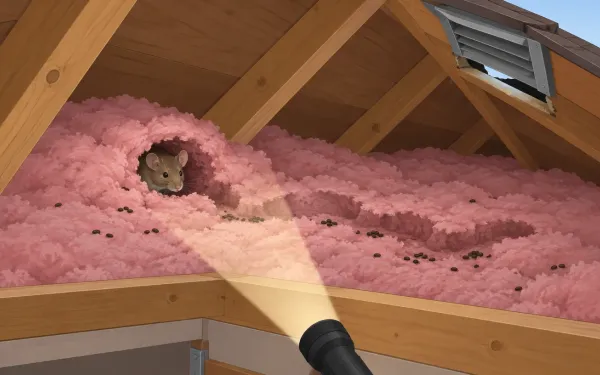
- Droppings: ⅛ to ¼ inch long with pointed ends, near walls, in cabinets and behind appliances. Much larger droppings point to rats.
- Rub marks and gnaw holes: dark smudges and small, clean-edged holes along baseboards and cabinet backs.
- Musky odor: a musky smell is common with large or long-term infestations.
More noise suspects are compared in scratching in the walls.
How Do Mice Get Inside Walls?
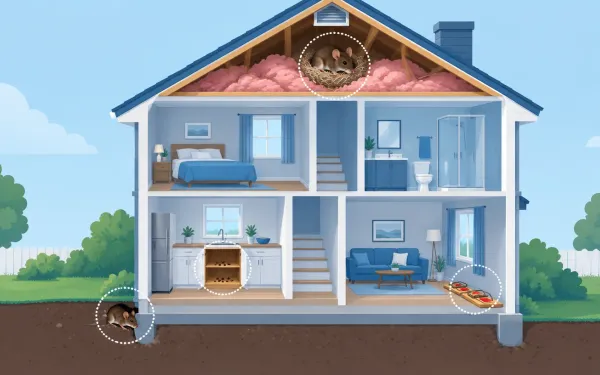
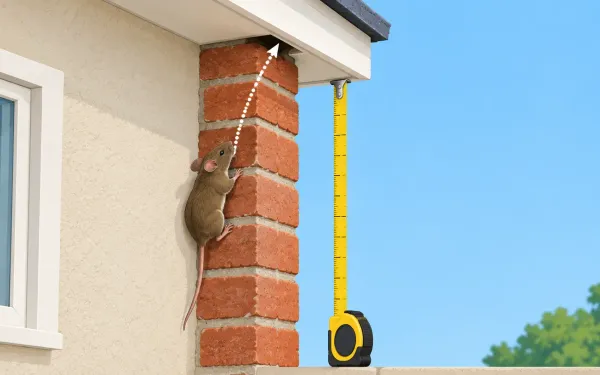
Through gaps about ¼ inch across at the foundation, around utility lines and under siding. Wall cavities connect to the crawl space or basement below, the attic above, and the gaps around pipes, wires and vents. Mice climb up inside those cavities along pipes and wires; see can mice climb walls.
They don’t go far: UC IPM says house mice seldom travel more than 30 feet from their nest and food. The mice in your kitchen wall are probably living and eating close to where you hear them.
Step 1: Find Where Mice Leave the Wall
Check every exit with a flashlight. Look where pipes come through under the kitchen and bathroom sinks, behind the stove, fridge, washer and dishwasher kick plate, along baseboards in closet corners, around radiators and floor vents, and in the back of lower cabinets.
Read the droppings. Fresh ones are dark and soft; old ones are dry and crumbly.
Dust flour if you’re unsure. Spread a thin layer of flour or talcum powder in front of the exit at night. Tracks in the morning mean mice are using it.
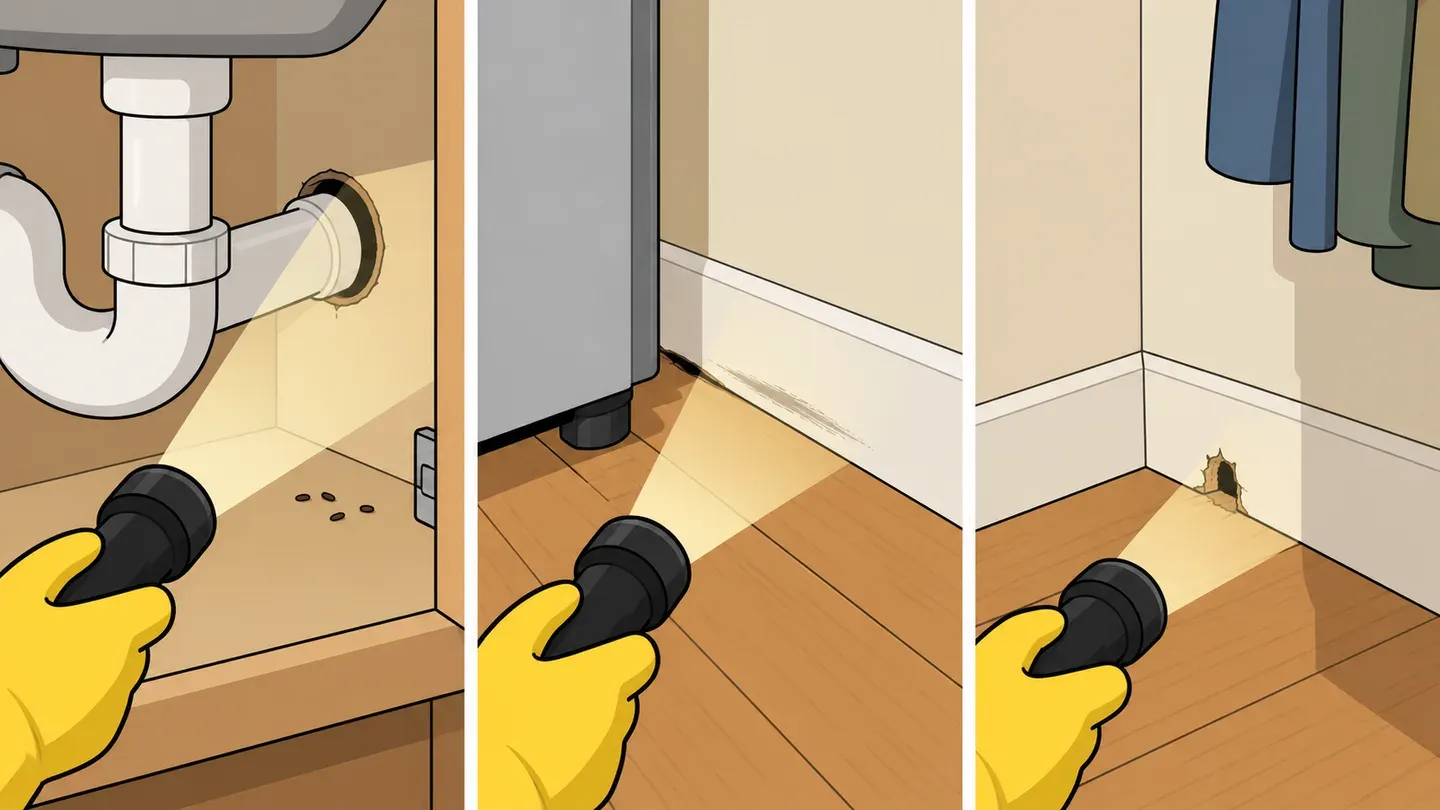
Illustration: a pipe gap under a sink, a gap behind a refrigerator and a gnawed hole in a baseboard.
Step 2: Trap at the Exit Points
Set snap traps against the wall next to each active exit, baited end touching it so the trap forms a “T,” as the CDC recommends. Space them no more than about 10 feet apart, in pairs 1 to 2 inches apart to catch mice that jump over a single trap.
Box them in, not out in the open, where children and pets live: an enclosed trap station or a spot they can’t reach. Check traps every day and note what you catch and where.
Bait, setup and trap types are in how to set a mouse trap, the best mouse trap bait and which mouse trap to use.
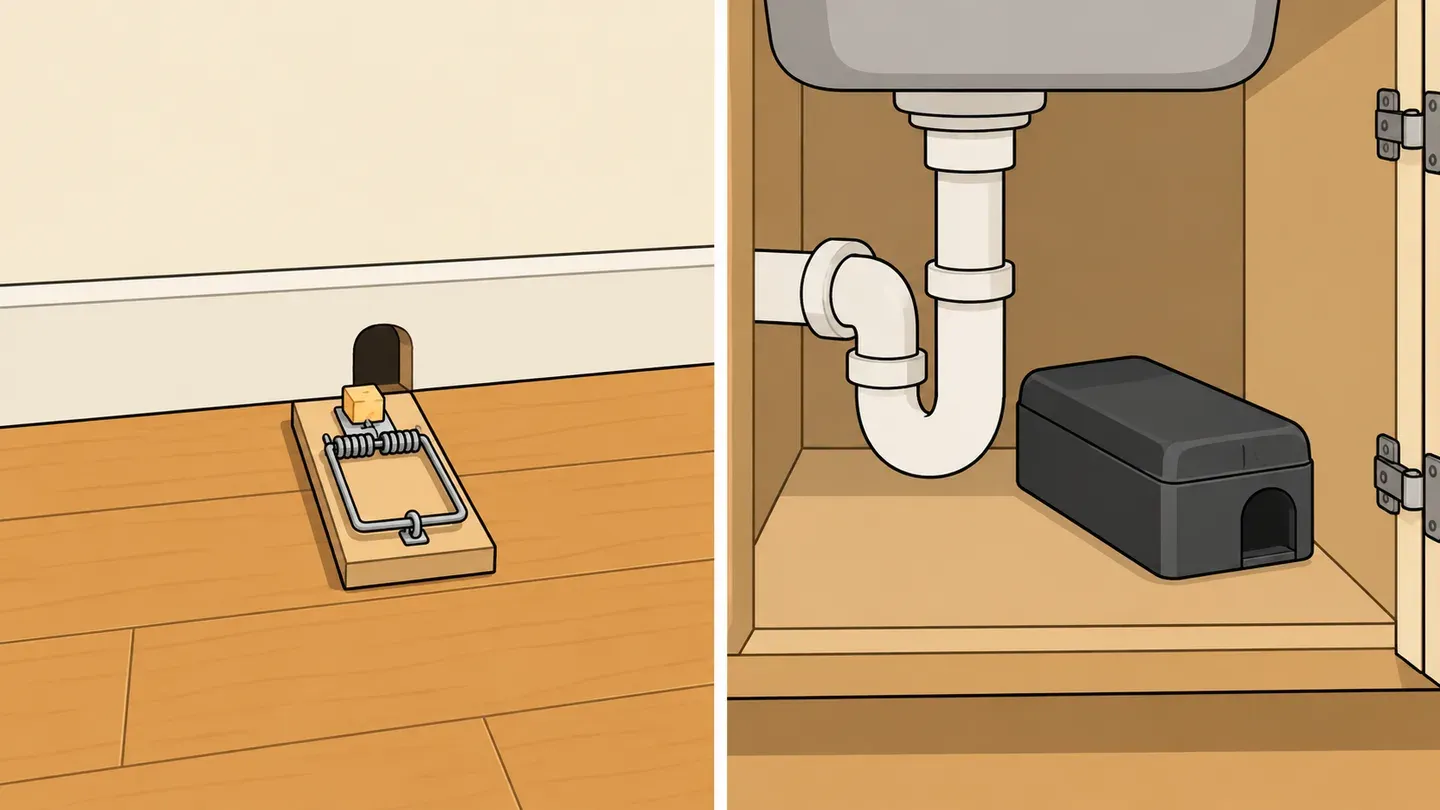
Illustration: a snap trap at a right angle to the baseboard beside a gap, and a second trap in an enclosed box under a sink.
Step 3: Seal in the Right Order
Seal outside first, while traps keep working inside. Close gaps around the foundation, where pipes and wires enter, at garage door corners and around vents. New mice can’t get in, and the ones inside still come out to the traps.
Seal inside exits last. Wait until traps have gone several nights without a catch and there are no fresh droppings. Sealing earlier can shut mice inside the wall.
Use metal, not foam. The ICWDM recommends ¼-inch wire mesh or stainless steel or copper wool; steel wool vs. copper mesh compares the two.
Should You Cut Into the Wall?
Usually not, and if you rent, ask your landlord first. A small inspection hole makes sense only for a strong odor in one spot, which suggests a dead mouse, or a nest you’ve pinpointed. If you do open a wall:
- Turn off the circuit before removing any outlet or switch cover, and use a stud finder to avoid pipes and wires.
- Start with a small hole and an inspection camera (borescope).
- Clean droppings or nesting material wet, as the CDC describes: spray with disinfectant, let it soak, then wipe. Don’t sweep or vacuum.
How to Get Rid of Rats in the Walls
Same plan, bigger tools: rat droppings run about ½ to ¾ inch. Use rat-size snap traps fastened to the surface, which UC IPM says focuses the snap; seal with steel wool, wire screen or sheet metal, since rats chew through foam and caulk; and look higher for roof rats, which favor attics and false ceilings. The full plan is in how to get rid of rats.
How to Tell the Mice Are Gone
The CDC’s rule of thumb: nothing caught for a week and no new signs. Log what you hear and catch, then leave a couple of traps along the old routes.
Which Plan Fits Your Situation
| Situation | What to do | Why |
|---|---|---|
| You rent | Trap and store food inside your unit; tell the landlord in writing, with photos, before sealing outside or opening a wall | Outside sealing and wall repairs are the landlord’s call; keep a copy. |
| Kids or pets at home | Snap traps inside enclosed trap boxes; no poison | Keeps paws and fingers off the trigger and bait out of reach. |
| Noise in the ceiling | Trap where it meets the walls, the attic or a drop-ceiling tile you can lift | A ceiling works like a wall lying flat; check the attic above for droppings. |
| A smell you can’t trace | Follow the odor to one spot before any small inspection hole | It may be a dead mouse in the cavity. |
| Flickering lights or dead outlets | Get an electrician to check the wiring | UC IPM says mice chew wires inside walls. |
| Droppings ½ inch or bigger | Switch to the rat plan above | Rats need bigger traps and metal sealing. |
What It Might Still Cost
| Item | Typical cost |
|---|---|
| DIY: 12–24 snap traps, 20 ft copper mesh, gloves, bleach | $57–71 |
| Pro trap-and-seal job, 53 shared quotes (middle half) | $1,400–$3,000 |
| Pro visit, price-guide range (usually no sealing) | $150–$655 |
| Pro attic insulation cleanup, if upsold | $7,500–$14,000 |
DIY: U.S. list prices from Victor, DoMyOwn and Target on September 30, 2026, before tax and shipping. Pro: the middle half of 53 trap-and-seal quotes homeowners shared on Reddit (see the quote table). Price-guide range: This Old House for mice (April 2026) and HomeAdvisor for rats (June 2026); it usually covers a trap-and-bait visit, with sealing extra. Attic cleanup: the middle half of 35 shared quotes that included new insulation.
Sealing quotes can run far higher: one homeowner on Reddit was quoted $2,400 for mouse-proofing the siding. Ask what exactly will be sealed and with what; exterminator vs. DIY cost sets the numbers side by side.
Before You Start: A Quick Checklist
- Confirm it’s mice: droppings ⅛ to ¼ inch near an exit, not just a sound.
- Find every exit under sinks, behind appliances and along baseboards.
- Set snap traps in pairs against the wall at each active exit.
- Seal outside gaps first with metal, not foam.
- Leave inside exits open until traps go several nights without a catch.
- Skip poison, so nothing dies inside the wall.
When to Call a Pro
Call one if you smell a dead animal you can’t locate, find chewed wiring, or still hear noise after two weeks of trapping at every exit, or if a wall must be opened near wiring you’d rather not work around. Ask whether they plan to use poison inside.
Common questions
Not while they have food and shelter nearby. Mice stay close to their nest, so if they’re in your walls, they’re probably feeding in your house.
Yes. Mice gnaw through drywall, wood and insulation. Once they’re gone, seal any holes with wire mesh or steel wool and a patch.
They can. UC IPM says many fires of unknown origin are believed to be caused by rodents gnawing on wires.
The Bottom Line
Trap at the exits, seal outside before inside, and leave the drywall and the poison alone. It costs about $57–71 in supplies, and you rarely need to cut into the wall.
Sources and further reading · 7
- University of Nebraska–Lincoln Extension: Controlling House Mice (G1105) — sounds, droppings, nests and gap sizes.
- ICWDM: Identifying Noises Caused by Wildlife in Structures — what noises may mean.
- UC IPM: Tree Squirrels — sealing squirrels out and their legal status.
- ICWDM: House Mouse Damage Prevention and Control and House Mice — signs, sealing materials and tracking patches.
- UC IPM: House Mouse Pest Notes and Rats — travel distance, trap spacing, sealing and chewed wires.
- CDC: How to Trap Up to Remove Rodents and How to Clean Up After Rodents — trapping and safe clean-up.
- NC State Extension: Pest Problems After Storms — Rodents — why indoor bait can leave carcasses in walls.