Mice in Basement or Crawl Space: How to Get Rid of Them
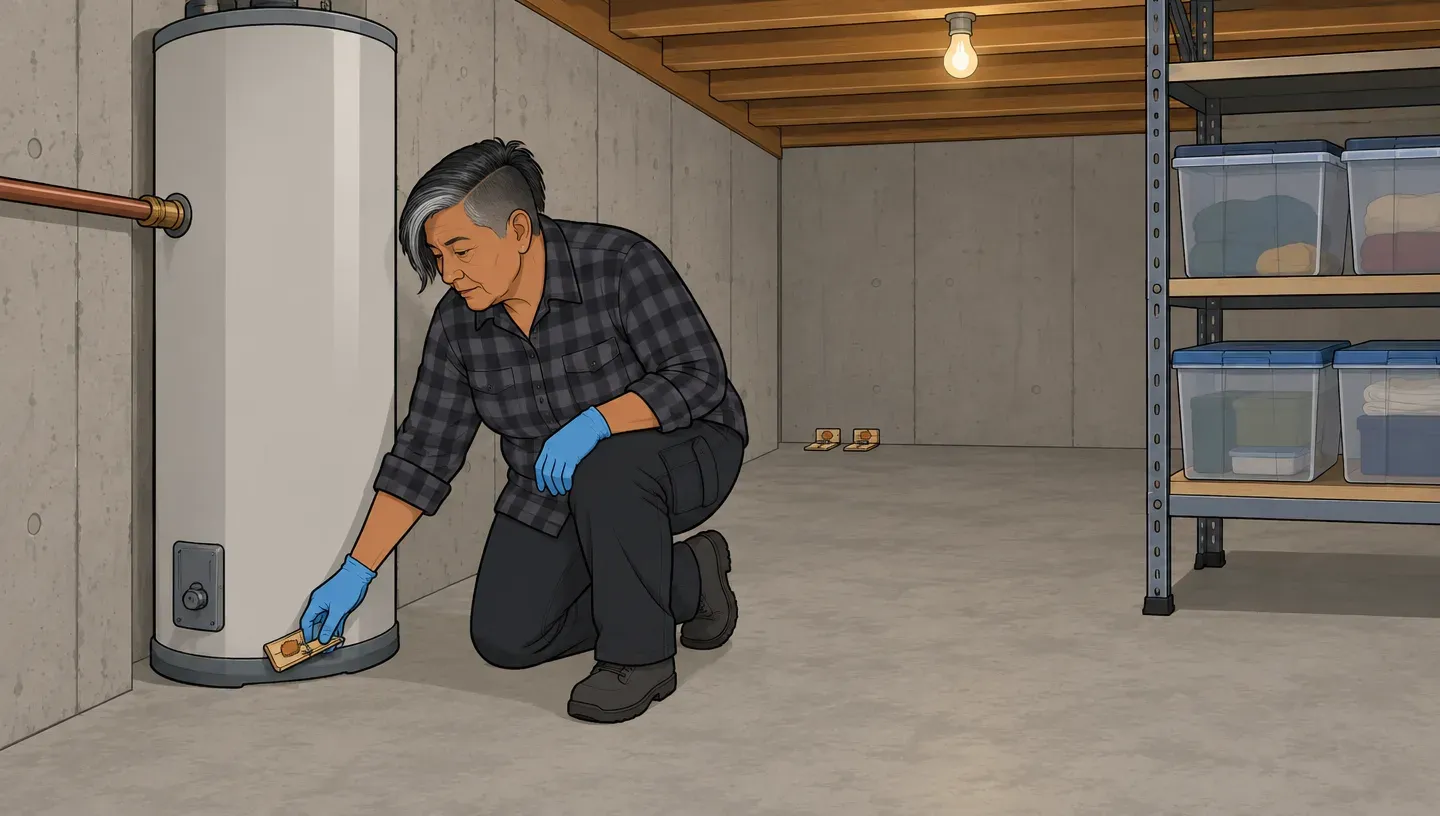
Illustration: a snap trap at a right angle to the wall, bait end touching it, and a pair of traps farther along the same wall.
Mice in the basement or crawl space get in through foundation cracks, pipe gaps, floor drains and vents. Set snap traps along the walls near droppings, seal every gap ¼ inch or larger with metal or cement, and disinfect droppings wet. Skip poison and plug-in repellers. Keep traps out at least 15 days; a week with no catches and no new droppings means they’re gone.
Cost: about $57–71 in supplies. Difficulty: moderate. Call a pro if rodents are in your heating or cooling ducts, a crawl space heavy with droppings is more than you can reach or clean safely, rats keep digging under the foundation, or at least 15 days of trapping and rebaiting haven’t stopped them.
This guide covers basements, crawl spaces, soiled ceilings and insulation, and rat burrows along the foundation. We haven’t tested these methods ourselves; this rests on CDC, University of California, National Park Service and state health department guidance and 2026 list and platform prices.
Saw a mouse or rat in the basement tonight? Put food, pet food and birdseed in containers with tight lids. Set snap traps with a small dab of peanut butter along the walls, where kids and pets can’t reach. Don’t sweep or vacuum droppings. For mice upstairs too, see how to get rid of mice.
What Works and What Doesn’t in a Basement
| Method | Works? | Cost | Main limitation |
|---|---|---|---|
| Snap traps along walls | Yes | Part of the $57–71 kit | Rats need rat-size traps, prebaited unset |
| Copper mesh, cement, hardware cloth | Yes, for sealing | Part of the kit | Foundation work may need your landlord’s OK |
| Foam alone | No | — | Rats chew through foam, plastic, wood and caulk |
| Poison | Skip | — | Poisoned mice usually die inside and smell |
| Ultrasonic plug-ins, peppermint oil | No | — | Rodents quickly get used to sounds and smells (UC) |
| Glue and live traps | No | — | Scared rodents urinate more |
Why Mice and Rats End Up in Your Basement
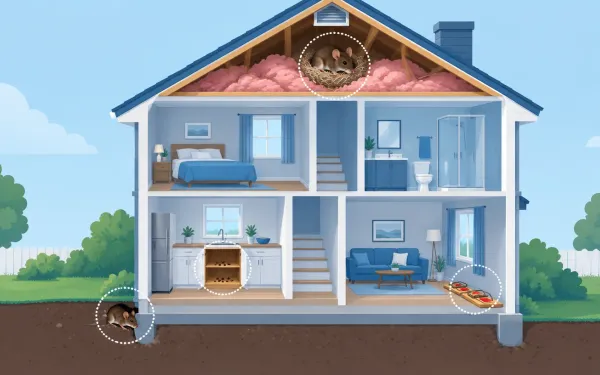
Warmth and easy gaps. House mice nest next to water heaters and pilot lights and move indoors as it cools off in fall. Rats in the basement are usually Norway rats, which dig burrows along the foundation and stay low once inside.
Look for droppings beside the furnace or water heater (rat droppings are raisin size; see mouse poop vs. rat poop), nests behind boxes, and burrows along the foundation.
Is It Dangerous to Have Mice in the Basement?
The risk is mostly what they leave behind: rodent germs reach people through dust stirred up from urine, droppings and nests, so clean them wet (Step 3). Deer mice, which spread the most common U.S. hantavirus, aren’t normally found in residential areas unless fields or woods are nearby, University of California experts say, and human cases are rare.
Step 1: Trap Mice in the Basement
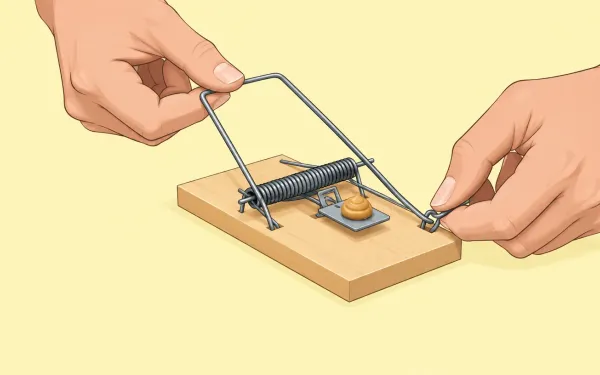
Snap traps are the tool: wooden ones are cheapest, plastic ones easier to set and clean (how to set a mouse trap).
Set a “T”, not a parallel line. Put each trap at a right angle to the wall, baited end touching it, with a small dab of chunky peanut butter on the bait pan. Mice run along walls and cross right over the trigger.
Cover the hot spots. Start near droppings, behind the furnace, water heater and washer, and under shelves. Mice seldom travel more than 30 feet from their nest, so set a trap about every 10 feet along walls with signs, roughly 4 per 40 feet.
Double up where droppings are heaviest. Some mice jump a single trap, so set two traps 1 to 2 inches apart.
Keep them out of reach of kids and pets: behind appliances or on ledges. For rats, use rat-size traps, baited but unset for the first few days, because rats fear anything new.
Check every morning for at least 15 days (CDC). You’re done when a full week passes with no catches and no new droppings. Dead mouse? Wearing gloves, spray it with disinfectant, wait 5 minutes, then double-bag it with the trap; more in dead mouse removal.
Step 2: Seal Basement Gaps and Floor Drains
Mice fit through a hole about ¼ inch across, the width of a pencil. Check around every pipe and utility line, floor drains (fit grates with openings under ¼ inch), dryer vents, the floor-wall joint and, outside, the foundation line.
Small holes: steel wool or copper mesh, then caulk. Bigger holes and foundation cracks: cement, hardware cloth or sheet metal, not foam. One Reddit poster whose foam-and-mesh job failed worried that sealing would push rats “further up the house,” so seal outside first and keep traps set inside, upstairs too (how mice get into the house).
Renting? Tell your landlord in writing, with photos of the droppings, before you seal the foundation or anything outside. Food bins and traps can start tonight.
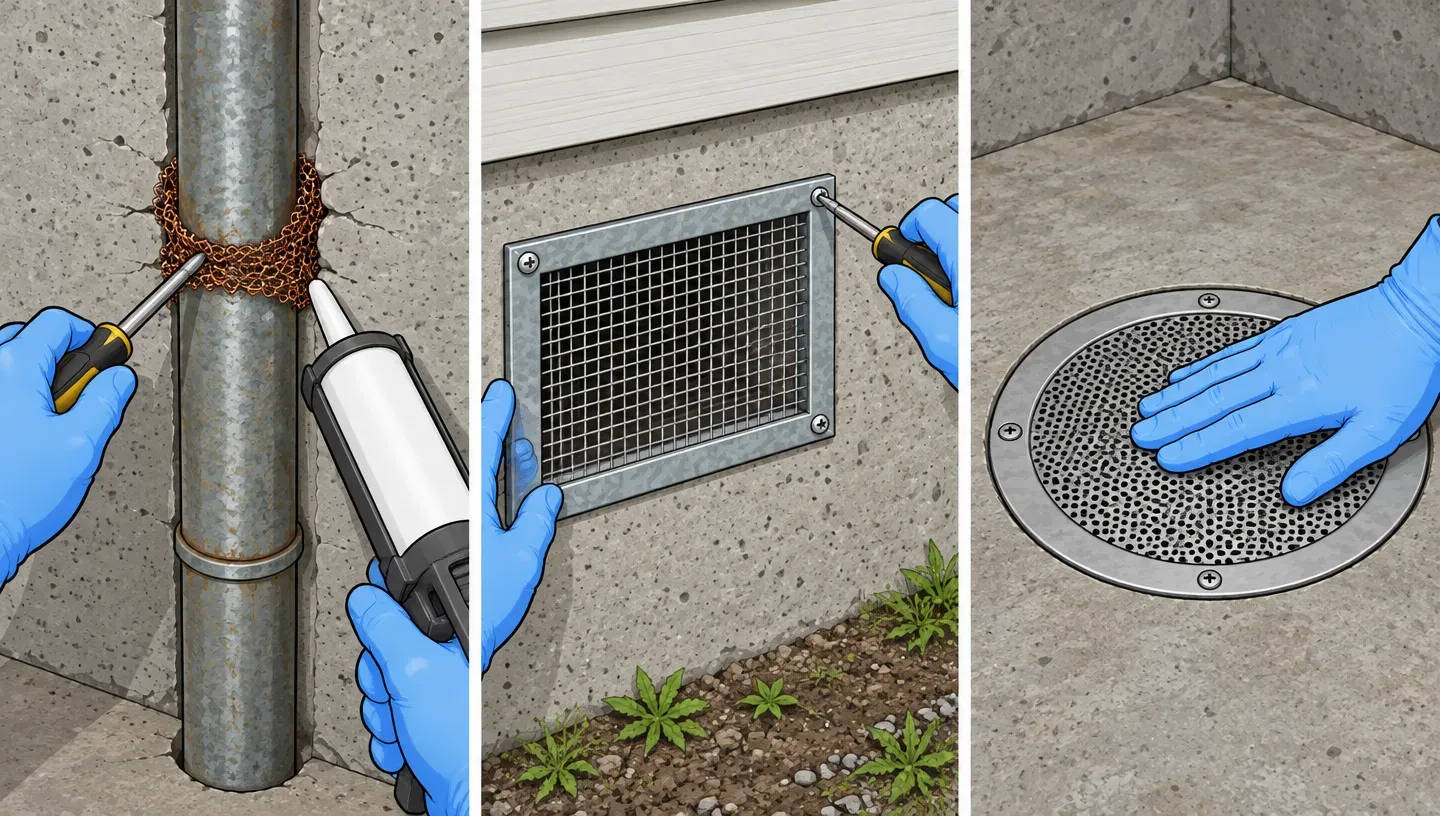
Illustration: metal mesh around a pipe, a screened foundation vent and a covered floor drain.
Step 3: Clean Up Basement Droppings
Open doors and windows and stay out for 30 minutes first. Then put on rubber or plastic gloves, spray droppings with household disinfectant or a fresh mix of 1.5 cups of bleach per gallon of water until soaked, wait 5 minutes, and wipe up with paper towels (CDC). More in how to clean mouse droppings.
Toss soiled cardboard boxes; disinfect plastic, glass and metal containers. New York’s health department advises keeping food out of the basement and storage racks 18 inches off the floor.
How to Get Rid of Mice in a Crawl Space
Prepare before you crawl in: a closed, poorly ventilated crawl space is a hantavirus risk factor when rodents are active, says New York’s health department.
Air it out. Open the hatch and vents and stay out for at least 30 minutes. For heavy droppings or nests, the CDC calls for coveralls, rubber boots, gloves, goggles and a half-mask respirator with a HEPA filter. Leave chewed wiring to an electrician.
Trap near the hatch. Traps need a daily check, so set the first ones within arm’s reach of the hatch, then along the foundation walls.
Find gaps with the lights off. Go in during the day: daylight shows through the gaps. Cover foundation vents with ¼-inch hardware cloth or screened, self-closing vents (National Park Service), make the access door close tightly, and check plastic heating ducts for chew holes.
Clean a dirt floor slowly. The National Park Service says to wet a dirt floor with disinfectant, let it sit at least 10 minutes and pick up droppings with wet paper towels.
Keep an intact vapor barrier. The CDC’s rule is to disinfect hard, nonporous items, so disinfect the plastic and replace only torn or badly soiled sections.
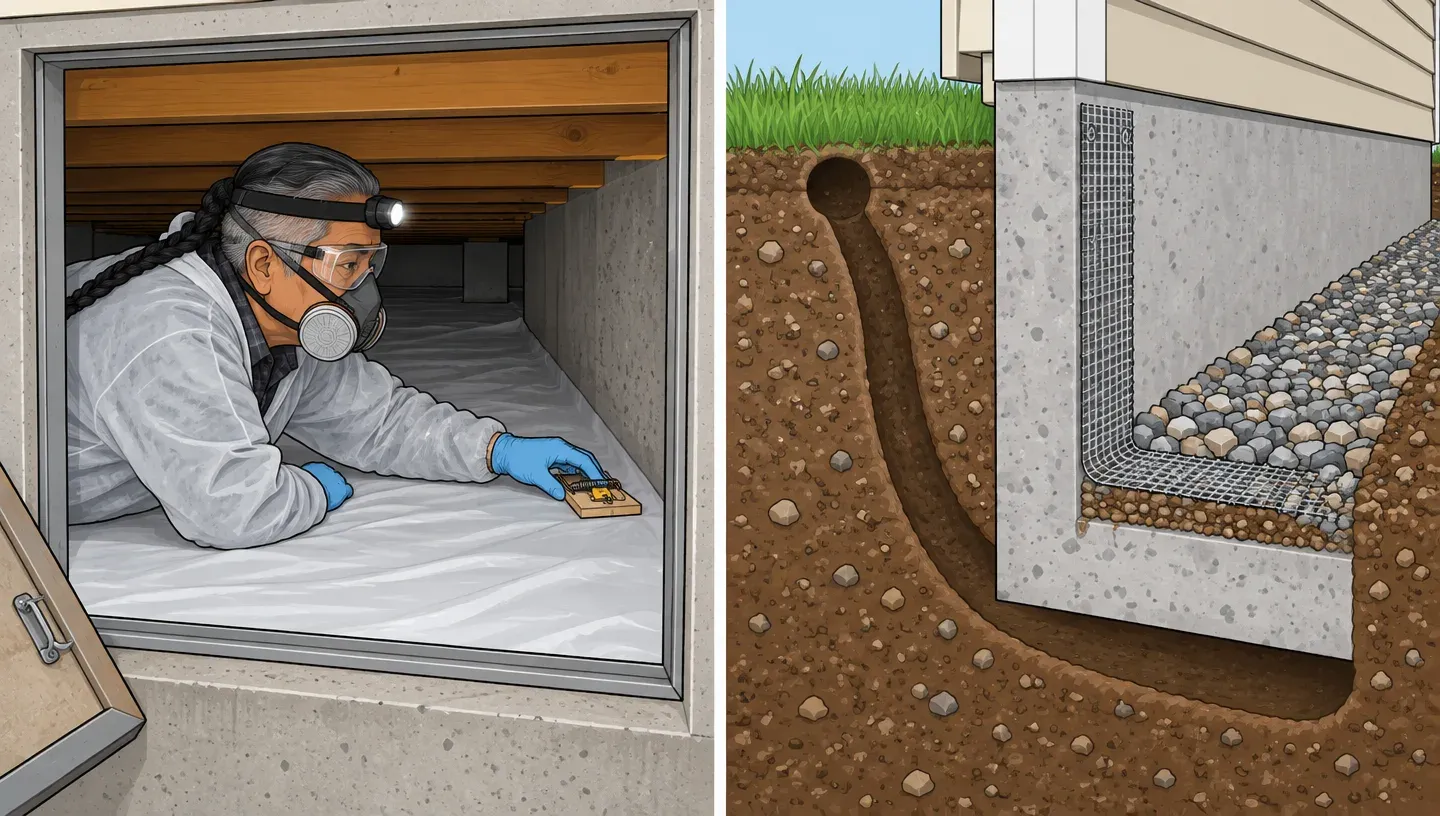
Illustration: a trap just inside the crawl space hatch, and an L-shaped mesh barrier along the foundation.
Basement Ceiling or Insulation: Clean, Don’t Tear Out
You rarely need to tear out the whole ceiling. Mice travel above drop ceilings and on sill plates (Nebraska Extension), so set traps on ceiling tiles near the walls too.
- Ceiling tiles: replace stained or soaked tiles; wipe and disinfect the grid.
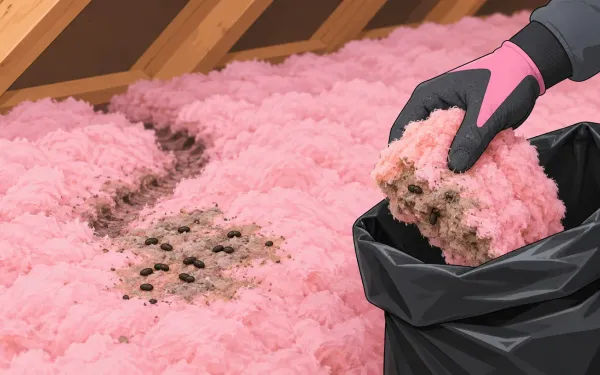
- Fiberglass or loose insulation: spray soiled spots until wet, then bag and replace only the soiled pieces (CDC).
- Large areas soaked with urine, or a smell that won’t fade: that’s when removal is worth a quote. More in mice in insulation.
Rat Holes Near the Foundation
Rat holes near the foundation are usually Norway rat burrows, 2 to 4 inches across and smooth or worn when in use (Utah State Extension).
Trap first. If a burrow runs under the foundation with no other way out, remove the rats before sealing.
Close and watch. Fill burrows with rocks and dirt; a reopened burrow means rats are still there.
Stop the digging. Lay a band of 1-inch or larger gravel, 2 feet wide and 6 inches deep, along the foundation (National Park Service).
Add a mesh curtain. Fix an L-shaped strip of ¼-inch hardware cloth to the wall 5 to 6 inches above ground, bend it outward 5 to 6 inches and bury it under 2 or more inches of soil. Rats upstairs too? See rats in the house.
Which Plan Fits Your Situation
| Your situation | Start with | Then |
|---|---|---|
| Renting | Traps and sealed food bins tonight | Landlord seals the foundation |
| Kids or pets | Traps on ledges, behind appliances | Skip poison entirely |
| Crawl space with heavy droppings | Air it out; HEPA respirator and coveralls | A pro if you can’t use the gear |
| Rat burrows along the foundation | Trap, then fill burrows | Gravel band and mesh curtain |
Crawl Space Rodent Cleanup Cost: What’s Fair?
| Item | Typical cost |
|---|---|
| DIY mouse kit: 12–24 snap traps, copper mesh, gloves, bleach | About $57–71 |
| DIY rat kit: rat traps, copper mesh, gloves, bleach | About $65–87 |
| Pro trap-and-seal job, 53 shared quotes (middle half) | $1,400–$3,000 |
| Pro visit, price-guide range (usually no sealing) | $150–$655 |
| Pro attic insulation cleanup, if upsold | $7,500–$14,000 |
| Crawl space rodent control: traps, minor cleaning, follow-up | $200–$700 |
| Extensive infestation: full cleaning plus sealing | $1,500–$4,000 |
| New vapor barrier, installed | $1,200–$4,000 |
DIY: U.S. list prices from Victor, DoMyOwn and Target, September 30, 2026, before tax. Pro: the middle half of 53 trap-and-seal quotes homeowners shared on Reddit (see the quote table). Price-guide range: This Old House for mice (April 2026) and HomeAdvisor for rats (June 2026); it usually covers a trap-and-bait visit, with sealing extra. Attic cleanup: the middle half of 35 shared quotes that included new insulation. Crawl space: HomeGuide (February 2026).
Big quotes happen: one Reddit poster who caught a single rat was quoted “almost 20 K” to redo the insulation and vapor barrier, though HomeGuide puts the plastic alone at $0.15 to $0.50 per square foot. Ask for photos, a line-item price and the company’s license, as the EPA advises (what an exterminator does).
Before You Start: A Quick Checklist
- Move food, pet food and birdseed into lidded bins.
- Buy enough traps for one every 10 feet of wall with signs.
- Air out the basement or crawl space for 30 minutes before you clean.
- Mix bleach fresh: 1.5 cups per gallon of water.
- Check pipes, drains, vents and the foundation line for ¼-inch gaps.
- Photograph droppings and damage before any pro visit.
When to Call a Pro
- Rodents in your heating or cooling ducts (CDC).
- Heavy droppings, nests or deer mice in a closed crawl space, if you can’t use the gear above.
- Rats that keep digging under the foundation; the National Park Service says a concrete curtain wall may be needed.
- You’ve trapped and rebaited for at least 15 days and still find new droppings.
Common questions
There’s no instant fix. Rats may take several days to approach new traps, so prebait them unset first. Seal the entry points outside, then trap until a full week passes with no catches.
Sources and further reading · 11
- CDC: Trap Up, Seal Up, Clean Up and About Hantavirus.
- University of California (UC IPM): Rats, House Mouse and Deer Mouse; UC ANR: Debunking Pest Myths.
- National Park Service: Rodent Exclusion Manual (2019).
- Internet Center for Wildlife Damage Management: House Mouse Biology and Norway Rat Control.
- Utah State Extension: Rats and Mice IPM Manual.
- UGA Extension: Rats and Mice.
- Nebraska Extension: Controlling House Mice (G1105).
- New York State Department of Health: Controlling the Rat and Hantavirus Fact Sheet.
- Illinois Department of Public Health: Norway Rats.
- EPA: Tips for Hiring a Rodent Control Professional.
- Poison Control: Mouse and Rat Poisons.