Mice in Insulation: Do You Need to Replace It All?
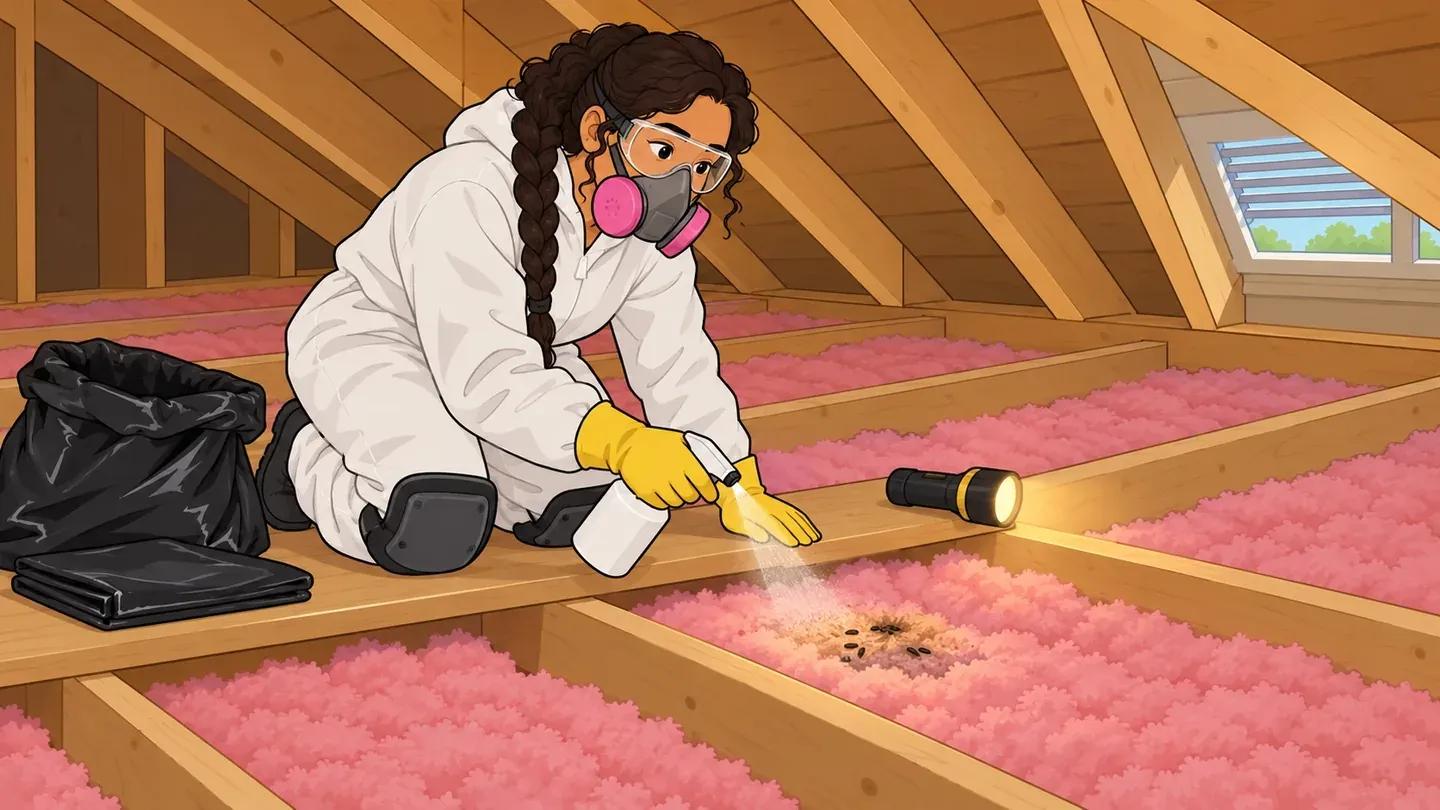
Illustration: a woman in a coverall, goggles and respirator, kneeling on a plank across the joists, sprays a small patch of soiled insulation.
Mice in insulation don’t automatically mean replacing it all. The CDC says to bag and remove exposed insulation soiled with urine and droppings, so a few dirty patches can be taken out and topped up. Trap and seal first, then clean. Skip “pest control” insulation as a mouse fix. The mice are gone when a week passes with no catches and no new droppings (CDC).
Difficulty: hard. Call a pro if your insulation is vermiculite, urine and droppings cover most of the attic, rodents got into your heating or cooling ducts, or you find chewed wiring.
This guide covers judging the damage, safe spot removal, what removal costs and how to read a big quote. We haven’t tested these methods ourselves; this rests on CDC, EPA, UC IPM and ICWDM guidance, HomeGuide and HomeAdvisor price data, and quotes homeowners posted on Reddit. For the rest of the house, start with getting rid of mice.
Renting? Don’t remove attic insulation yourself. Send your landlord photos of the droppings and ask in writing for cleanup and sealing.
What Works and What Doesn’t for Mouse-Soiled Insulation
| Method | Works? | Cost | Main limitation |
|---|---|---|---|
| Spot removal of soiled patches | Yes, the CDC’s rule | DIY kit $57–71, insulation extra | Not for widespread soiling or vermiculite |
| Full removal and restoration | When soiling is widespread | $3.30–$5.50 per sq ft | Often more than the soiling calls for |
| New insulation on top of old | Sometimes (HomeAdvisor) | Varies | Only after soiled patches are out |
| New insulation without sealing | No | — | Invites the mice back |
| Borate “pest control” insulation | Not for rodents | — | One EPA label lists no mice or rats |
Do You Need to Replace Attic Insulation After Mice?
Not always. It depends on how much is soiled, and no health agency we checked gives a percentage or a rule for replacing a whole attic.
The CDC’s instruction covers soiled, exposed insulation, not all of it. HomeAdvisor tells readers to ask whether only some can be removed and replaced; HomeGuide says to remove insulation damaged by pests, which also gives access to seal openings underneath.
One Texas homeowner’s pest company quoted about $8,000 to strip, sanitize and re-insulate a 1,500-square-foot attic, arguing soiled insulation draws mice back (r/homeowners). If so, that argues for removing the soiled parts and sealing the gaps. Reddit commenters split; one wrote that “99% of the time there is no need to replace the insulation” (r/pestcontrol).
| What you find | What it points to |
|---|---|
| Droppings or a nest in a few spots, often near the eaves | Spot removal you can do yourself |
| Soiled areas in several parts of the attic | Partial removal; ask for quotes by section |
| Urine and droppings across most of the attic, or a long-vacant house full of rodents | Full removal by a crew using the CDC’s heavy-infestation precautions |
| Pebble-like insulation, gray-brown or silver-gold | Likely vermiculite: don’t touch it (EPA) |
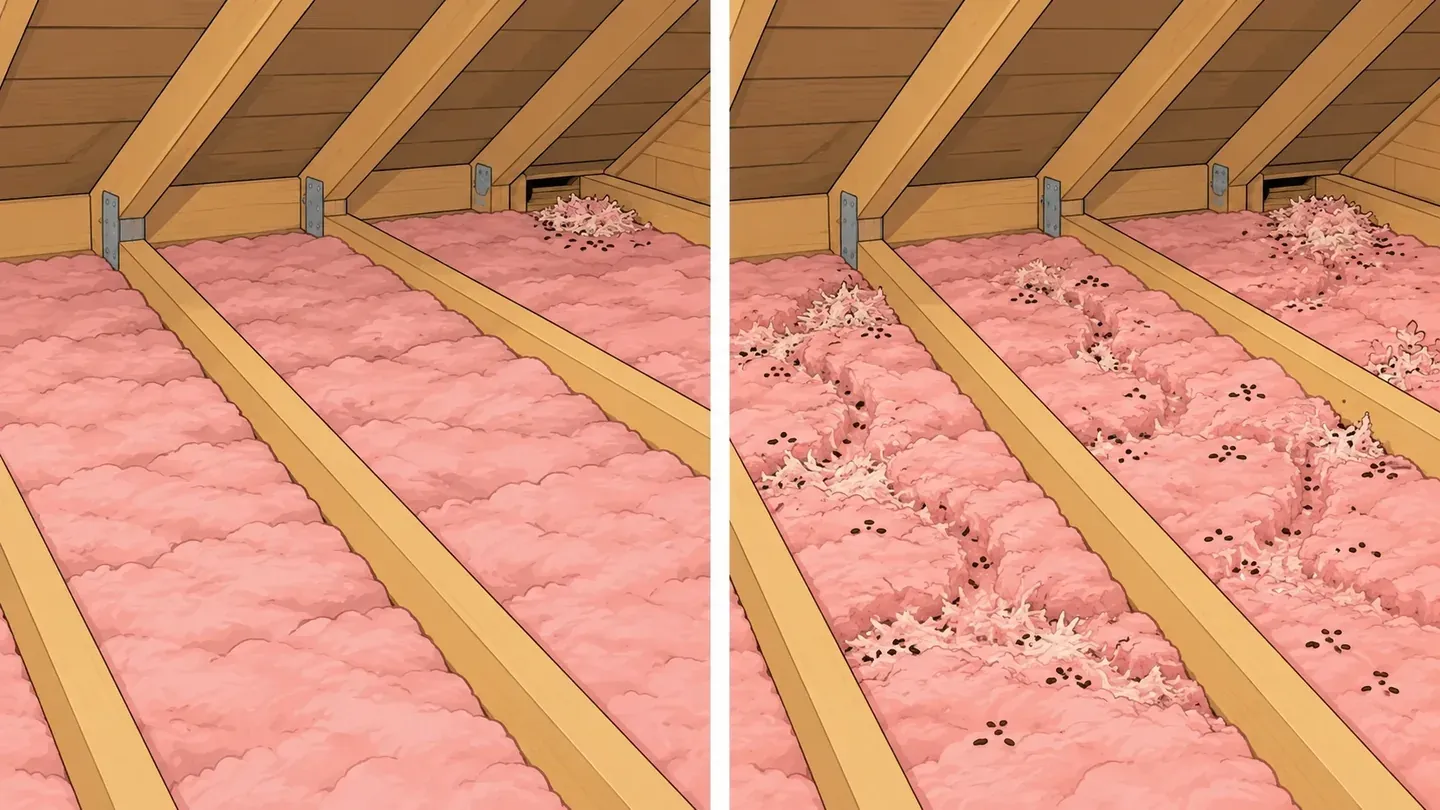
Illustration: droppings and a nest in one corner near the eaves (left), and droppings and trails across most of the attic (right).
How to Check the Damage Safely
Go up in daylight, after traps are set, and look without digging.
Step 1: Identify the insulation first. Pebble-like, pour-in insulation that’s gray-brown or silver-gold is likely vermiculite, which may contain asbestos (EPA). Don’t disturb it; hire an asbestos professional.
Step 2: Walk on joists, not insulation. Wear a particulate respirator or double-strap dust mask, gloves and knee pads (ENERGY STAR). Never vacuum or sweep droppings: hantavirus gets into the air when fresh urine, droppings or nests are disturbed (CDC).
Step 3: Look with a flashlight. Check for trails, nests of shredded nesting material and droppings: ⅛ to ¼ inch with pointed ends for mice (Nebraska Extension), bigger for rats (rat poop vs. mouse poop).
Step 4: Check the wires. Rodents chew wire insulation, and UC IPM says many fires of unknown origin are believed to start that way. Leave damaged wiring to an electrician.
Step 5: Map it. Photograph each soiled area and estimate its size against the whole attic. That’s your baseline for any quote.
If urine and droppings cover most of the attic, stop there. For heavy infestations, the CDC calls for disposable coveralls, rubber boots or shoe covers, gloves, goggles and a fit-tested half-mask respirator with HEPA filters.
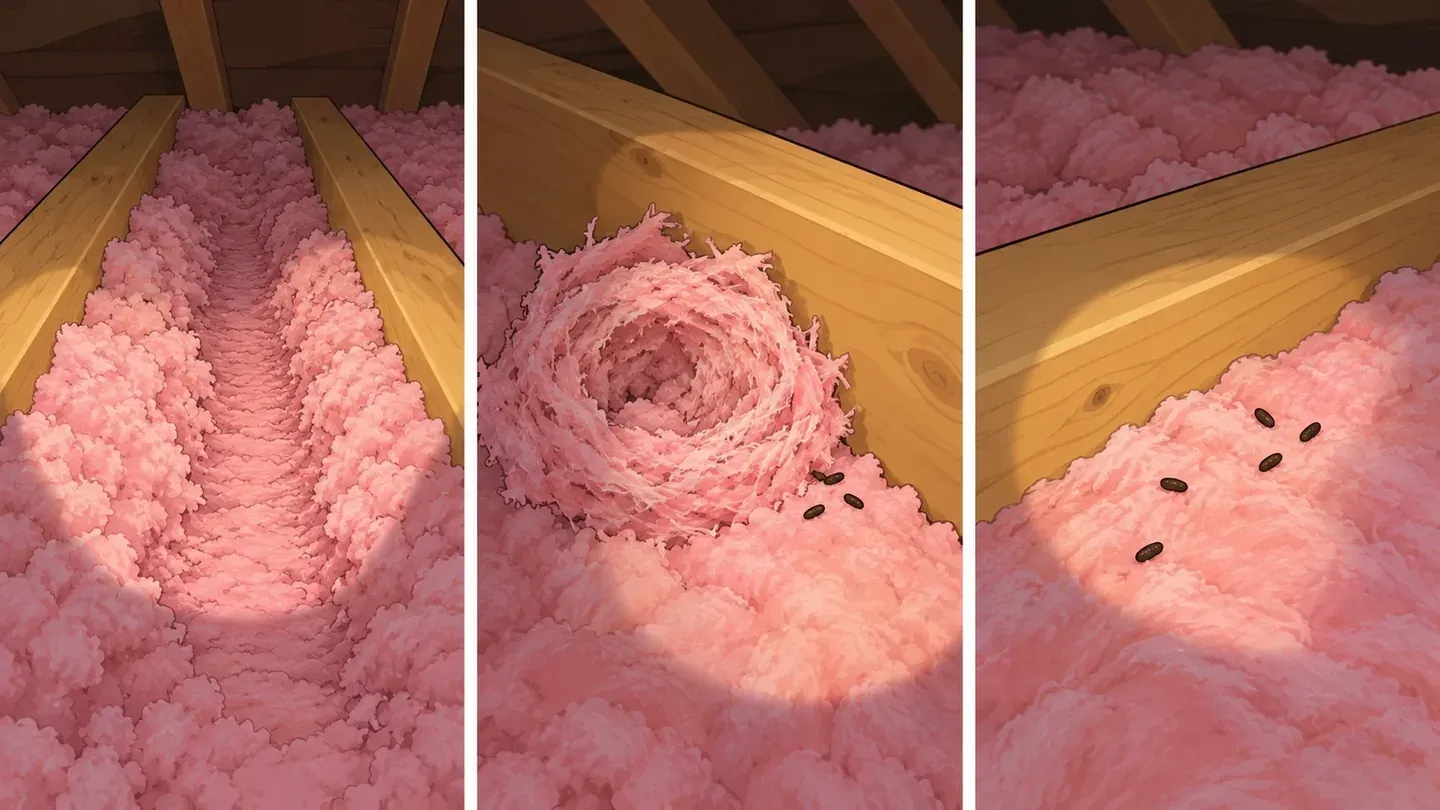
Illustration: a trail through the insulation, a nest of shredded fiberglass and droppings along a joist.
How to Get Rid of Mice in the Attic Under Insulation
Clean last: if mice are still getting in, new droppings land on fresh insulation. The full method is in mice in the attic.
- Trap on top of the insulation along trails, joists and the eaves, at a right angle to the wall, bait end touching it. For rats, use rat-size traps (rats in the house).
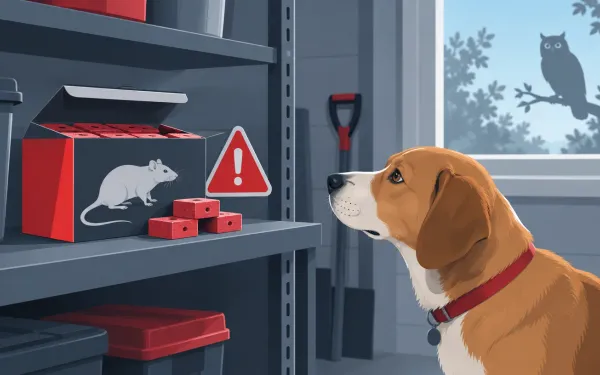
- Skip poison. Poisoned mice often die inside the structure, where the odor becomes a problem (why we skip poison).
- Seal entry points ¼ inch or larger with metal, not foam (steel wool or copper mesh, caulked in). UC IPM calls exclusion the most successful and permanent form of house mouse control. Include the eaves and roofline, since mice can climb walls to reach the attic.
- Keep trapping until a week passes with no catches and no new signs.
How to Remove Mouse-Soiled Insulation Yourself
For a few soiled patches, apply the CDC’s cleanup method (full method):
Step 1: Air it out. Ventilate for 30 minutes and stay out meanwhile; open the hatch and any vents you can.
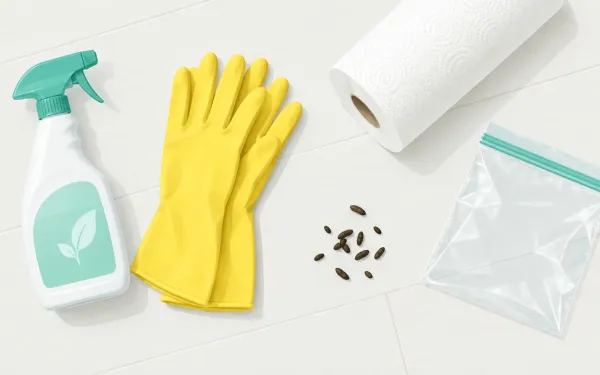
Step 2: Soak it. Wearing rubber or plastic gloves, spray droppings, urine and nests with disinfectant or bleach solution (1.5 cups of bleach per gallon of water) until very wet, then let it sit 5 minutes.
Step 3: Double-bag it. Lift the soaked section into a plastic bag, tie it shut and put it inside a second bag. Disinfect joists and the top plate where droppings sat.
Step 4: Wash gloved hands, then bare hands. Use soap and water or disinfectant before taking the gloves off.
Step 5: Fill the gap with matching insulation. Still smell urine afterward? See mouse urine smell.
What Rodent Insulation Removal Costs
| Job | Typical cost |
|---|---|
| DIY: 12–24 snap traps, copper mesh, gloves, bleach (patch insulation extra) | About $57–71 |
| Pro sealing (exclusion), 53 shared quotes (middle half) | $1,400–$3,000 |
| Pro sealing, price-guide range | $200–$600 |
| Insulation removal only | $1–$2 per sq ft; about $1,600–$3,600 per attic |
| Rodent cleanup and disinfecting, on top of removal | $600–$1,000 |
| Full restoration: removal, cleaning, sanitizing, new insulation | $3.30–$5.50 per sq ft |
At HomeGuide’s restoration rate, a 1,500-square-foot attic comes to roughly $5,000 to $8,250 (our math), and some contractors have a $1,500 to $3,000 minimum for attic sanitation. HomeAdvisor’s $600 to $1,200 removal figure is, in its own size table, the price for a 600-square-foot attic.
DIY: U.S. list prices from Victor, DoMyOwn and Target, September 30, 2026, before tax. Sealing: HomeAdvisor (June 2026). Removal, cleanup and minimums: HomeGuide (November 2025). Restoration: HomeGuide (April 2024).
How to Judge an Insulation Removal Quote
Quotes vary widely for similar jobs: $3,500 for a 528-square-foot attic (r/HomeMaintenance) and $14,800 for 1,950 square feet, including sealing and deeper new insulation (r/HomeMaintenance).
- Do the per-foot math. Divide the total by the attic’s square footage and compare it with HomeGuide’s $3.30–$5.50 for a full restoration. A price well above that should come with a reason.
- Ask for dated photos of each contaminated area, and whether they can remove only those sections.
- Get it itemized, with sealing on its own line. One Reddit homeowner’s $12,000 quote didn’t include sealing at all (r/pestcontrol).
- Question “pest control insulation.” The EPA registration for one borate-treated product lists cockroaches, ants and termites, but no mice or rats.
- Compare three quotes with the same scope, and don’t pay in full before the job is done (HomeGuide). More in exterminator vs. DIY cost.
In quotes homeowners shared, adding attic insulation turned a typical $1,800 rodent job into $8,700; our study of 5,315 exterminator quotes shows how often it came up.
Is There Mouse-Proof Insulation?
No source we checked calls any type rodent-proof. The ICWDM says mice are very destructive to rigid foam, fiberglass batting and other insulation. What keeps rodents out of the insulation is keeping them out of the building (how mice get in).
Which Plan Fits Your Situation
| Your situation | Start with | Then |
|---|---|---|
| Renting | Photos to your landlord, in writing | Their crew cleans and seals |
| A few soiled spots | Trap and seal | DIY spot removal |
| Most of the attic soiled | Trap and seal | Itemized quotes by section or for the whole |
| Mice inside closed walls | Trap where they come out | Leave the wall closed |
| Vermiculite | Don’t touch it | Asbestos professional |
Before You Start: A Quick Checklist
- Set traps and seal gaps before any insulation comes out.
- Check for vermiculite before you touch anything.
- Photograph and measure each soiled area.
- Pack gloves, a dust mask or respirator, knee pads and heavy plastic bags.
- Mix fresh bleach solution: 1.5 cups per gallon of water.
- Ask every contractor for an itemized, photo-backed quote.
When to Hire a Pro
- The insulation is vermiculite: an asbestos contractor (EPA).
- Urine and droppings cover most of the attic, or the house stood empty with many rodents.
- Rodents got into heating or cooling ducts, which the CDC says needs a professional.
- Wiring is chewed: an electrician.
Common questions
Yes. The ICWDM lists fiberglass batting among the insulation mice damage, and house mouse nests are made of finely shredded fibrous material. Look for a pocket of shredded fibers with droppings nearby.
UC IPM describes rats shredding insulation in walls and ceilings to build nests. The fix is the same as for mice: trap, seal, then remove the soiled part.
The CDC’s rule applies anywhere: bag exposed insulation soiled with urine and droppings (mice in the basement). Insulation inside closed walls is a different job: usually you trap where the mice come out instead of opening the wall.
Sources and further reading · 7
- CDC: Clean Up After Rodents, Trap Up and Hantavirus Prevention.
- EPA: Vermiculite Insulation and ENERGY STAR: Tips for Working in the Attic.
- UC IPM: House Mouse and Rats — poison, exclusion, nests, rats shredding insulation, wiring fires.
- Nebraska Extension: Controlling House Mice (G1105).
- Internet Center for Wildlife Damage Management (ICWDM): Inspection, House Mouse Control and Roof Rats.
- Cost guides: HomeAdvisor: Attic Insulation Removal, HomeGuide: Attic Insulation Removal and HomeGuide: Attic Cleaning.
- EPA Pesticide Product Label System: Reg. No. 103652-1, a borate-treated insulation’s registered pests.