How to Get Rid of a Mouse in Your Apartment as a Renter
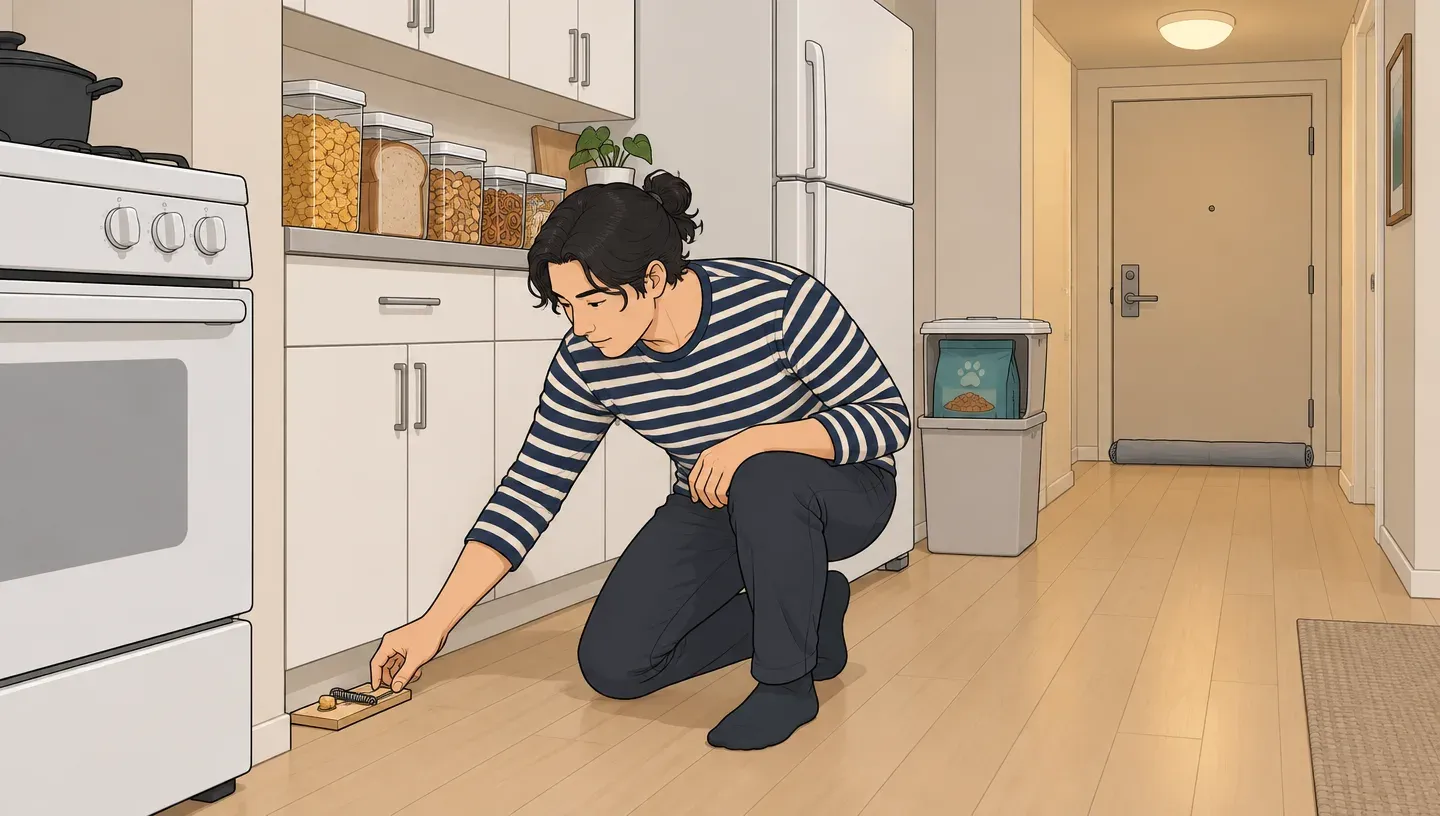
Illustration: a snap trap set against the wall beside the stove, with food sealed away on the counter.
To get rid of a mouse in your apartment, set snap traps in pairs along the walls behind the stove and fridge, move all food into sealed containers, and report it to your landlord in writing, because mice travel between units along shared pipes. Skip glue traps, poison and plug-in repellers. A week with no catches and no new droppings means it worked.
Cost: about $57–71 in supplies. Difficulty: moderate. Call a pro if new droppings still turn up after at least 15 days of trapping, mice are in places you can’t reach to clean, or neighbors have mice too. In a rental, ask your landlord to send their pest control company first.
This guide covers the renter’s side of the job: trapping, food, sealing gaps inside your own unit and getting the building involved. We haven’t tested these methods ourselves; this rests on CDC, UC IPM, Nebraska Extension and StopPests guidance and September 2026 list prices.
Saw a mouse tonight? Put food and pet food in sealed containers, take out the trash and push a rolled towel against the gap under your front door. Don’t sweep up droppings. Send your landlord the email in Step 4, and buy a 12-pack of snap traps tomorrow. The whole-house plan is in how to get rid of mice.
What Works and What Doesn’t in an Apartment
| Method | Works? | Cost | Main limitation |
|---|---|---|---|
| Snap traps in pairs | Yes, the type the CDC backs | $13.74 for 12 | Daily checks; keep away from kids and pets |
| Sealed food, daily trash | Yes, alongside traps | Free | Doesn’t remove mice already inside |
| Copper mesh and sealant caulk | Yes, for gaps in your unit | Part of the $57–71 kit | Shared walls and hallways are the building’s job |
| Building pest control | Yes, for shared pipes | Depends on local code | Does little if only one unit is treated |
| Glue and live traps | No | — | Scared mice urinate, raising your risk of getting sick |
| Poison | Skip | — | A mouse can die and smell inside a wall |
| Peppermint oil, plug-in repellers | No | — | Peppermint stopped working within a week in a 2022 lab study |
Signs of a Mouse in Your Apartment
Droppings are the surest sign: ⅛ to ¼ inch long, pointed at one or both ends, 50 to 75 a day from one mouse (Nebraska Extension). Also look for clean-cut holes in food packages, shredded-paper nests behind the oven or fridge, and night scratching in the walls (mice in walls). Clean up; new droppings mean mice are still active.
Step 1: Catch the Mouse in Your Apartment
Snap traps are the cheapest way to catch a mouse in an apartment, and the type the CDC recommends. Skip glue and live traps: they scare mice into urinating (why glue traps backfire).
Buy one 12-pack. That’s six pairs, a fair start for an apartment; Nebraska Extension suggests about two dozen for a whole house.
Bait lightly. A pea-size dab of chunky peanut butter, not a spoonful, works best, says the CDC. Peanut allergy? Use a cotton ball, which mice take as nesting material.
Put them where mice run. Start behind the stove and fridge (or in the gap beside them), then the back of cabinets, under the sink and next to droppings.
Point the bait end at the wall. Set each trap at a right angle to the wall, bait end touching the baseboard, in pairs 1 to 2 inches apart, so a mouse that jumps one lands on the other. Keep pairs within about 10 feet of each other (UC IPM). Full setup in how to set a mouse trap.
Check every morning. Keep re-baiting for at least 15 days, and stop only after a week with no catches and no new droppings.
Dead mouse? Wearing gloves, spray it with disinfectant, wait 5 minutes, then double-bag it, trap and all, for a covered trash can (CDC). More on removing a dead mouse.
Step 2: Take Away Food and Hiding Spots
A mouse needs about one crumb a night, says StopPests, so clean the spots tenants miss: under the lifted stovetop, around the fridge and dishwasher, and under the couch.
- Keep food in thick plastic, metal or glass containers with tight lids, not the original bags.
- Throw out food in packages with chew holes or droppings, then wipe counters, cabinets and drawers with disinfectant.
- Don’t leave pet food out overnight, especially cat food.
- Take trash out daily, and cut back on cardboard boxes and paper bags, where mice nest.
More on getting mice out of the kitchen.
Step 3: Seal the Gaps Inside Your Unit
A mouse fits through a hole the width of a pencil, about ¼ inch (CDC). Look under the sinks, behind the stove and fridge, around radiator and gas pipes, and where the floor meets the wall.
Tonight: steel wool. It’s a fine temporary plug, but it rusts (does steel wool keep mice out?).
This week: copper mesh plus caulk, not spray foam. Pack mesh into the gap and cover it with caulk labeled “sealant”; mice chew through foam.
Ask your landlord for the rest: pipe collars (metal rings where a pipe enters the wall) and a door sweep. Tell them in writing before you drill or attach anything; hallways and shared walls are the building’s job.
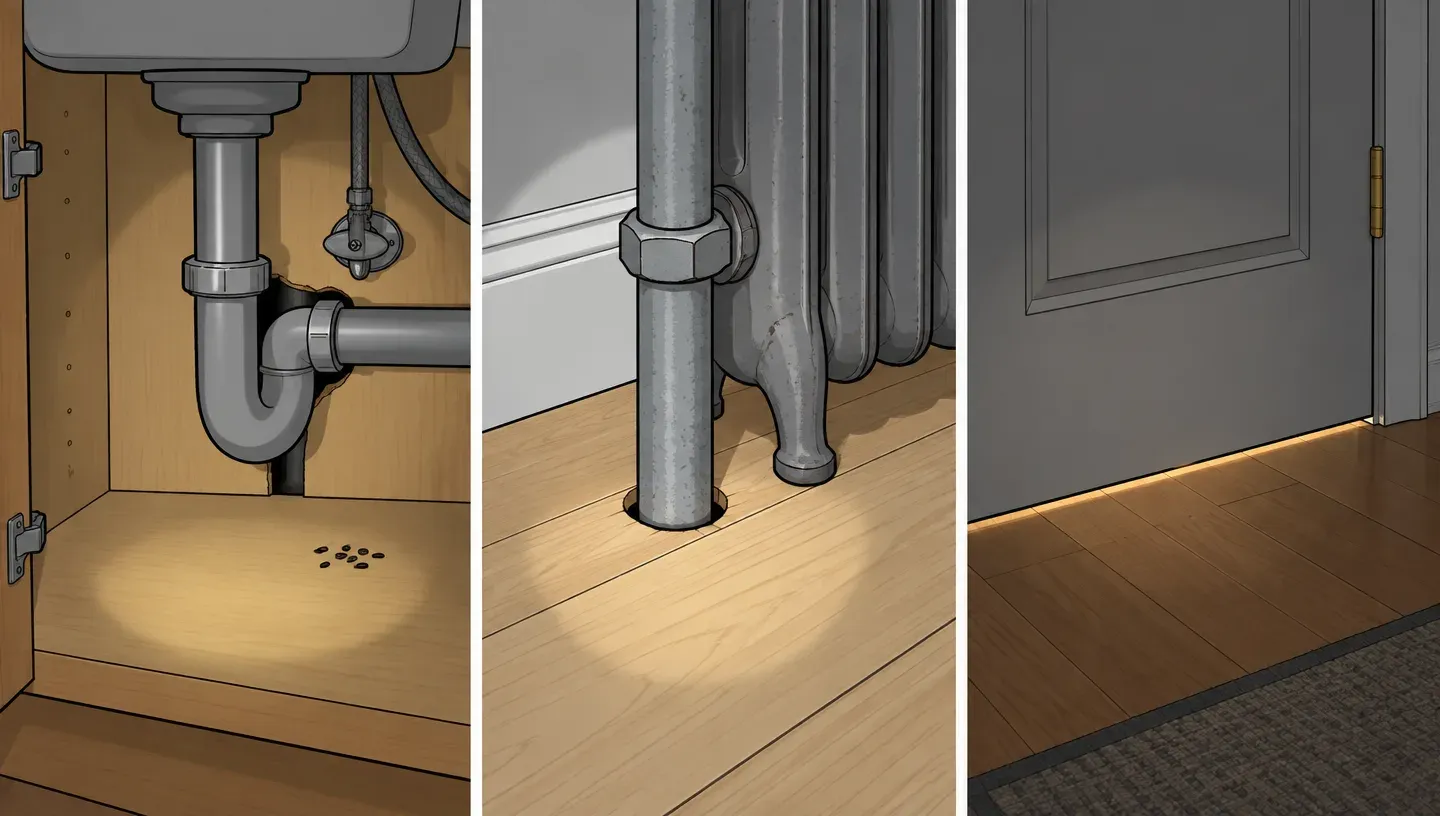
Illustration: a gap around the pipes under the kitchen sink, a gap around a radiator pipe, and light under the front door.
Step 4: Get Your Landlord and Building Involved
You can’t seal shared pipes and hallways yourself. StopPests tells tenants to work with the building’s manager and exterminator: the units above, below and beside yours need mouse-proofing too, and any bait belongs in tamper-resistant stations.
Copy this, fill in the brackets, attach photos and send it tonight:
Subject: Mice in apartment [number]
Hi [name], I saw a mouse in my [kitchen] on [date] and found droppings [where]. Photos attached. Please send the building’s pest control company, seal the gaps around my pipes and under my front door, and check the apartments above, below and beside mine. [I have a child and pets, so please keep any bait in tamper-resistant stations.] When can someone come?
Who is responsible depends on your local housing code. In New York City, owners of buildings with three or more apartments must keep units free of pests and inspect for them yearly; tenants can call 311 if the landlord doesn’t act (NYC HPD).
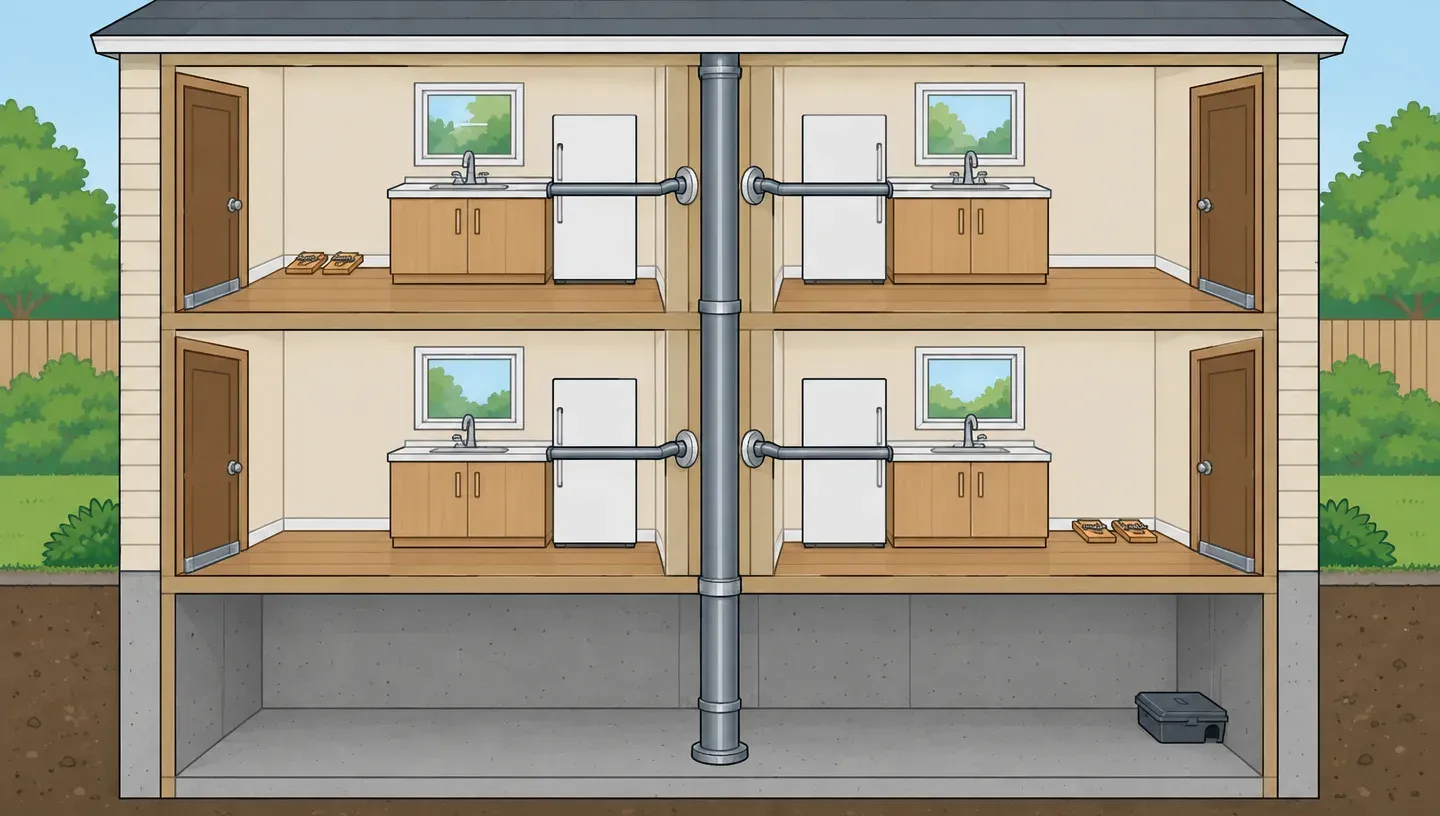
Illustration: four apartments with one pipe running up through every kitchen, and traps and pipe collars in several units.
Is It Dangerous to Live in an Apartment With Mice?
Mostly through what mice leave behind, and the risk drops once you trap and clean up safely.
- Droppings and urine. Rodent diseases mainly reach people through contaminated air (CDC). Spray droppings with disinfectant and wipe them up, not sweep or vacuum, as in how to clean mouse droppings.
- Pregnancy or a weak immune system. House mice spread LCM, a virus that can be serious in these cases (CDC). Ask someone else to handle traps and cleanup.
- Asthma. House mouse urine is a major allergen, linked to early-onset asthma in sensitive children (UC IPM).
- Building bait. If a child may have eaten rodent bait, call Poison Control at 1-800-222-1222; for a pet, call your vet.
Why Do Mice Get Into Apartments?
Usually through shared pipes: sink plumbing, gas lines and radiator pipes run through walls and floors into every unit, plus the gap under your front door. House mice seldom travel more than 30 feet from their nest, so yours probably lives in your kitchen or the wall beside it. A clean apartment can still get mice; crumbs and cardboard just let them multiply.
Which Plan Fits Your Situation
| Your situation | Start with | Then |
|---|---|---|
| One sighting, a few droppings | 12 snap traps behind the stove and fridge | Seal food; email your landlord |
| Kids or pets at home | Traps in closed cabinets or tamper-resistant stations | Ask that building bait stays in stations |
| Scratching in walls or ceiling | Traps along the nearest walls | Landlord seals shared pipes and chases |
| Neighbors have mice too | Your own traps and food storage | Ask for the units above, below and beside yours |
| Pregnant or immune-compromised | Someone else sets traps and cleans | Landlord’s pest control company |
What It Might Still Cost
| Item | Typical cost |
|---|---|
| 12 wooden snap traps (all you need to start) | $13.74 |
| Optional: more traps, copper mesh, gloves and bleach (full kit total) | About $57–71 |
| Pro trap-and-seal job, 53 shared quotes (middle half) | $1,400–$3,000 |
| Pro visit, price-guide range (usually no sealing) | $150–$655 |
| Pro attic insulation cleanup, if upsold | $7,500–$14,000 |
DIY: Victor, DoMyOwn and Target list prices, September 30, 2026. Pro: the middle half of 53 trap-and-seal quotes homeowners shared on Reddit (see the quote table). Price-guide range: This Old House for mice (April 2026) and HomeAdvisor for rats (June 2026); it usually covers a trap-and-bait visit, with sealing extra. Attic cleanup: the middle half of 35 shared quotes that included new insulation.
Before You Start: A Quick Checklist
- Move every open food bag and the pet bowl into sealed containers tonight.
- Buy one 12-pack of snap traps and set them in pairs behind the stove and fridge.
- Photograph droppings and gnaw marks before you clean them.
- Email your landlord in writing, with photos, the same day.
- Plug gaps under the sink with steel wool until copper mesh and caulk go in.
- Check traps every morning for at least 15 days.
When to Call a Pro (or the Health Department)
- New droppings keep appearing after at least 15 days of trapping (CDC).
- Mice are in places you can’t reach to clean, such as heating ducts or inside an appliance.
- Droppings cover a large area; heavy cleanups call for a HEPA-filter respirator (CDC).
- Your landlord doesn’t respond: the CDC suggests contacting your local or state health department.
Common questions
Assume more than one until the traps go quiet (what one mouse means). The StopPests tip sheet puts a mouse family at about 10, often nesting in cluttered closets, cabinets and stored cardboard.
Usually, yes. The main risk is droppings and urine, not the mouse. Keep food out of the bedroom and pull the bed off the wall; more on a mouse in the bedroom.
Usually timing or coverage. Poison bait takes several days to work (UC IPM), the CDC’s minimum is 15 days of treatment, and bait only in the basement or in units with complaints does little against a building infestation (StopPests). Keep your own traps going between visits.
Rarely. Nebraska Extension says cats seldom control mice because mice hide where pets can’t reach, and pet food can even feed them.
Sources and further reading · 9
- CDC: Trap Up, Seal Up, Clean Up, Controlling Wild Rodent Infestations and About LCM.
- StopPests (Northeastern IPM Center, HUD-funded): Controlling Mice in Apartment Buildings, by Bobby Corrigan (2017), and Rodents.
- UC IPM: House Mouse.
- Nebraska Extension: Controlling House Mice (G1105).
- University of Nebraska–Lincoln: IPM for Rats and Mice (PDF hosted by Utah State University Extension).
- University of Kentucky Entomology: Control of Mice.
- Chulikhit et al. (2022): herbal oils as mouse repellents.
- NYC HPD: Indoor Allergen Hazards (Mold, Mice, Roaches and Rats) and Bulletin to Property Owners, November 2024 (annual inspections).
- Poison Control: Mouse and Rat Poisons.