What Smell Do Rats Hate? Peppermint and Repellents Checked
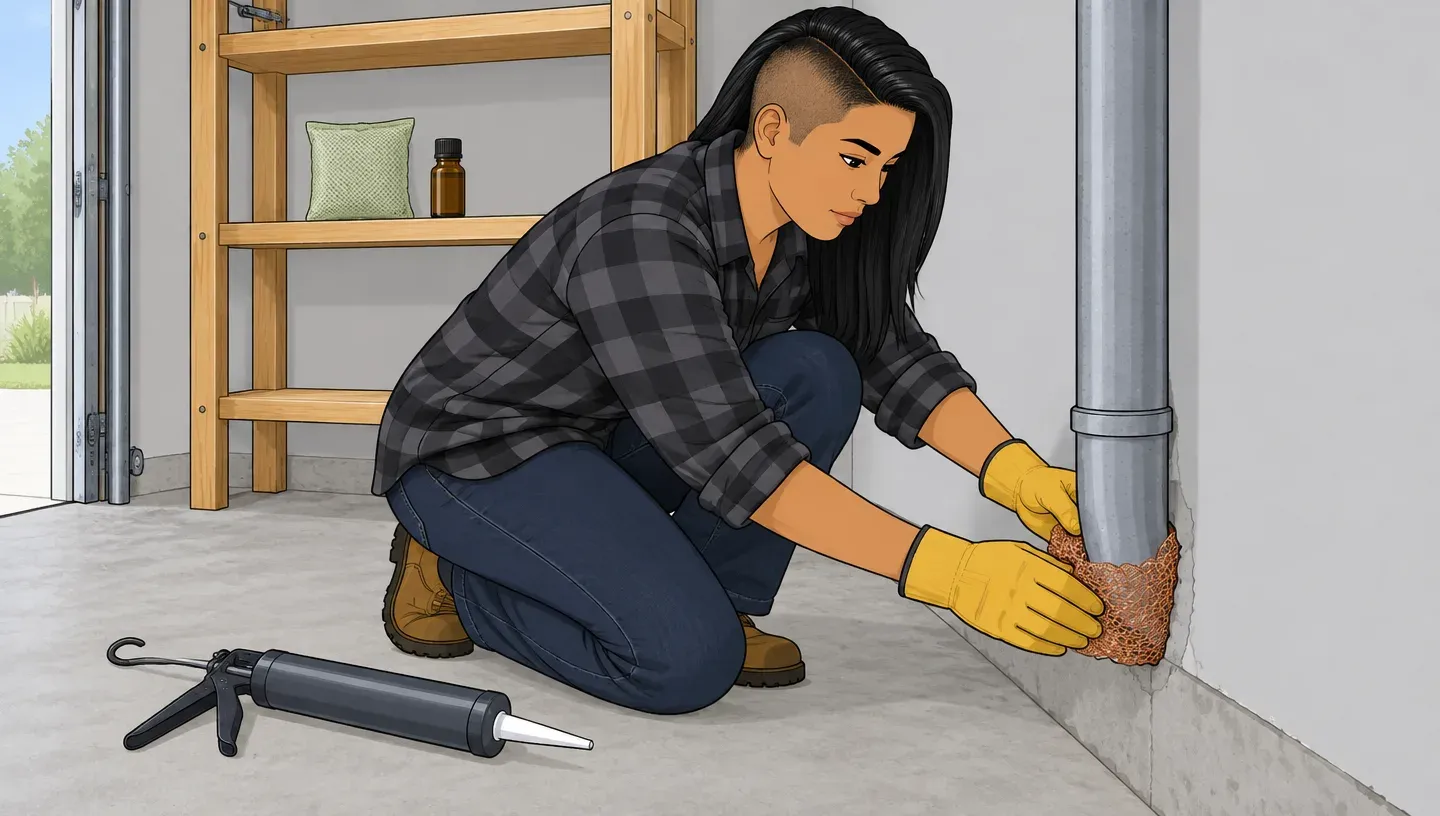
Illustration: sealing a pipe gap with copper mesh while the repellent pouch sits unused.
What smell do rats hate? Peppermint, eucalyptus and predator urine, but only briefly, in lab tests: University of California experts say no repellent has solved a rat problem for more than a very short time. Skip scents, sprays and mothballs. Seal gaps wider than ½ inch and set rat-size snap traps instead.
Cost: about $65–87 in supplies. Difficulty: moderate. Call a pro if rats are in a roof, attic or crawl space you can’t reach safely, or fresh droppings keep appearing after at least 15 days of trapping and re-baiting.
This guide checks each smell and store repellent against the studies, then lays out what keeps rats out and what it costs. We haven’t tested these repellents ourselves; this rests on lab and field studies, UC IPM, ICWDM, University of Georgia and CDC guidance, product labels and list prices. The full plan is in our guide to getting rid of rats in your house.
How We Compared These Smells and Repellents
We rated each option on five things:
- Evidence: whether a lab or field study tested it on rats, and for how long.
- Staying power: whether the effect lasts or rats get used to it.
- Safety: risks to cats, kids and you.
- Upkeep: how often it has to be renewed.
- Price: U.S. list prices checked September 30 to October 1, 2026.
Sources are listed at the end.
What Smells Do Rats Hate? What the Studies Show
Rats do dislike some odors, but none keeps them out for long:
| Smell | What the evidence shows |
|---|---|
| Peppermint oil | Lab rats spent less time near it in a 30-minute test. No home test. |
| Eucalyptus oil | Rats ate less from a sprayed nest box in a lab; it worked best sprayed daily, as the oil evaporates. |
| Predator urine, cat smell | Lab rats avoid a chemical in carnivore urine. A wild colony ignored 9 predator odors. |
| Vinegar, ammonia, cayenne | No rat study found. |
| Dryer sheets, bar soap | University of California experts say they don’t repel rodents. |
| Mothballs | Little or no effect, and using them off-label can put you at risk (NPIC). |
Why the effect fades: a strong smell can make a rat hesitate, but University of California experts say rodents quickly get used to smells and keep causing damage. Part of that first reaction is simple caution around anything new, the same reason rats avoid traps at first.
Does Peppermint Oil Repel Rats?
Only for a moment. In a 2010 lab study, rats spent less time near a peppermint-scented spot during a 30-minute test, and the authors said real-world studies are still needed. One Reddit poster wondered whether a peppermint candle would keep rats away; it won’t for long.
“EPA exempt” on the label doesn’t mean it works. Peppermint oil can go into pest products without EPA registration, and the EPA says it generally doesn’t review those products. Pet Poison Helpline lists peppermint, eucalyptus, cinnamon, clove, citrus and wintergreen oils as known to poison cats: most of the “smells rats hate” list.
Best for: nothing you need to rely on.
Main limitation: a 30-minute lab effect, and a poisoning risk for cats.
How to Use It, If You Try
Soak a few cotton balls in peppermint oil and set them where you’ve seen droppings, out of reach of cats. Plan to refresh them every day: no study gives a schedule for cotton balls, but in the eucalyptus lab study below the oil worked best sprayed daily because it evaporates, and a store pouch lasts up to 30 days by its maker’s count. Treat strong odors as a short-term nudge at most. What keeps rats out long term is sealing entry points and trapping, covered in what actually keeps rats away.
Eucalyptus Oil: Works Only While It’s Fresh
Eucalyptus did better than peppermint in a lab: rats ate less from a sprayed nest box. But it worked best sprayed daily, because the oil evaporates, and it is on the same cat-toxic list.
Best for: no home use; the study was a lab test.
Main limitation: daily respraying, and no home study.
Do Rats Hate the Smell of Cats or Predator Urine?
Can rats smell cats? Yes, and in a lab study rats avoided a chemical found in meat-eaters’ urine. That’s the idea behind fox and coyote urine products. But on a farm, a wild rat colony kept eating from food boxes scented with nine predator odors.
A real cat doesn’t help much either. Some cats catch a rat now and then, but the Internet Center for Wildlife Damage Management (ICWDM) says they can’t be depended on to control Norway rats.
Best for: not rat control.
Main limitation: wild rats ignored predator odors on a real farm.
Vinegar, Ammonia and Other Home Remedies: Untested
Vinegar, ammonia, cayenne, cloves, coffee grounds and scented soap all show up on natural rat repellent lists. We found no study testing them on rats, and University of Georgia experts say homemade products generally don’t work. University of California experts say dryer sheets and bar soap don’t repel rodents.
Best for: nothing; save the vinegar for cleaning.
Main limitation: no evidence at all on rats.
Rat Repellent Sprays, Pouches and Gels: Skip Them
Most store sprays, pouches and granules use the same plant oils, and University of Georgia experts say products sold as rat repellents generally don’t work either. A peppermint pouch lasts up to 30 days, per the maker.
The one rat-labeled repellent gel we found has to be reapplied every 6 hours, and its label requires traps around it, so you end up trapping anyway. Plug-in sound devices are no better, as our ultrasonic repeller review explains.
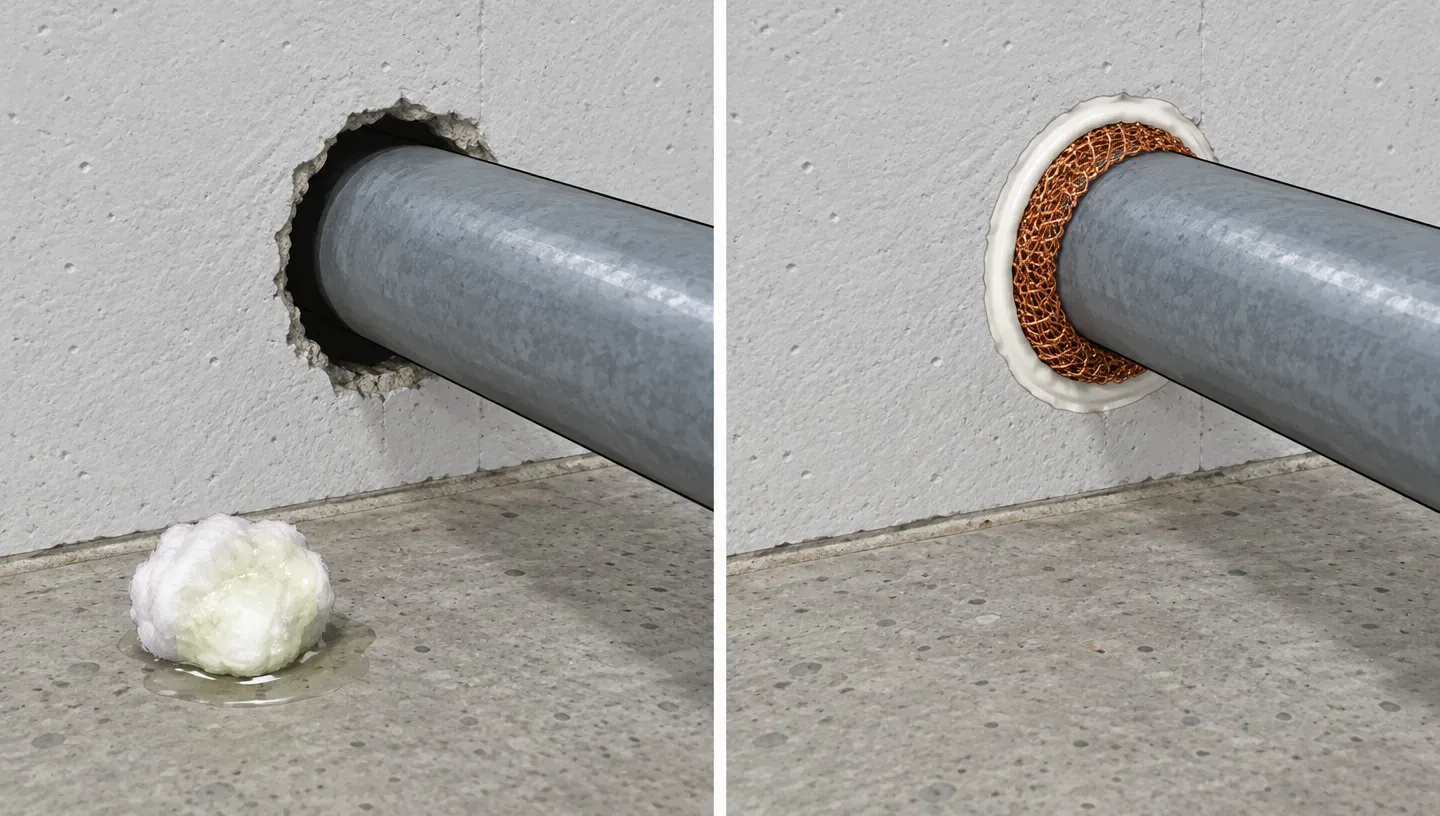
Illustration: a peppermint cotton ball by an open gap (left); the same gap sealed (right).
Best for: nothing a trap and a sealed gap don’t do better.
Main limitation: ongoing cost for an effect rats get used to.
What Actually Keeps Rats Away
Sealing and trapping, not scent. A trap and a sealed gap keep working after a pouch runs out.
Step 1: Find and seal every hole over ½ inch. The ICWDM says young rats can squeeze under a door with only a ½-inch gap. Check under sinks, behind appliances, around pipes, dryer vents and doors, along the foundation and at attic and crawl space vents; plug gaps loosely with paper first, and the ones pushed out are in use.
Step 2: Use metal, not foam. Stuff small gaps with copper mesh or fine (grade 00) steel wool, then caulk over it; rats chew through caulk or foam alone. Steel wool rusts, so use copper mesh outdoors. Cover larger holes and vents with ¼-inch hardware cloth or sheet metal, and tell your landlord in writing before sealing outside if you rent.
Step 3: Cut rats’ roads to the roof. Prune tree limbs within 3 to 6 feet of the roof (UC IPM), pull climbing plants off the walls, and keep shrubs 2 feet from the house.
Step 4: Trap the rats already inside. University of California experts call snap traps the safest, most effective and most economical way to trap rats. Space them 10 to 20 feet apart against the wall, baited end touching it, with a small amount of chunky peanut butter. Leave them baited but unset until the bait is taken a few times, then set them all at once; if every trap’s bait is gone, double the number.
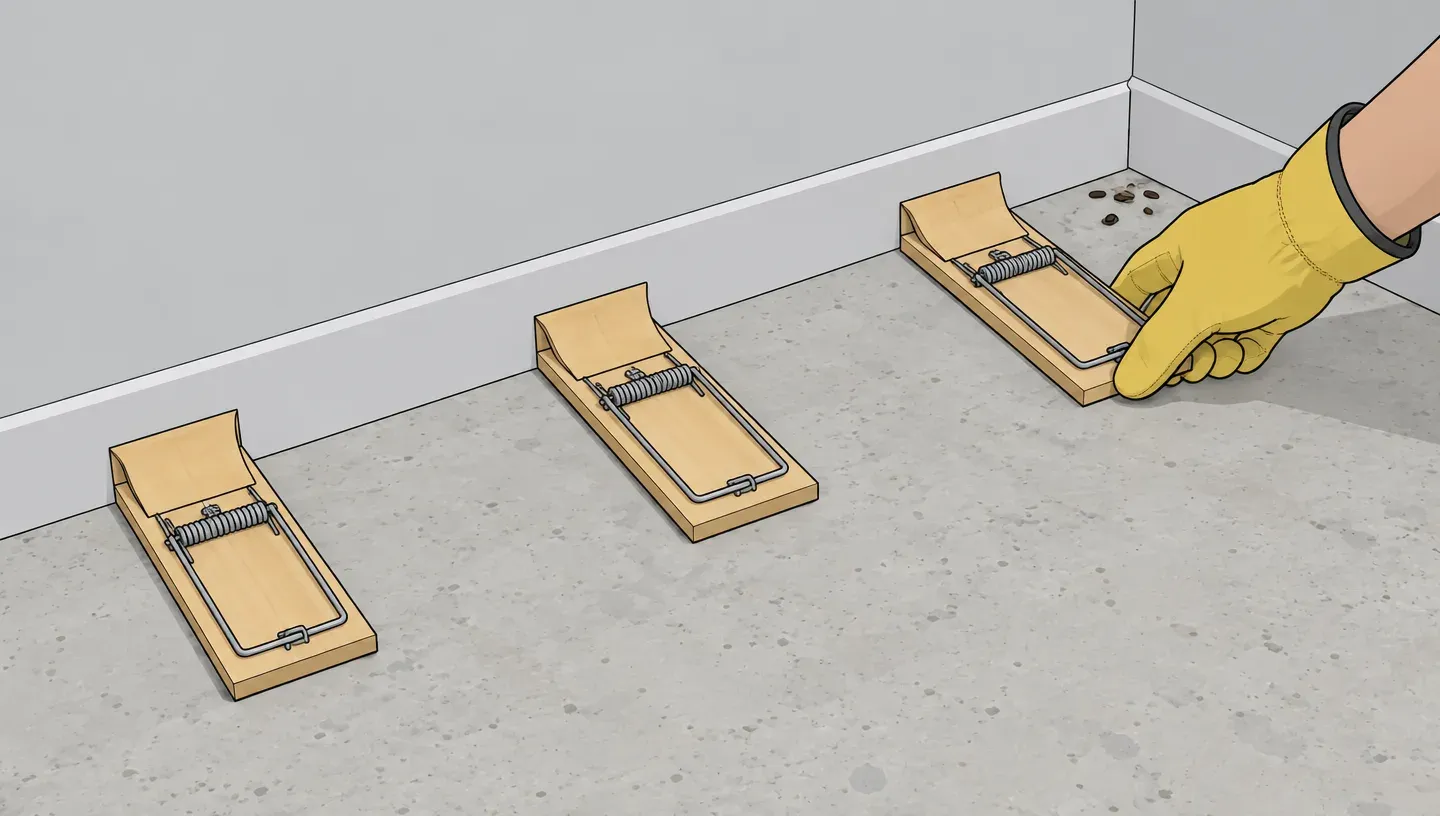
Illustration: rat-size snap traps along a wall, trigger ends at the baseboard.
Step 5: Lid up the food. Store pet food and bulk food in heavy containers with tight lids; galvanized steel resists rats better than plastic. Don’t leave pet food or water out overnight.
Step 6: Clean up with bleach, not a broom. Never sweep or vacuum droppings; that puts germs in the air. Air the room 30 minutes, wear gloves, spray until very wet with 1½ cups of bleach in a gallon of water, wait 5 minutes, then wipe up with paper towels. A dead rat gets the same spray, then double-bagged into a covered can; cleaning up droppings has the full method.
The CDC says to save poison and bait stations for infestations that persist after trapping.
Which Option Fits Your Situation
| Situation | What to use | Why |
|---|---|---|
| Cat at home | Traps in a box or station, no essential oils | Peppermint, eucalyptus and clove oils are known to poison cats. |
| Small children or dogs | Traps behind a barrier or in a trap station | Keeps paws and fingers away from the trigger. |
| You rent | Traps inside; landlord in writing about outside gaps | Sealing or cutting outside usually needs permission. |
| Rats in the attic or roof | Trim limbs within 3 to 6 feet of the roof, trap, seal | Roof rats climb; limbs give them a way in. |
| You already put out peppermint | Pick it up if you have a cat; buy traps | It won’t keep rats away for long. |
| Not sure it’s rats | Compare droppings first | Mice need smaller traps and their own repellent checks. |
What It Might Still Cost
| Item | Typical cost |
|---|---|
| Peppermint repellent pouches, 5-pack (sold for mice) | about $12 |
| Scent repellent granules, 3 lb | $15–17 |
| DIY kit: traps, copper mesh, gloves, bleach | $65–87 |
| Pro trap-and-seal job, 53 shared quotes (middle half) | $1,400–$3,000 |
| Pro visit, price-guide range (usually no sealing) | $150–$655 |
| Pro attic insulation cleanup, if upsold | $7,500–$14,000 |
The kit is 6–12 rat snap traps at $3.59 each, a 20-foot roll of copper mesh, a box of nitrile gloves and a jug of bleach. Retail prices were checked Sept. 30–Oct. 1, 2026, before tax; pro prices are the middle half of 53 trap-and-seal quotes homeowners shared on Reddit (see the quote table) and, for trapping alone, HomeAdvisor (June 2026). Attic cleanup: the middle half of 35 shared quotes that included new insulation. Hardware cloth and caulk for bigger holes aren’t priced here.
Before You Buy a Repellent: A Quick Checklist
- Skip the essential oils if a cat lives with you.
- Plug gaps loosely with paper to find the holes rats use.
- Seal holes over ½ inch with copper mesh and caulk, not foam.
- Set 6–12 rat snap traps along the walls, pre-baited and unset at first.
- Lid up pet food and bulk food overnight.
- Wet droppings with bleach instead of sweeping them.
- Count a full week with no catches and no new signs before calling it done.
When to Call a Pro
Call one if rats are in a roof, attic or crawl space you can’t reach safely, if you can’t find where they get in, or if new droppings, urine spots or gnawing continue after at least 15 days of trapping and re-baiting; the CDC suggests professional help if trapping doesn’t solve it. Ask what they’ll seal, with what, and how many visits the price covers.
The CDC’s test for done: no rats caught for a week and no new signs. A quiet week beside a repellent pouch doesn’t count; the rats may have just moved rooms.
Common questions
Sealing gaps keeps new rats out without harming them. For rats already inside, University of California experts advise against live traps: legally, a caught rat must be humanely euthanized or released right where it was caught, where it stays a health risk.
None. The gases that do kill rodents are fumigants and gas cartridges, which University of Georgia experts say should be used only by licensed pest control operators. For a quick kill, use snap traps.
Check the droppings. Norway rat droppings can reach ¾ inch long and roof rat droppings are about ½ inch with pointed ends; mouse droppings are ⅛ to ¼ inch. Our mouse vs. rat guide covers the other clues.
We found no study testing bleach as a rat repellent. Bleach is for cleaning up after rats, not keeping them away.
No study ranks them. Lab rats avoid carnivore urine and oils such as peppermint and eucalyptus, but only briefly, and there’s no good evidence they hate vinegar at all.
The Bottom Line
Put the money for peppermint oil and pouches toward traps and copper mesh. Smells make rats hesitate only briefly; a sealed ½-inch gap and a row of snap traps along the wall keep working until the rats are gone.
Sources and further reading · 11
- UC IPM: Pest Notes — Rats
- ICWDM: Norway Rat Control Methods and Norway Rats
- UC ANR: Debunking Pest Myths
- UGA IPM: Rats and Mice
- CDC: Trap Up, Seal Up and Clean Up
- National Park Service: Rodent Exclusion Manual
- Nebraska Extension: House Mice
- Studies: Stryjek 2018 (predator odors), Ferrero 2011 (carnivore urine), Kalandakanond-Thongsong 2010 (peppermint), Singla 2014 (eucalyptus)
- EPA: Minimum Risk Pesticides, 40 CFR 152.25 and capsaicin rat repellent label
- NPIC: Mothballs
- Pet Poison Helpline: Essential Oils and Cats