Common House Bugs: 20 Household Pests and How to ID Them
Common house bugs in the US are mostly ants, cockroaches, pantry beetles, carpet beetles, small flies, spiders, silverfish and the damp-loving crowd: springtails, booklice, centipedes and pill bugs. Only a few are harmful: bed bugs, fleas, German cockroaches and termites. To identify yours, note the room, size and color, then match it.
Difficulty: easy. Call a pro if you find termite signs (mud tubes, swarmers, hollow wood), confirm bed bugs, or a German cockroach or pharaoh ant problem keeps coming back after several weeks of baiting. Renters should tell the landlord in writing first.
This page covers 20 of the most common household bugs and house insects in the US, grouped by where they turn up, with size, looks and whether each one is a problem. Facts come from the Pest Library, which is built on university extension fact sheets (UC IPM, Kentucky, NC State, Colorado State, Maryland) and EPA and CDC guidance.
Know the color but not the bug? Jump to small black bugs in the house, tiny brown bugs in the house or tiny white bugs.
In this guide:
- Common House Bugs at a Glance
- Kitchen and Pantry Bugs
- Bathroom and Basement Bugs: The Moisture Group
- Bedroom and Closet Bugs
- Small Flying Bugs in the House
- Spiders in the House
- Seasonal Invaders on Walls and Windows
- Which Household Bugs Are Harmful?
- House Bug Identification in Four Steps
- Common Questions
Common House Bugs at a Glance
| Room where you see it | Usual suspects |
|---|---|
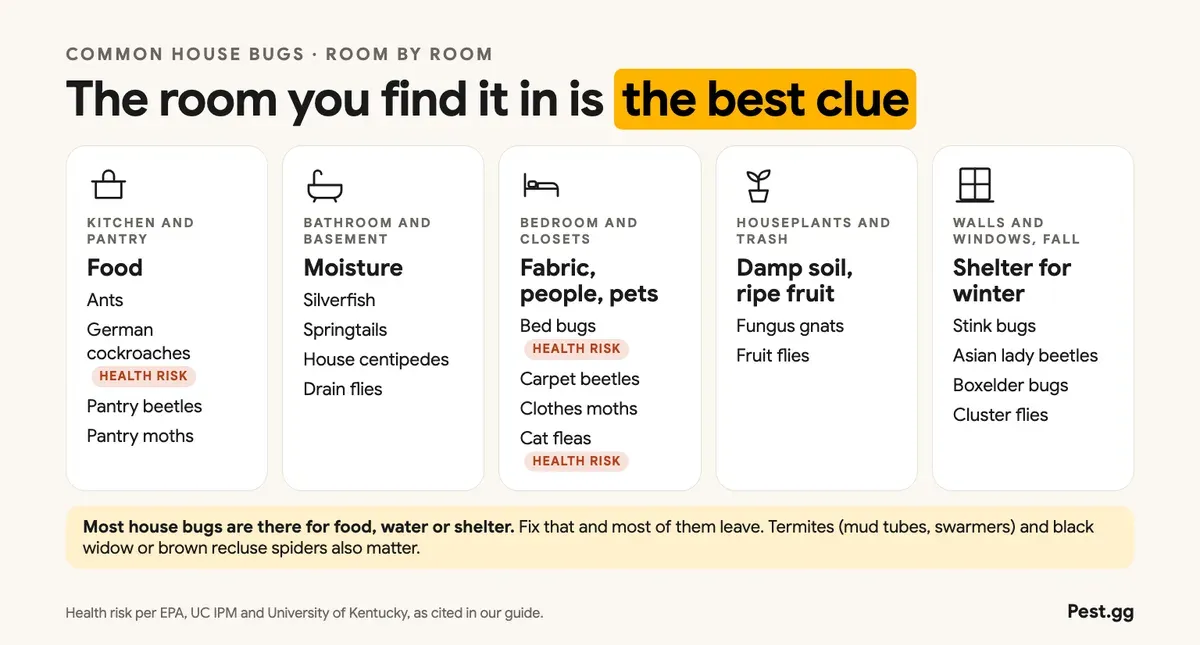
| Kitchen and pantry | Ants, German cockroaches, pantry beetles, pantry moths |
| Bathroom and basement | Silverfish, springtails, centipedes, drain flies |
| Bedroom and closets | Bed bugs, carpet beetles, clothes moths, fleas |
| Around houseplants and trash | Fungus gnats, fruit flies |
| Walls and windows, fall | Stink bugs, lady beetles, boxelder bugs, cluster flies |
The room matters because most house bugs are there for one thing: food, water or shelter. Fix that and most of them leave.
Kitchen and Pantry Bugs
1. Odorous house ant. 1/16–1/8 inch, dark brown to black, fast trails on counters. Smells like rotten coconut when crushed. A nuisance; bait the trails, as in how to get rid of sugar ants.
2. Pavement ant. About 1/8 inch, dark with lighter legs, from nests under slabs and sidewalks. Leaves little soil piles in cracks.
3. Pharaoh ant. About 1/16 inch, pale yellow to light brown, nests inside warm walls. Sprays make colonies split and spread, so use slow-acting bait.
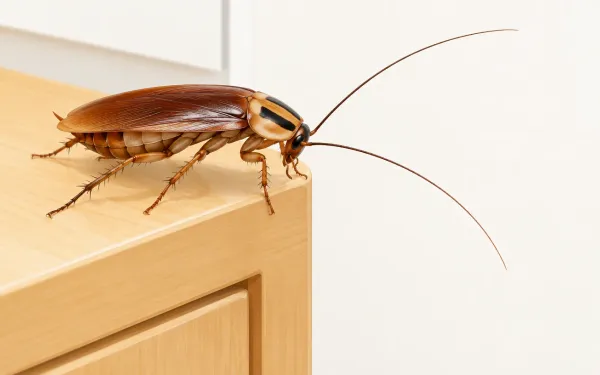
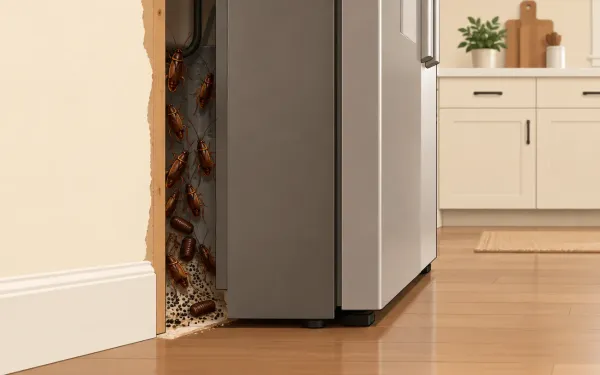
4. German cockroach. About 1/2 inch, light brown with two dark stripes behind the head. It lives entirely indoors near warmth, water and food, and its allergens trigger asthma. The one kitchen bug to act on the same day: see how to get rid of German roaches.
5. Pantry beetles. The drugstore beetle (about 1/10 inch, reddish brown), red flour beetle (1/8–3/16 inch, shiny reddish brown) and rice weevil (about 1/8 inch, with a snout). They spoil food but aren’t a health risk. Throw out the infested package and store the rest in sealed containers (UC IPM).
6. Indian meal moth. About 1/2 inch at rest, wings pale gray near the body and coppery on the outer two-thirds. Webbing in flour, cereal, nuts or birdseed. See how to get rid of pantry moths.
Bathroom and Basement Bugs: The Moisture Group
These bugs need damp conditions, so they double as a sign that something is too wet.
7. Silverfish. About 1/2–3/4 inch not counting the tails, silvery gray, carrot-shaped, with three tails. They eat paper, glue and starch. See how to get rid of silverfish.
8. Springtails. About 1/16 inch, gray, white or black specks that jump. Harmless; dry the area out.
9. House centipede. Body 1–1 1/2 inches with much longer, banded legs, yellowish gray with three dark stripes. Alarming, but it eats insects and spiders and rarely bites.
10. Booklice. 1–2 mm, pale, on damp paper and cardboard. They usually cause no damage (University of Maryland).
11. Pill bugs and millipedes. Slate-gray roly-polies and brown, many-legged worms that wander in from mulch and die indoors without moisture. Earwigs, with pincers at the tail, come in the same way; see how to get rid of earwigs.
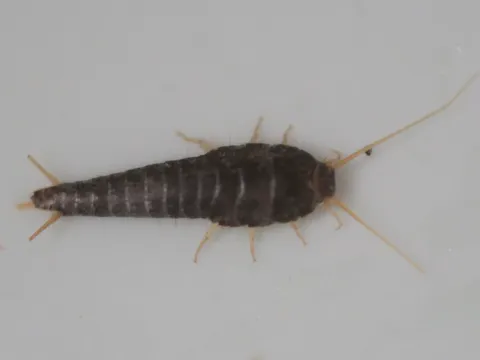 HarmlessSilverfishAbout 1/2–3/4 inch, three tails.
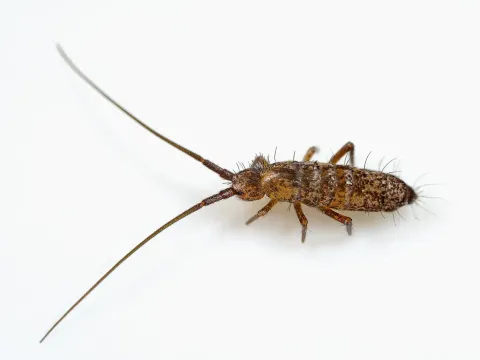 HarmlessSpringtailAbout 1/16 inch; jumps.
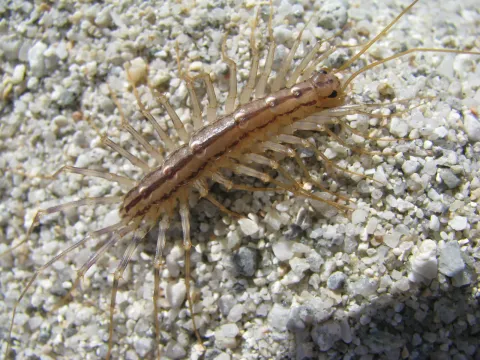 Rarely bitesHouse centipedeLong, banded legs; eats insects.
Our guide to using a dehumidifier for bugs covers the humidity target for this whole group.
Bedroom and Closet Bugs
12. Bed bug. Adults about 3/16 inch, flat, oval and reddish brown, like an apple seed. They hide in mattress seams, box springs and headboards and feed on blood at night. EPA says bites are “a poor indicator”; confirm with live bugs, shed skins, pale eggs or dark spots that bleed into fabric like a marker.
13. Carpet beetles. Adults are tiny: the varied carpet beetle is mottled and about 1/10–1/8 inch, the black carpet beetle shiny black and up to 3/16 inch. The hairy larvae eat wool, silk, feathers and fur. See carpet beetles and carpet beetle vs bed bug.
14. Webbing clothes moth. About 1/4 inch, plain golden buff, with silk webbing on stored wool. See how to get rid of clothes moths.
15. Cat flea. 1/16–1/8 inch, dark reddish brown, jumps, bites around the ankles. It’s the usual flea on dogs too (UC IPM). See what do fleas look like for eggs and flea dirt.
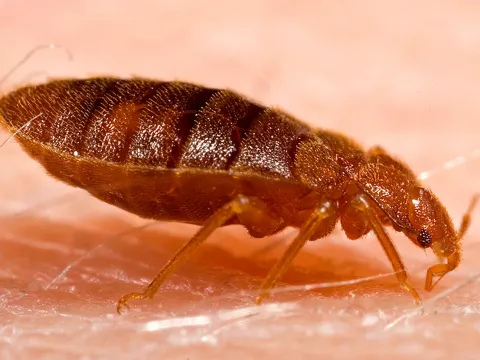 BitesBed bugFlat, oval, reddish brown.
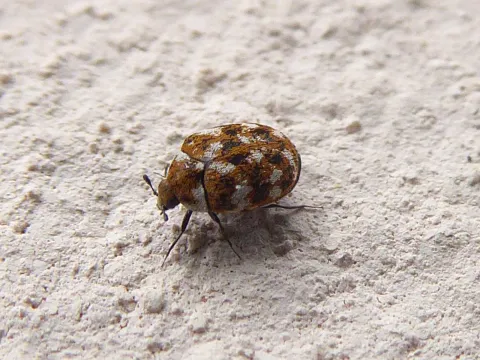 Damages fabricVaried carpet beetleMottled; larvae eat wool.
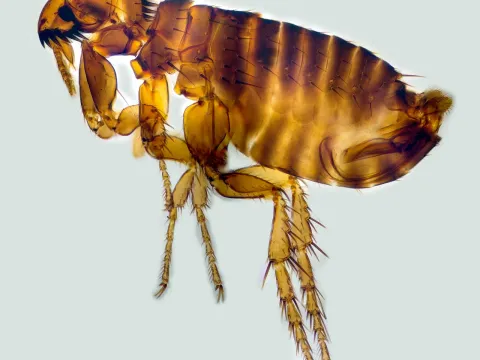 BitesCat fleaJumps; bites around ankles.
Small Flying Bugs in the House
16. Fruit fly. About 1/8 inch, tan with red eyes, at the fruit bowl and trash. See how to get rid of fruit flies.
17. Fungus gnat. About 1/8 inch, dark gray to black, around houseplants. Let the soil dry between waterings; see how to get rid of fungus gnats.
18. Drain fly. About 1/8 inch, fuzzy, gray to tan, wings held like a roof, on bathroom walls. Cleaning the slime out of the drain is the fix: how to get rid of drain flies.
The house fly and phorid fly round out the list; getting rid of gnats helps tell the small ones apart.
Spiders in the House
19. Common house spider. Body about 3/16–1/4 inch, mottled brown, gray and tan, with a round abdomen, in room corners and windows. Harmless.
Two spiders do matter. The black widow (female shiny black with a red hourglass underneath) lives in woodpiles, garages and sheds, and the brown recluse (uniform tan with a dark violin shape) in closets, boxes and attics in the south-central and midwestern US. A black widow bite needs medical care; recluse bites are rare but can cause a slow-healing wound. See how to get rid of spiders.
Seasonal Invaders on Walls and Windows
20. Fall invaders. Stink bugs, Asian lady beetles, boxelder bugs and cluster flies gather on sunny walls in fall and spend winter in attics and wall voids. They don’t breed indoors and are mostly harmless, though Asian lady beetles can pinch, and several stain or smell when crushed. Vacuum them up, and seal gaps before next fall: how to get rid of stink bugs has the sealing checklist.
Which Household Bugs Are Harmful?
Most common house bugs are nuisances. A short list carries real risk:
| Bug | Why it matters |
|---|---|
| German cockroach | Allergens trigger asthma; can contaminate food |
| Bed bug | Itchy bites, lost sleep; not known to spread disease |
| Cat flea | Itchy bites; can pass tapeworms to pets |
| Subterranean termite | Can cause serious structural damage |
| Black widow, brown recluse | Bites can need medical care |
| Ticks (brought in) | Can spread Lyme disease and other infections (CDC) |
Ticks come in on people and pets from outdoors; getting rid of ticks covers the yard.
Subterranean termite workers are creamy white and rarely seen; look for mud tubes on the foundation and winged swarmers with dark brown to black bodies (University of Kentucky).
Everything else on this page (ants, pantry beetles, silverfish, springtails, booklice, centipedes, flies, house spiders and fall invaders) is a nuisance or a damage problem, not a health risk.
House Bug Identification in Four Steps
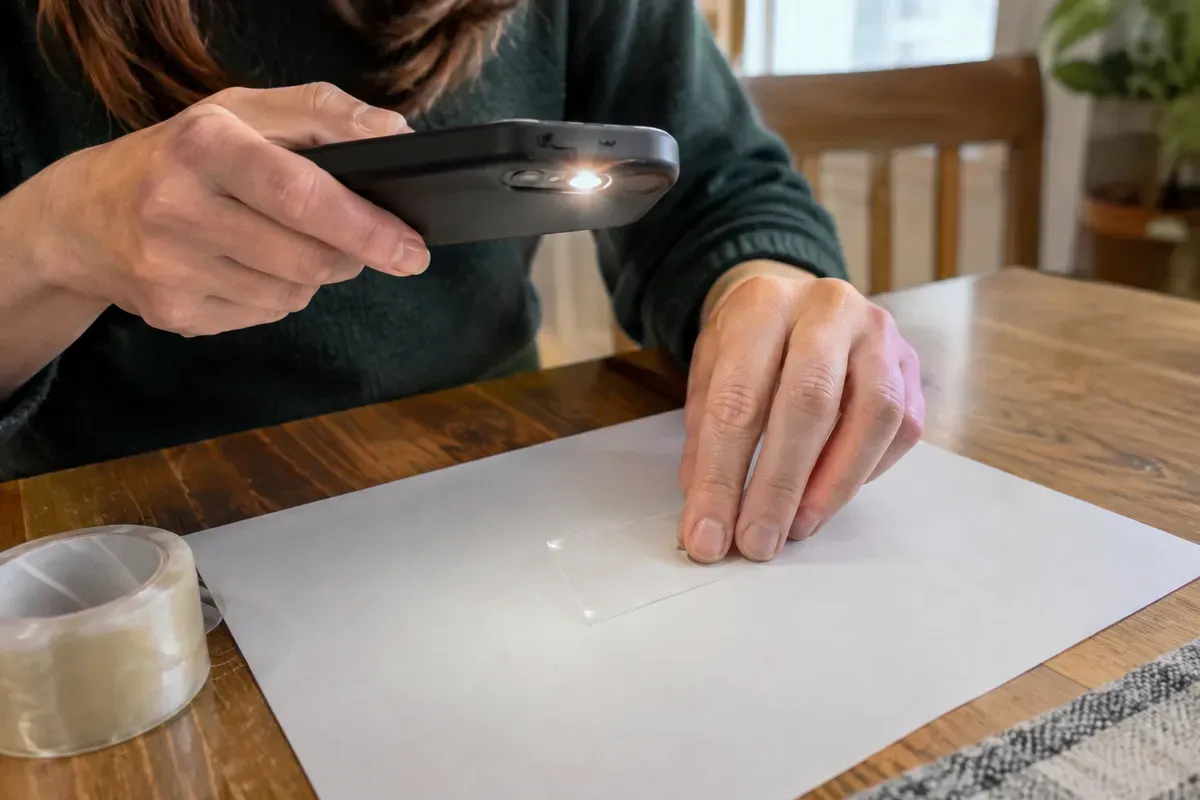
Step 1: Catch it. Press clear tape on it and stick it to white paper, or trap it under a glass.
Step 2: Note three things. Size against a grain of rice, color in good light, and how it moved: crawled, jumped or flew.
Step 3: Photograph it. Zoom in with your phone’s flashlight on. Upload it to our free bug identifier, which matches it against the house pests in the Pest Library and says whether it’s harmful.
Step 4: Check the source. The nearest food, damp spot, rug edge or mattress seam usually tells you more than the bug.
Got bites instead of a bug? Try the free bug bite identifier.
Common questions
Ants, cockroaches, pantry beetles, carpet beetles, small flies, silverfish and house spiders are the bugs people find indoors most often. Most are there for food, water or shelter, so the room you find them in is the best clue.
Of common indoor bugs, bed bugs, fleas and German cockroaches affect health, and termites damage the house. Black widow bites need medical care, and ticks carried in from outside can spread disease (CDC).
Tiny indoor bugs are most often springtails, booklice, grain mites, small ants, pantry beetles, fleas or carpet beetles. Sort them by color with small black bugs, tiny brown bugs and tiny white bugs.
Sources and further reading · 6
- UC IPM: Ants, Cockroaches, Pantry Pests, Carpet Beetles, Fleas, Silverfish and Firebrats and Fungus Gnats.
- University of Kentucky Entomology: Ant Control for Householders (EF619), Cockroach Elimination (EF614), Stored Product Pests in the Pantry (EF612), Carpet Beetles (EF601), Drain Flies (EF615) and Termite Control: Answers for Homeowners (EF604).
- NC State Extension: German Cockroach Surveillance and Management.
- University of Maryland Extension: Booklice.
- EPA: How to Find Bed Bugs.
- CDC: About Lyme Disease.